An antibody is supposed to bind one thing, and one thing only. In reality, that is rarely the full picture.
Most antibodies can bind to more than just their intended target, a phenomenon known as cross reactivity. Sometimes this is harmless. Other times, it quietly produces false positives, extra bands, or misleading results that go unnoticed for weeks.
This guide explains what causes antibody cross reactivity, how to test for it, and what you can do to keep it from compromising your data.
What Is Antibody Cross Reactivity
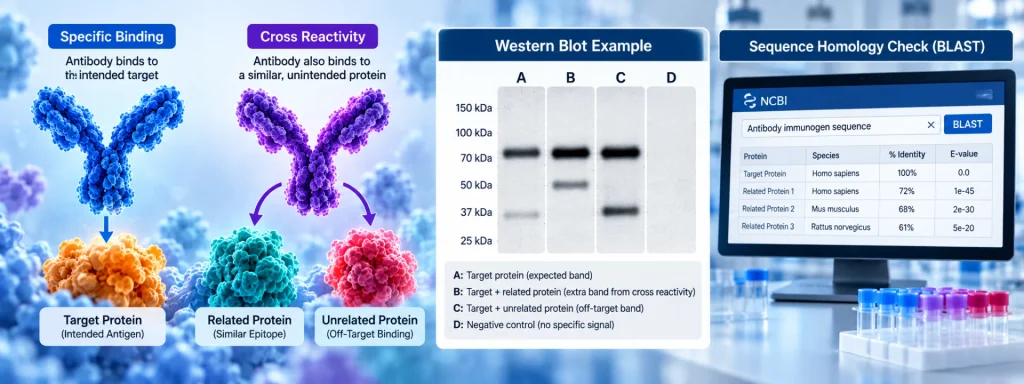
Cross reactivity happens when an antibody binds to a protein, or epitope, other than the one it was raised against.
This occurs because the binding site on the antibody, called the paratope, can sometimes accommodate more than one structurally similar target.
Cross reactivity is not always a problem. In some cases, it is intentional, allowing one antibody to detect the same protein across multiple species. The issue arises when it binds something you did not intend to detect at all.
Why Cross Reactivity Happens
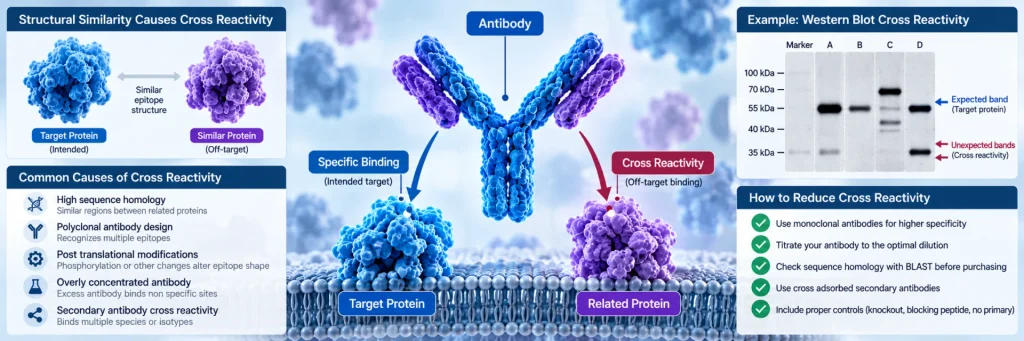
Most cross reactivity comes down to one simple idea, similarity. If two proteins share enough structure, an antibody trained on one may bind the other too.
Cause
Why It Happens
Most Affected
High sequence homology
Shared regions between related proteins look the same to the antibody
Protein family members, isoforms
Polyclonal antibody design
Recognizes multiple epitopes at once, increasing off target binding
Polyclonal antibodies more than monoclonal
Post translational modifications
Phosphorylation or other changes can alter epitope shape
Phospho specific and modification specific antibodies
Overly concentrated antibody
Excess antibody binds weaker, non specific sites
Any antibody used above optimal dilution
Poor secondary antibody specificity
Secondary binds host immunoglobulins from multiple species
Multiplex assays, multi species samples
Monoclonal vs Polyclonal Cross Reactivity
Monoclonal antibodies are generated from a single B cell clone, so they recognize one specific epitope. This generally makes them less prone to cross reactivity.
Polyclonal antibodies come from a mixed pool of B cells, recognizing multiple epitopes on the same antigen. This can be useful for sensitivity, but it raises the chance that one of those epitopes is also present on an unrelated protein.
If specificity is your top priority, especially for multiplexing or low abundance targets, monoclonal antibodies are usually the safer choice.
How to Predict Cross Reactivity Before You Buy
• Run the antibody immunogen sequence through NCBI BLAST to compare it against related proteins
• Check the datasheet for tested cross reactivity, many suppliers list species and family members already screened
• Look at the percent homology between your target and any closely related family members
• Consider the host species of the antibody, and whether your sample contains proteins from that same species
A quick BLAST search before ordering can save you weeks of confusing, unreliable results later.
How to Test for Cross Reactivity in the Lab
Western Blot
Run your sample alongside a known positive and known negative control. Extra bands at unexpected molecular weights are a clear sign of cross reactivity.
Knockout or Knockdown Controls
The strongest evidence of specificity comes from a sample where your target protein has been genetically removed. If signal remains, you are looking at cross reactivity, not your target.
Blocking Peptide Test
Pre incubating the antibody with excess immunogen peptide should eliminate true signal. If a band persists, it likely reflects non specific binding.
Immunoprecipitation Followed by Mass Spectrometry
For especially stubborn cases, pulling down the antibody target and identifying it by mass spec can confirm exactly what protein is actually being bound.
Preventing Cross Reactivity in Your Experiments
• Choose monoclonal antibodies when specificity matters more than sensitivity
• Titrate your antibody, since excess concentration increases non specific binding
• Use cross adsorbed secondary antibodies, especially in multiplex assays
• In multiplex western blots, choose primary antibodies from distantly related host species, such as rabbit and rat, rather than closely related ones
• Always include a no primary antibody control to rule out secondary antibody background
When Cross Reactivity Is Actually Useful
Not all cross reactivity is bad news. Some antibodies are deliberately selected for their ability to detect the same protein across multiple species, which is extremely useful when working with animal models.
In diagnostics, cross reactivity between related pathogens has even been studied as a basis for broader vaccine protection. The key difference is intent, planned cross reactivity is documented and validated, while unplanned cross reactivity is not.
Frequently Asked Questions
What causes antibody cross reactivity
Structural similarity between your target protein and unrelated proteins.
Are monoclonal antibodies less likely to cross react
Yes, monoclonal antibodies target one epitope, reducing cross reactivity risk.
How much sequence homology causes cross reactivity
Around 60 to 75 percent homology often leads to noticeable cross reactivity.
How can I test if my antibody is cross reacting
Use knockout controls, blocking peptides, or compare bands by molecular weight.
Can cross reactivity ever be useful
Yes, it allows one antibody to detect a protein across multiple species.
Does antibody concentration affect cross reactivity
Yes, overly concentrated antibody increases non specific, off target binding.
What is a cross adsorbed secondary antibody
A secondary antibody purified to remove reactivity against unwanted species or isotypes.
Fast & Free Shipping
Free shipping on orders $999+
Quality Guarantee
Advenit post multos Scudilo Scutariorum tribunus velament
Secure Payment
We accept credit cards, PayPal, and bank wires
Lifetime Customer Support
Responsive and knowledgable customer service via email, text or phone