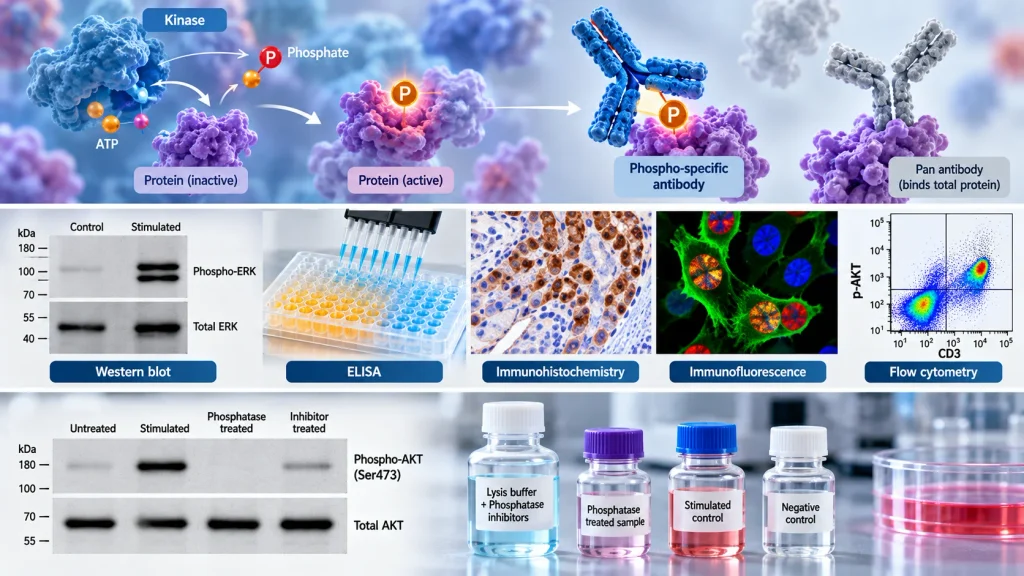
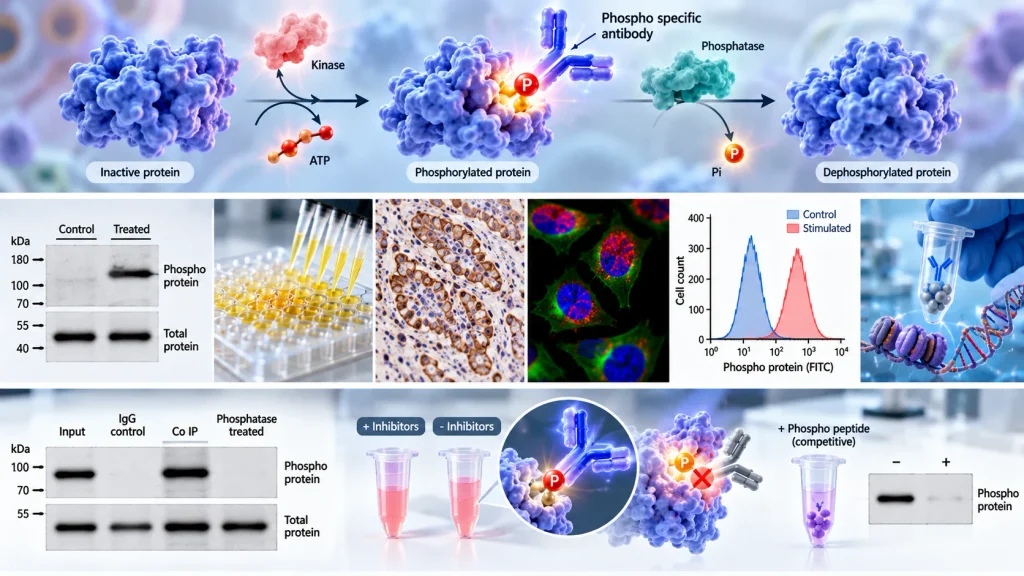
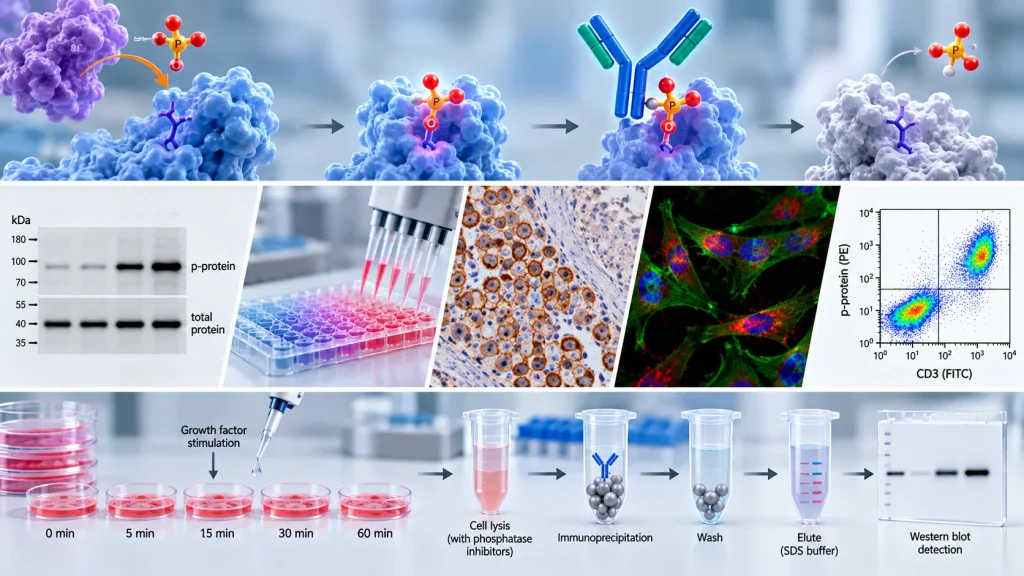
Cells are constantly turning signals on and off, and one of the main ways they do this is through phosphorylation. A kinase adds a phosphate group to a protein, the protein changes shape or activity, and a signal moves forward. A phosphatase removes that phosphate, and the signal stops. This switching happens in seconds, which makes it hard to study with ordinary tools.
Phospho specific antibodies solve this problem. They are designed to recognize a protein only when it carries a phosphate group at a particular site, so they let you see exactly when and where a signaling event is happening, not just whether the protein itself is present.
This guide covers what phospho specific antibodies are, how they work, where they are used, and what to watch out for when choosing or working with one.
What Is a Phospho Specific Antibody
A phospho specific antibody is an antibody raised against a short peptide sequence that includes a phosphorylated amino acid, usually serine, threonine, or tyrosine. The antibody binds tightly to the phosphorylated form of the protein but shows little or no binding to the same protein when it is not phosphorylated.
This is different from a pan antibody, sometimes called a total antibody, which recognizes the protein regardless of its phosphorylation state. Researchers often use both together. The pan antibody tells you how much total protein is present, and the phospho specific antibody tells you how much of it is active at that moment.
Because phosphorylation sites are often named by their amino acid position, you will commonly see antibodies labeled something like Phospho ERK1/2 Thr202/Tyr204 or Phospho AKT Ser473. The number refers to the exact residue the antibody was designed to detect.
Why Phosphorylation Matters in Cell Signaling
Phosphorylation is the most common reversible modification used to control protein function. It can switch an enzyme on, switch it off, change where a protein sits inside the cell, or create a new binding site for other proteins.
• Cell growth and division signals, including the MAPK and PI3K AKT pathways
• Immune cell activation, including T cell and B cell receptor signaling
• Apoptosis and cell survival decisions
• Neuronal signaling and synaptic plasticity
• DNA damage response, such as ATM driven phosphorylation of H2AX after double strand breaks
Because these pathways are disrupted in cancer, diabetes, cardiovascular disease, and neurodegenerative conditions, phospho specific antibodies are widely used in both basic research and drug development.
Main Applications of Phospho Specific Antibodies
Phospho specific antibodies work across nearly every standard immunodetection method. The choice of method depends on what question you are asking, whether that is how much, where, or in which cells.
Application
What It Tells You
Typical Use
Western blot
Confirms phosphorylation at a specific site and shows relative activation levels across samples
Comparing treated vs untreated cell lysates
ELISA
Quantifies phosphorylation level in a large sample set, gives a numeric readout
Drug screening, biomarker studies
Immunohistochemistry
Shows where phosphorylation happens in tissue, preserves spatial context
Tumor tissue analysis, pathology
Immunofluorescence
Shows subcellular location of the phosphorylated protein
Measures phosphorylation in single cells, can separate cell populations
Immune cell signaling, drug response in mixed populations
Chromatin immunoprecipitation
Identifies DNA regions bound by a phosphorylated transcription factor
Gene regulation studies
Western Blot
Western blot is the most common application for phospho specific antibodies. It separates proteins by size, so you can confirm the signal is coming from a protein of the expected molecular weight, not a nonspecific band. Running a phospho specific antibody alongside a pan antibody on the same lysate lets you calculate a ratio of phosphorylated to total protein, which is a standard way to report pathway activation.
ELISA
ELISA is used when you need to quantify phosphorylation across many samples at once, such as in a drug screening assay or a biomarker study. A sandwich ELISA format, using a capture antibody against the total protein and a phospho specific detection antibody, is a common setup for measuring the fraction of protein that is phosphorylated in each sample.
Immunohistochemistry and Immunofluorescence
These methods preserve spatial information. Immunohistochemistry shows phosphorylation patterns in tissue sections, which is valuable in pathology and tumor biology, for example detecting phosphorylated EGFR in breast cancer tissue. Immunofluorescence is often used in cultured cells to track subcellular movement, such as a transcription factor moving into the nucleus once it becomes phosphorylated.
Flow Cytometry
Flow cytometry allows phosphorylation to be measured in individual cells rather than as a bulk average. This is especially useful in immunology, where only a subset of cells in a mixed population may respond to a stimulus. Detecting phospho ERK or phospho STAT signals by flow cytometry can reveal which specific cell types are activated after a treatment.
Chromatin Immunoprecipitation
Some phosphorylated proteins are transcription factors that bind DNA once activated. Chromatin immunoprecipitation using a phospho specific antibody can identify which genes are being regulated by the active, phosphorylated form of that transcription factor.
Phosphotyrosine vs Phosphoserine and Phosphothreonine Antibodies
Phosphorylation occurs on three amino acids, serine, threonine, and tyrosine. Most kinases in the human genome act on serine and threonine, so phospho serine and phospho threonine antibodies cover the largest share of signaling events. Phosphotyrosine antibodies are less abundant in terms of total sites but are heavily used in cancer research and drug discovery, since many oncogenic kinases, including receptor tyrosine kinases, act on tyrosine residues.
Some antibodies are designed to recognize phosphorylation broadly, at any serine or tyrosine residue, which is useful for general screening. Site specific antibodies, in contrast, are designed against one exact residue and are far more useful for studying a defined biological event.
Choosing the Right Phospho Specific Antibody
• Confirm the exact phosphorylation site matches your protein of interest, including the species you are studying
• Check the datasheet for validation data in your intended application, since an antibody validated for western blot is not automatically validated for IHC or flow cytometry
• Look for evidence the antibody was tested against both the phosphorylated and nonphosphorylated peptide, confirming true specificity
• Use a phosphatase treated sample as a negative control whenever possible
• Pair with a pan antibody against the same target so you can compare total protein levels to phosphorylated protein levels
Common Mistakes When Working With Phospho Specific Antibodies
• Skipping phosphatase inhibitors during sample preparation, which allows phosphate groups to be removed before you even run the assay
• Using lysis buffers without proper inhibitor cocktails, leading to false negative results
• Assuming cross reactivity between closely related family members will not occur, when it often does
• Not including a stimulated positive control, making it hard to confirm the assay is working
• Over interpreting a single phosphorylation site as proof of full pathway activation, when multiple sites or proteins may be involved
Frequently Asked Questions
What is a phospho specific antibody used for
It detects a protein only when phosphorylated at a specific site, showing whether a signaling pathway is active.
What is the difference between a phospho specific and a pan antibody
A pan antibody detects total protein. A phospho specific antibody detects only the phosphorylated form.
Which applications use phospho specific antibodies
Western blot, ELISA, immunohistochemistry, immunofluorescence, flow cytometry, and chromatin immunoprecipitation.
Why is phosphorylation important in research
It controls activation of key pathways in cancer, immunity, neuroscience, and metabolic disease.
How do I prevent loss of phosphorylation signal during sample prep
Add phosphatase inhibitors to your lysis buffer and keep samples cold throughout processing.
Can phospho specific antibodies cross react with related proteins
Yes. Closely related family members can share similar sequences near the phosphorylation site.
What controls should I use with a phospho specific antibody
Use a stimulated positive control and a phosphatase treated negative control alongside a pan antibody.
Fast & Free Shipping
Free shipping on orders $999+
Quality Guarantee
Advenit post multos Scudilo Scutariorum tribunus velament
Secure Payment
We accept credit cards, PayPal, and bank wires
Lifetime Customer Support
Responsive and knowledgable customer service via email, text or phone