Ubiquitin and Ubiquitination: Antibodies for Studying the Proteasome Pathway
Ubiquitin is a small protein with an outsized influence on cell biology, controlling everything from protein degradation to DNA repair and immune signaling.
Studying it properly depends on choosing the right antibody, and that choice is far more complicated than it first appears.
This guide explains what ubiquitination is, why linkage specific antibodies matter so much, and how to select and validate antibodies for studying the ubiquitin proteasome pathway.
What Is Ubiquitination
Ubiquitination is a reversible posttranslational modification in which the small protein ubiquitin is attached to a target protein.
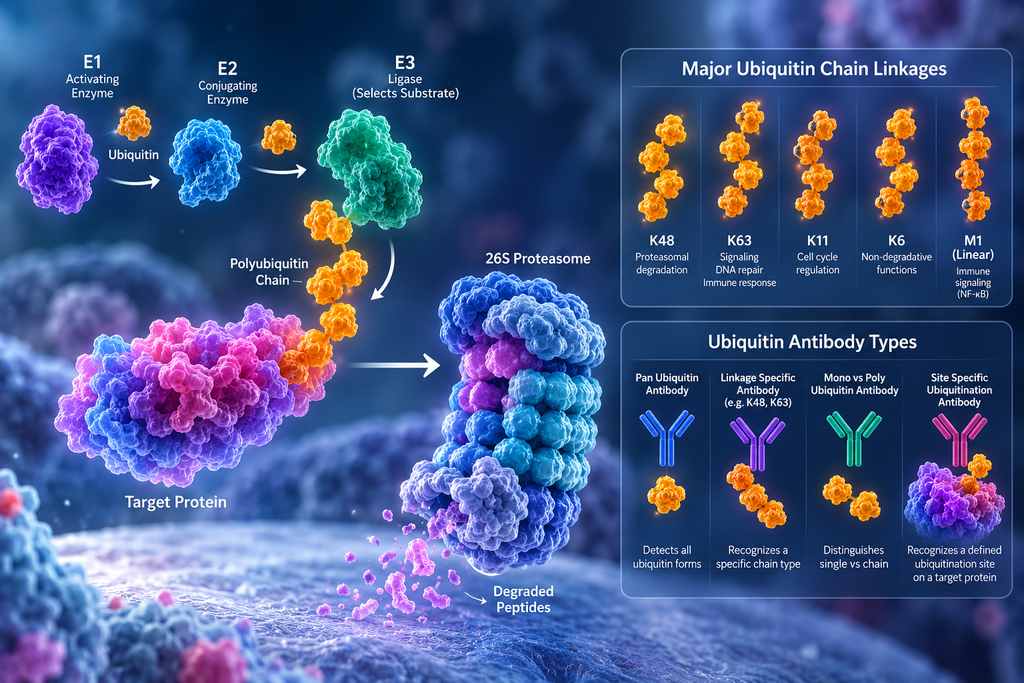
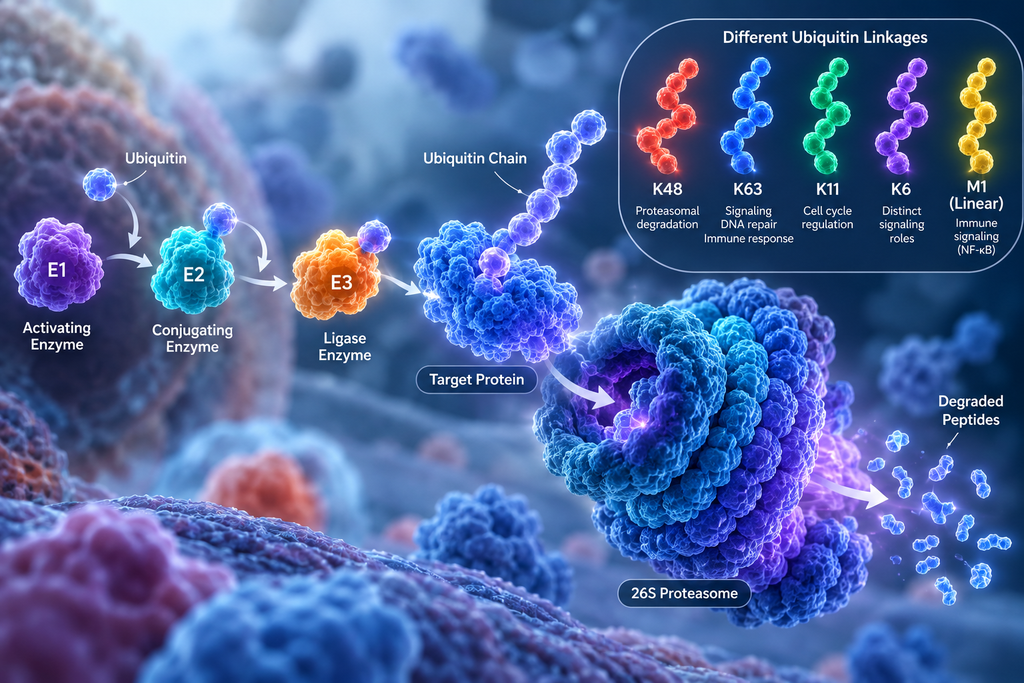
The process requires three classes of enzymes working in sequence, an activating enzyme called E1, a conjugating enzyme called E2, and a ligase called E3 that selects the specific substrate to be modified.
Ubiquitin attaches through its C terminal glycine, forming an isopeptide bond with a lysine residue on the target protein, or occasionally with the protein's amino terminus.
A single ubiquitin molecule can be enough to send a signal, but the more biologically significant events usually involve chains of ubiquitin linked together, known as polyubiquitin chains.
Why Ubiquitin Chain Linkage Matters
Ubiquitin itself contains seven lysine residues, and any one of them can be used to link the next ubiquitin molecule in a chain.
This means the same modification, ubiquitination, can produce chemically distinct chains with completely different biological outcomes depending on which lysine is used.
The most studied linkage types include
· K48 linked chains, the classical signal for proteasomal degradation, marking proteins for destruction
· K63 linked chains, associated with non degradative signaling, including DNA repair, immune signaling, and endosomal trafficking
· K11 linked chains, involved in cell cycle regulation and also implicated in proteasomal targeting
· K6 linked chains, recently shown to play a role distinct from degradation, with HUWE1 identified as a major E3 ligase responsible for assembling this chain type
· Linear, or M1 linked chains, formed through the N terminal methionine rather than a lysine, and central to immune signaling pathways such as NF kB activation
Because each linkage type carries a different biological message, a generic pan ubiquitin antibody cannot tell you which pathway is actually active in your sample. This is exactly why linkage specific antibodies exist.
Types of Ubiquitin Antibodies
Pan Ubiquitin Antibodies
Detect ubiquitin broadly, regardless of chain type or linkage. Useful as a first pass screen to confirm that a protein is ubiquitinated at all, but they cannot distinguish between degradative and non degradative signals.
Linkage Specific Antibodies
Recognize a particular chain type, such as K48 or K63, by targeting the unique conformation created when ubiquitin molecules are joined through a specific lysine.
These antibodies have been used to directly demonstrate that proteins like RIP1 and IRAK1 undergo polyubiquitin editing, switching from K63 linked chains during active signaling to K48 linked chains when the protein is marked for degradation.
Mono versus Polyubiquitin Specific Antibodies
Some antibodies are designed to distinguish single ubiquitin attachment from chain formation, which matters because monoubiquitination often signals processes like endocytosis or histone regulation rather than degradation.
Site Specific Ubiquitination Antibodies
Recognize ubiquitination at a defined residue on a specific target protein, similar in concept to a phospho specific antibody, and are typically developed for well studied signaling proteins.
How Linkage Specific Antibodies Achieve Specificity
Linkage specific antibodies do not recognize ubiquitin itself in isolation. They recognize the unique three dimensional surface created when two ubiquitin molecules are joined through a particular lysine.
Structural studies using a cocrystal of an anti K63 antibody fragment bound to K63 linked diubiquitin have shown exactly how these antibodies achieve their specificity, recognizing the distinct interface formed by that particular linkage.
This structural basis explains why linkage specific antibodies can be remarkably precise, but it also means small differences in chain conformation or neighboring modifications can sometimes affect binding, making validation essential before drawing conclusions from your data.
Choosing the Right Ubiquitin Antibody for Your Question
If You Want to Know Whether a Protein Is Ubiquitinated at All
Start with a pan ubiquitin antibody alongside immunoprecipitation of your target protein, followed by Western blot detection.
If You Want to Know Which Pathway Is Involved
Use linkage specific antibodies, most commonly anti K48 and anti K63, run side by side on the same samples to determine which signal dominates under your experimental conditions.
If You Are Studying Degradation Specifically
K48 specific antibodies are the standard choice, since this linkage is the primary signal recognized by the 26S proteasome.
If You Are Studying Signaling, DNA Repair, or Trafficking
K63 specific antibodies are typically the right starting point, since this linkage type is most associated with non degradative outcomes.
If You Are Studying a Less Common Linkage
K11, K6, and linear chains each have dedicated antibodies, though they are less widely available and generally require more careful validation due to fewer published comparisons.
Validating Ubiquitin Antibodies
Validation matters enormously here, since cross reactivity between linkage types can completely change the interpretation of an experiment.
Use Recombinant Chains as Positive Controls
Purified K48 linked and K63 linked diubiquitin or polyubiquitin chains are commercially available and provide a direct test of antibody specificity before using the antibody on biological samples.
Confirm Specificity Against the Wrong Linkage Type
A K63 specific antibody should show minimal or no signal against purified K48 chains, and vice versa. Any meaningful cross reactivity should be documented and accounted for in your interpretation.
Use Lysine to Arginine Mutants
Cells expressing ubiquitin with a specific lysine mutated to arginine cannot form that particular linkage. Comparing antibody signal between wild type and mutant cells is a strong functional validation strategy, as demonstrated in studies of K63 polyubiquitination using K63R mutant cell lines.
Confirm with Mass Spectrometry Where Possible
Targeted mass spectrometry approaches, sometimes called Ub AQUA, can quantify the relative abundance of different linkage types using signature peptides, providing an antibody independent check on your Western blot results.
Include Proteasome Inhibitor Controls
Treating cells with a proteasome inhibitor such as MG132 should increase K48 linked signal if the antibody and pathway are behaving as expected, since degradation is blocked and ubiquitinated substrates accumulate.
Applications for Ubiquitin Antibodies
Western Blot
The most common application, often showing a high molecular weight smear rather than a single band, since polyubiquitinated proteins exist in a range of chain lengths.
Immunoprecipitation
Used to pull down ubiquitinated proteins or a specific target protein, followed by blotting with a ubiquitin antibody to confirm modification status.
Immunofluorescence
Useful for visualizing the cellular localization of ubiquitin signals, such as accumulation at sites of DNA damage or within specific organelles.
Enrichment Workflows
Linkage specific antibodies are increasingly used to enrich proteins modified with a particular chain type before mass spectrometry analysis, allowing researchers to identify which E3 ligases are responsible for a given linkage type in an unbiased way.
Common Mistakes in Ubiquitin Antibody Selection
· Using a pan ubiquitin antibody and assuming the result tells you which pathway is active
· Not testing for cross reactivity between closely related linkage types before trusting the data
· Interpreting a Western blot smear without a proteasome inhibitor control to confirm the expected accumulation pattern
· Assuming monoubiquitination and polyubiquitination signals are interchangeable, when they often represent entirely different biological processes
· Overlooking less common linkage types, such as K11 or K6, when a degradation focused antibody panel does not explain the observed phenotype
· Skipping validation against purified recombinant chains before committing to a full experiment series
Frequently Asked Questions
What is the difference between K48 and K63 ubiquitination?
K48 linked polyubiquitin chains are the primary signal for proteasomal degradation, marking proteins for destruction. K63 linked chains are mostly non degradative, involved in processes such as DNA repair, immune signaling, and endosomal trafficking. Both linkages can occur on the same protein at different times, a process known as polyubiquitin editing.
How do linkage specific ubiquitin antibodies work?
Linkage specific antibodies recognize the unique three dimensional surface created when two ubiquitin molecules are joined through a specific lysine residue, rather than recognizing ubiquitin alone. Structural studies have confirmed this mechanism directly, showing how an antibody fragment binds the distinct interface formed by a particular chain linkage.
Can I use a pan ubiquitin antibody instead of a linkage specific one?
A pan ubiquitin antibody confirms that a protein is ubiquitinated but cannot tell you which linkage type is present or what biological pathway is involved. If your research question depends on distinguishing degradative from non degradative signaling, linkage specific antibodies are necessary.
How do you validate a ubiquitin linkage specific antibody?
Test the antibody against purified recombinant K48 and K63 linked chains to confirm it does not cross react with the wrong linkage type. Lysine to arginine mutant cell lines, which cannot form a specific chain type, provide strong functional validation, and proteasome inhibitor treatment offers an additional behavioral check for K48 specific antibodies.
Why does my ubiquitin Western blot show a smear instead of a single band?
Polyubiquitinated proteins exist as a mixture of chain lengths attached to the target protein, producing a range of molecular weights rather than one defined band. This smear pattern is expected and normal for ubiquitinated proteins, particularly when probing with a pan ubiquitin antibody.
What are the most studied ubiquitin chain linkages?
K48 and K63 are the most extensively studied and the most abundant linkage types in most cell types. K11 is also well characterized and linked to cell cycle regulation, while K6, K27, K29, K33, and linear M1 linked chains are less common but increasingly recognized for distinct, non degradative signaling roles.
What controls should I include in a ubiquitination experiment?
Include a proteasome inhibitor such as MG132 to confirm expected accumulation of K48 linked signal, a lysine to arginine mutant where available to confirm linkage specificity, and purified recombinant ubiquitin chains as a direct positive control for antibody specificity testing.
Final Thoughts
Ubiquitin research depends on antibodies that can distinguish between chemically similar but biologically distinct modifications, and that distinction is the whole point of linkage specific antibodies.
Start with a clear question about degradation versus signaling, choose the linkage specific antibody that matches it, and validate against purified chains and genetic controls before drawing conclusions from your data.
AbTrivia offers a range of modified antibodies, including ubiquitin and ubiquitination specific options, supported by documented specificity data to help you study this pathway with confidence.
Fast & Free Shipping
Free shipping on orders $999+
Quality Guarantee
Advenit post multos Scudilo Scutariorum tribunus velament
Secure Payment
We accept credit cards, PayPal, and bank wires
Lifetime Customer Support
Responsive and knowledgable customer service via email, text or phone