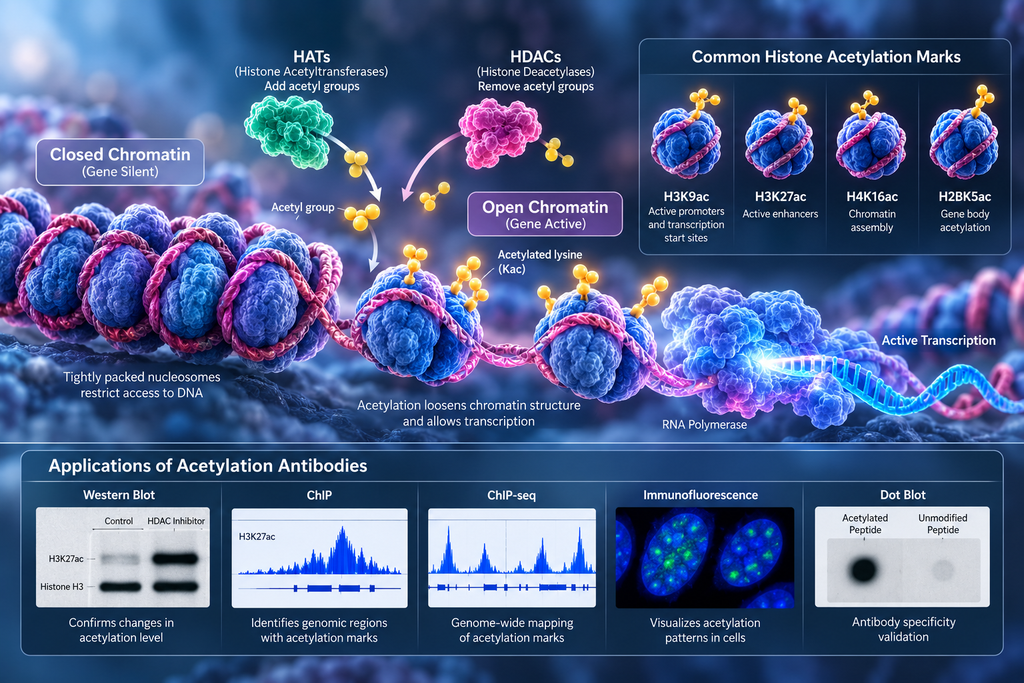
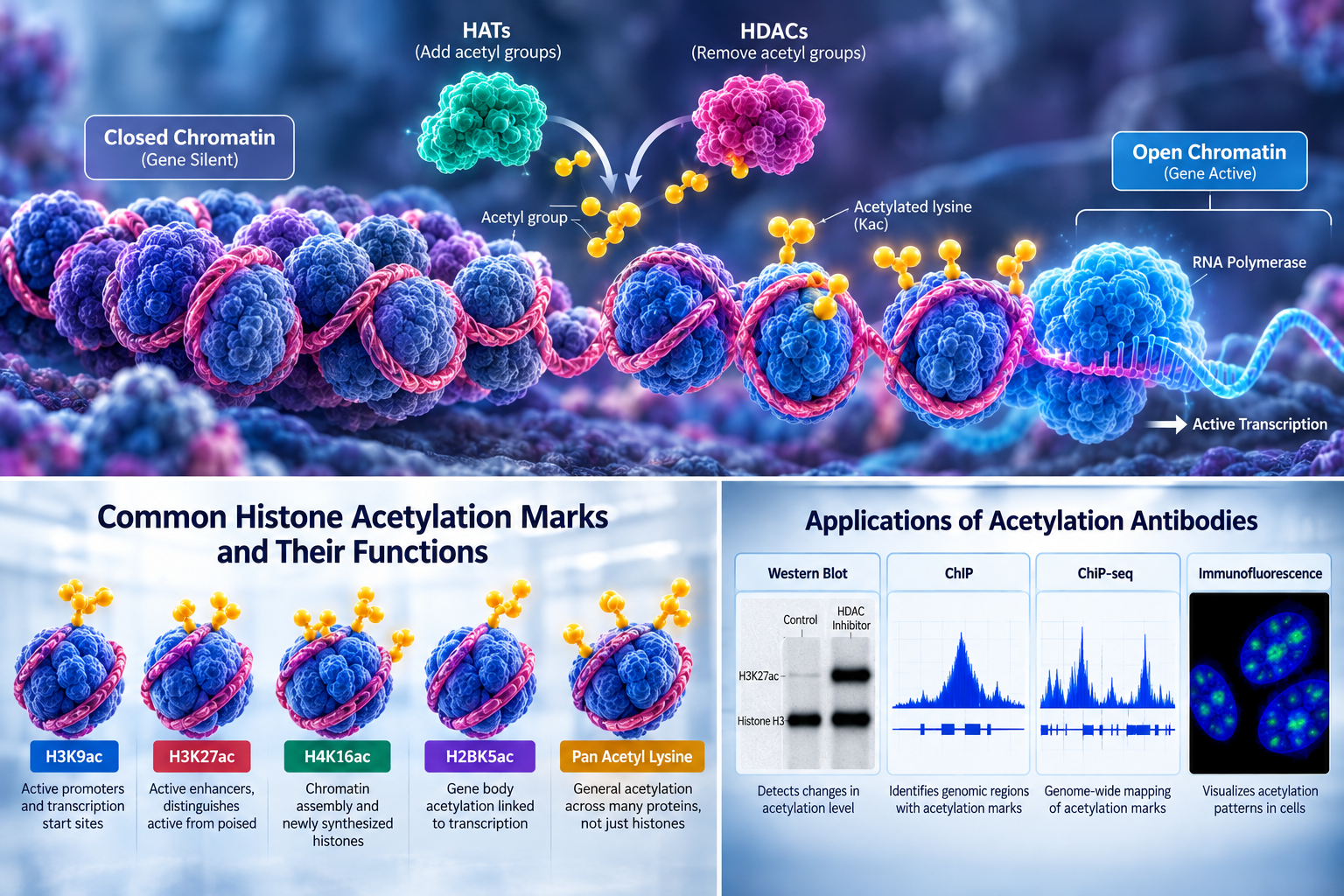
DNA does not work alone. It is wrapped around histone proteins, packaged into chromatin, and tightly controlled by chemical marks that decide which genes are switched on and which stay silent.
Acetylation is one of the most important of these marks. It is a reversible chemical change that loosens chromatin structure and opens the door to active gene transcription.
Acetylation antibodies are the tools researchers use to see this process happening, mapping exactly where acetylation occurs and how it changes under different conditions.
This guide explains what acetylation is, why it matters in epigenetics, the antibodies used to study it, and the practical considerations that affect how reliable your results will be.
What Is Histone Acetylation
Acetylation is a post translational modification, meaning it happens to a protein after it has already been made.
In this case, an acetyl group is added to a lysine residue, most often on the tails of histone proteins, by enzymes called histone acetyltransferases, or HATs.
This single chemical change has a big structural effect. Lysine normally carries a positive charge, which helps histones grip tightly to the negatively charged DNA backbone. Acetylation neutralizes that charge, loosening the grip and opening up the chromatin.
The opposite reaction is carried out by histone deacetylases, or HDACs, which remove the acetyl group and allow chromatin to tighten back up.
Why Acetylation Matters in Epigenetics
Acetylation is one of the clearest examples of how epigenetics works without changing the underlying DNA sequence at all.
The same genome can produce completely different patterns of gene activity depending on which regions are acetylated, which is part of how cells specialize into different types despite sharing identical DNA.
• Gene activation, since acetylated chromatin is generally more accessible to transcription machinery
• Cancer biology, where HDAC dysregulation can silence tumor suppressor genes
• Drug development, since HDAC inhibitors are an active and growing class of cancer therapeutics
• Aging and metabolism research, where acetylation patterns shift over time and in response to diet
Common Acetylation Marks Studied With Antibodies
Acetylation does not happen at just one site. Different lysine residues, on different histones, carry different biological meaning.
Acetylation Mark
Associated With
Common Application
H3K9ac
Active promoters and transcription start sites
ChIP-seq mapping of active genes
H3K27ac
Active enhancers, distinguishes active from poised
Enhancer mapping, ChIP-seq
H4K5ac, H4K8ac, H4K12ac, H4K16ac
Newly synthesized histones, chromatin assembly
Western blot, ChIP
H2BK5ac
Gene body acetylation linked to transcription
ChIP, ChIP-seq
Pan acetyl lysine
General acetylation across many proteins, not just histones
Western blot, IP, screening
Site specific antibodies, like those targeting H3K9ac or H3K27ac, let researchers map exactly where a particular acetylation event is happening across the genome, rather than just measuring total acetylation.
Site Specific vs Pan Acetylation Antibodies
Site Specific Antibodies
These antibodies are raised against a peptide that includes one exact acetylated lysine residue, such as H3K27ac. They allow precise mapping of individual marks and are the standard choice for ChIP and ChIP sequencing studies.
Pan Acetylation Antibodies
Pan acetyl antibodies are designed to recognize acetylated lysine broadly, across many different proteins and sites, rather than one specific residue. They are useful for a fast, general readout of total acetylation level, often used to confirm that an HDAC inhibitor treatment worked before moving to more detailed, site specific experiments.
Applications of Acetylation Antibodies
Application
What It Shows
Typical Use
Western blot
Confirms overall acetylation level of a target protein
Comparing HDAC inhibitor treated vs untreated cells
Chromatin immunoprecipitation (ChIP)
Identifies genomic regions marked by an acetylation site
Enhancer and promoter mapping
ChIP sequencing
Genome wide map of where an acetylation mark occurs
Large scale epigenomic studies
Immunofluorescence
Visualizes acetylation patterns within the nucleus
Imaging chromatin state changes
Dot blot
Quick specificity check against modified and unmodified peptides
Antibody validation before full experiments
Western Blot
Western blot is the fastest way to confirm a change in acetylation level. A classic experiment treats cells with an HDAC inhibitor and compares histone acetylation against untreated cells, expecting a clear increase in signal.
Chromatin Immunoprecipitation
ChIP uses an acetylation antibody to pull down chromatin fragments carrying that specific mark, then identifies which genomic regions were attached. This reveals exactly which genes or regulatory elements are associated with a given acetylation event.
ChIP Sequencing
Combining ChIP with next generation sequencing produces a genome wide map of an acetylation mark, which is the standard approach for large scale enhancer and promoter studies, including major projects like ENCODE.
Validating an Acetylation Antibody Before You Trust It
Because acetylation antibodies are detecting a small chemical modification, not a whole protein, validation is especially important.
• Dot blot testing against modified and unmodified peptides, confirming the antibody only binds the acetylated form
• HDAC inhibitor treatment as a positive control, since acetylation should visibly increase
• Comparison against a deacetylase deficient mutant, to confirm specificity for the intended mark over related modifications
• Checking published cross reactivity data, since some pan acyl antibodies have been shown to confuse acetylation with crotonylation or butyrylation
A 2021 study published in Scientific Reports specifically found that several widely used pan acyl antibodies struggled to distinguish between crotonylation and butyrylation marks, underscoring why validation cannot be skipped, even for well established commercial antibodies.
Practical Tips for Working With Acetylation Antibodies
• Add HDAC inhibitors such as sodium butyrate or trichostatin A to cell culture media if you want to preserve or enhance acetylation signal before harvesting
• Use fresh lysates whenever possible, since acetylation marks can be removed quickly by active deacetylases after cell lysis
• Include deacetylase inhibitors in your lysis buffer to prevent loss of signal during sample preparation
• Pair a site specific antibody with a pan acetylation antibody when you need both detailed mapping and a general overview
• Always run a no antibody or IgG control alongside ChIP experiments to confirm specificity of the pulldown
Frequently Asked Questions
What is histone acetylation
The addition of an acetyl group to a histone lysine, loosening chromatin structure.
What is the difference between site specific and pan acetylation antibodies
Site specific antibodies target one exact residue, pan antibodies detect acetylation broadly.
Why is acetylation important in epigenetics
It controls chromatin openness and gene activity without changing the DNA sequence.
What does H3K27ac mark indicate
Active enhancer regions, commonly mapped using ChIP sequencing.
Can acetylation antibodies cross react with other modifications
Yes, some pan antibodies confuse acetylation with crotonylation or butyrylation.
How do I validate an acetylation antibody
Use dot blot testing and HDAC inhibitor treatment as a positive control.
What enzymes remove acetylation marks
Histone deacetylases, known as HDACs, remove acetyl groups from lysine.
Fast & Free Shipping
Free shipping on orders $999+
Quality Guarantee
Advenit post multos Scudilo Scutariorum tribunus velament
Secure Payment
We accept credit cards, PayPal, and bank wires
Lifetime Customer Support
Responsive and knowledgable customer service via email, text or phone