Choosing Between E. coli, HEK293, and CHO for Recombinant Protein Expression
Choosing an expression system is one of the earliest decisions in any recombinant protein project, and it shapes everything that follows.
Pick the wrong host and you may end up with a protein that folds incorrectly, lacks the right modifications, or simply will not express at usable levels.
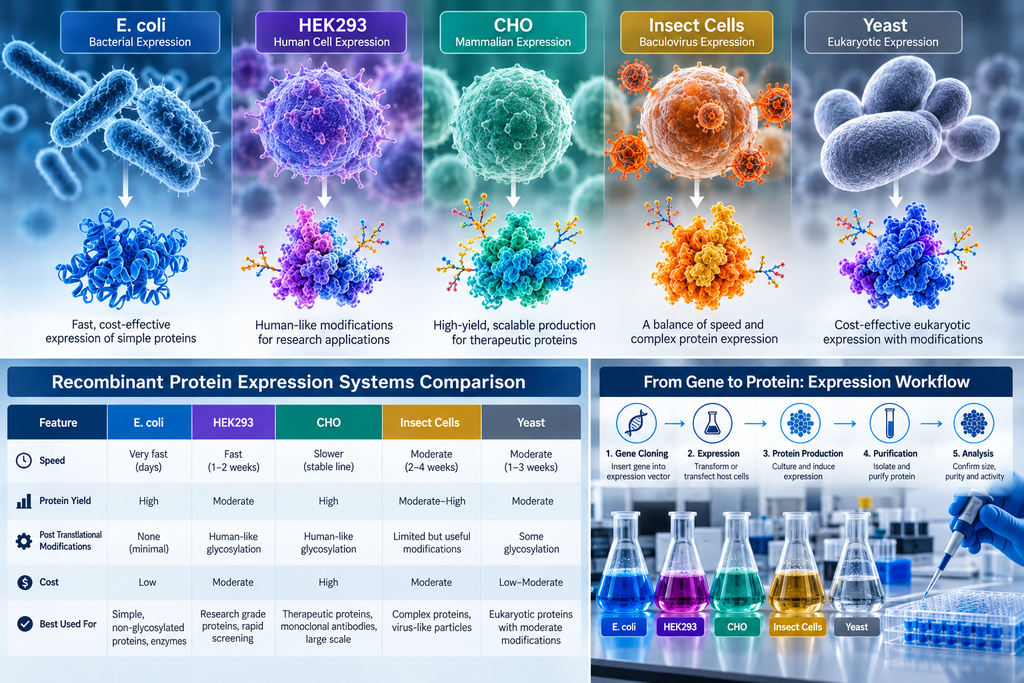
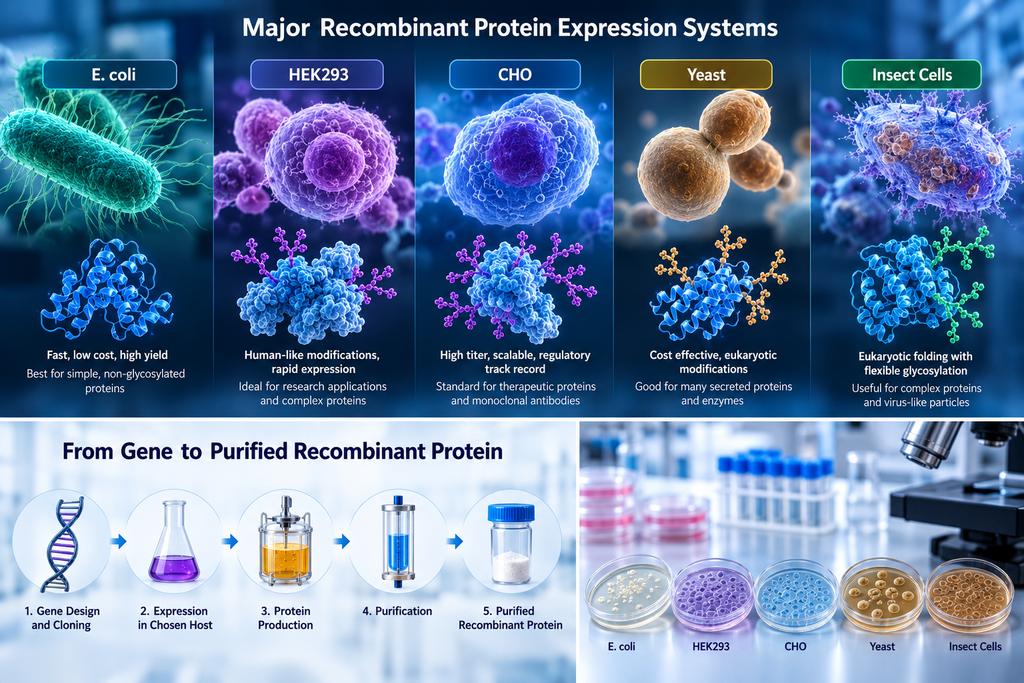
This guide compares the major recombinant protein expression systems, including E. coli, HEK293, CHO, yeast, and insect cells, so you can choose the right platform before your project begins.
What Determines the Right Expression System
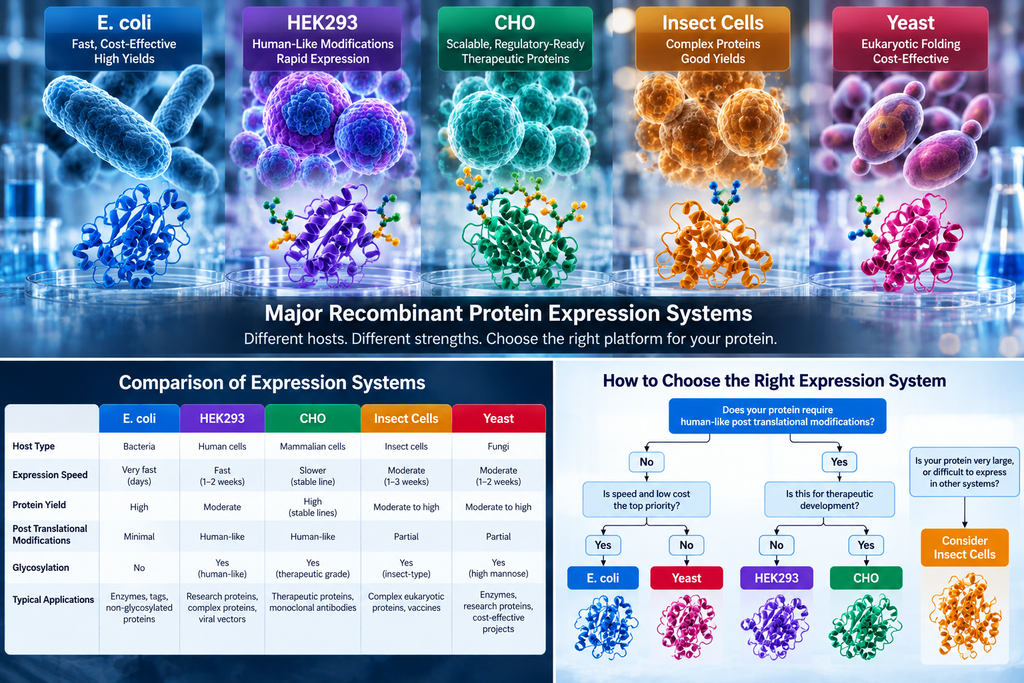
There is no single best expression system. The right choice depends entirely on what your protein needs to do.
· Does your protein require human like post translational modifications, such as glycosylation
· How quickly do you need results, days, weeks, or months
· What yield do you need, milligrams for a single assay or grams for downstream development
· What is your budget for media, reagents, and equipment
· Will the protein eventually move toward therapeutic or clinical development
Answering these questions first narrows your options considerably before you compare specific platforms.
E. coli Expression Systems
E. coli remains the fastest and most economical option for producing recombinant protein, and it is often the first system researchers try.
Advantages
· Extremely fast, with usable protein often available within days
· Low cost media and simple culture requirements
· Well established genetic tools and a huge range of vectors and strains
· High protein yields for many simple, non glycosylated proteins
Limitations
· Cannot perform most post translational modifications, including glycosylation
· Complex eukaryotic proteins often misfold or aggregate into inclusion bodies
· Lacks the chaperone systems needed for proper folding of many multi domain proteins
· Not suitable for most antibody fragments that require disulfide bond formation in an oxidizing environment
E. coli is the right choice for simple bacterial or non glycosylated proteins, enzymes, and many research grade tags or peptides where speed and cost matter more than native folding.
HEK293 Expression Systems
HEK293 cells are derived from human embryonic kidney cells and have become a standard platform for research grade recombinant protein production.
Advantages
· Human derived, producing glycosylation patterns closer to native human biology than non human systems
· Easy to transfect, with high transfection efficiency in both adherent and suspension formats
· Fast turnaround for transient expression, often producing protein within one to two weeks
· Strong capacity for certain post translational modifications, including tyrosine sulfation and glutamic acid carboxylation, which some therapeutic proteins specifically require
· Widely used for viral vector production in addition to protein expression
Limitations
· Generally lower long term yields compared to optimized stable CHO cell lines
· Transient expression requires repeated transfection for each production run unless a stable line is developed
· Less established regulatory track record for large scale therapeutic manufacturing compared to CHO
HEK293 is frequently the preferred system for research applications, rapid screening of multiple constructs, and proteins that specifically require human like modifications not well supported by CHO.
CHO Expression Systems
Chinese hamster ovary cells, commonly known as CHO cells, are the dominant platform for therapeutic protein and monoclonal antibody manufacturing worldwide.
Advantages
· Strong track record for large scale, high titer production, with established stable cell line development pipelines
· Human like glycosylation, generally well tolerated for therapeutic use
· Grows well in serum free suspension culture, supporting efficient scale up
· Lower risk of human virus contamination compared to human derived cell lines
· Extensive regulatory history, making it the preferred choice for biologics moving toward clinical development
Limitations
· Slower to establish a stable, high producing cell line compared to transient HEK293 expression
· Can introduce non human glycan structures, such as Neu5Gc, that may affect immunogenicity for some products
· Higher upfront cost and longer development timeline than bacterial or transient mammalian systems
CHO remains the standard for proteins headed toward therapeutic development, particularly monoclonal antibodies, where its regulatory track record and scalability are difficult to match.
Insect Cell and Baculovirus Expression Systems
Insect cell systems, most commonly using the baculovirus expression vector system, offer a useful middle ground between bacterial speed and mammalian complexity.
Advantages
· Capable of carrying very large DNA inserts, supporting expression of multi subunit protein complexes
· Generally higher yields than mammalian systems for many target proteins
· Performs some post translational modifications, though glycosylation patterns differ from mammalian cells
· Well suited for co expressing multiple protein subunits simultaneously
Limitations
· Longer development timeline than E. coli or transient HEK293 expression
· Glycosylation patterns are not human like, limiting suitability for many therapeutic applications
· Requires specialized baculovirus generation and infection workflow
Insect cells are a strong choice for structural biology projects and multi subunit complexes that are difficult to express in other systems.
Yeast Expression Systems
Yeast systems, particularly Pichia pastoris, offer a practical option between bacterial and mammalian platforms.
· Faster and cheaper than mammalian expression, while still performing some eukaryotic protein processing
· Can secrete protein directly into the culture medium, simplifying purification
· Glycosylation differs significantly from mammalian patterns, which can affect protein activity or immunogenicity
· A reasonable choice for non glycosylated or simply glycosylated proteins where mammalian expression is not necessary
HEK293 vs CHO: A Closer Comparison
Since these two systems are compared most often, they deserve a direct side by side look.
Speed
HEK293 wins for speed. Transient transfection can produce usable protein within one to two weeks, while establishing a stable CHO line typically takes months.
Scalability
CHO wins for scale. Established stable CHO lines support fed batch bioreactor production at scales that transient HEK293 systems are not designed for.
Glycosylation
Results vary by protein. HEK293 shows greater capacity for certain modifications, including tyrosine sulfation, while CHO is the more established choice for standard antibody glycosylation. For some difficult to express proteins, switching from CHO to HEK293, or the reverse, has rescued expression entirely due to differences in secretory pathway capacity between the two cell lines.
Regulatory Track Record
CHO has a much longer history in approved therapeutic manufacturing, making it the default choice once a project moves toward clinical development.
When to Choose Each
· Choose HEK293 for early stage research, rapid construct screening, and proteins needing specific human modifications not well supported elsewhere
· Choose CHO for proteins moving toward therapeutic development, large scale production, or projects requiring an established regulatory pathway
Common Mistakes When Choosing an Expression System
· Defaulting to E. coli for a complex, glycosylated protein simply because it is fast and cheap
· Choosing CHO for early stage research when a faster HEK293 transient system would answer the question just as well
· Ignoring post translational modification requirements until after the protein fails to fold or function correctly
· Underestimating the time needed to establish a stable CHO line when project timelines are tight
· Not considering insect cells for multi subunit complexes that are difficult to express elsewhere
· Assuming glycosylation patterns are interchangeable between expression systems without checking the specific requirements of the protein
Frequently Asked Questions
What is the best expression system for recombinant proteins?
There is no single best system. E. coli is fastest and cheapest for simple, non glycosylated proteins. HEK293 is preferred for rapid research grade production needing human like modifications. CHO is the standard for therapeutic proteins requiring large scale manufacturing and an established regulatory history.
Why is HEK293 used instead of CHO for some proteins?
HEK293 cells show a greater capacity for certain post translational modifications, including tyrosine sulfation and specific glycosylation patterns, that some proteins specifically require. HEK293 is also faster for transient expression, making it useful for early stage research and rapid screening.
Can E. coli produce glycosylated proteins?
No. E. coli lacks the cellular machinery needed for glycosylation and most other eukaryotic post translational modifications. Proteins that require these modifications for proper folding or function need a eukaryotic expression system such as HEK293, CHO, yeast, or insect cells.
Why is CHO the standard for biopharmaceutical manufacturing?
CHO cells combine human like glycosylation with strong scalability in serum free suspension culture, lower risk of human virus contamination, and decades of established regulatory history. These factors make CHO the default choice once a protein moves toward clinical development.
What expression system should I use for a multi subunit protein complex?
Insect cell systems using the baculovirus expression vector system are well suited for multi subunit complexes, since they can carry very large DNA inserts and support co expression of several protein subunits simultaneously.
Final Thoughts
Choosing a recombinant protein expression system comes down to matching the platform to your protein's specific requirements, your timeline, and where the project is headed.
E. coli for speed and simplicity, HEK293 for rapid research grade production with human like modifications, CHO for scalable therapeutic manufacturing, and insect or yeast systems for specific structural or budget needs.
AbTrivia produces recombinant proteins across multiple expression systems, including E. coli, mammalian, and baculovirus platforms, with documented purity and activity data for every product.
Fast & Free Shipping
Free shipping on orders $999+
Quality Guarantee
Advenit post multos Scudilo Scutariorum tribunus velament
Secure Payment
We accept credit cards, PayPal, and bank wires
Lifetime Customer Support
Responsive and knowledgable customer service via email, text or phone