When a protein has no antibody available, researchers often turn to tagging. A small, well characterized sequence is fused to the protein during cloning, and a tag specific antibody is used to detect it instead.
This approach removes the need to raise a custom antibody for every new target. It also gives you a predictable, well validated tool that behaves the same way across many different projects.
This guide covers the three most widely used tags in molecular biology, His tag, FLAG tag, and GFP tag, along with their antibodies, applications, and the practical issues researchers run into with each one.
Why Use Tag Antibodies
Tag antibodies solve a simple problem. Many proteins are expressed at low levels, are difficult to raise antibodies against, or simply have no commercial antibody available.
By fusing a short, well known tag to your protein of interest, you can use a single, thoroughly validated antibody to detect, purify, or track that protein, regardless of what it actually is.
• Detection by western blot, ELISA, or immunofluorescence
• Affinity purification of the tagged protein from a complex mixture
• Co immunoprecipitation to study protein interactions
• Tracking expression and localization in live or fixed cells
His Tag Antibodies
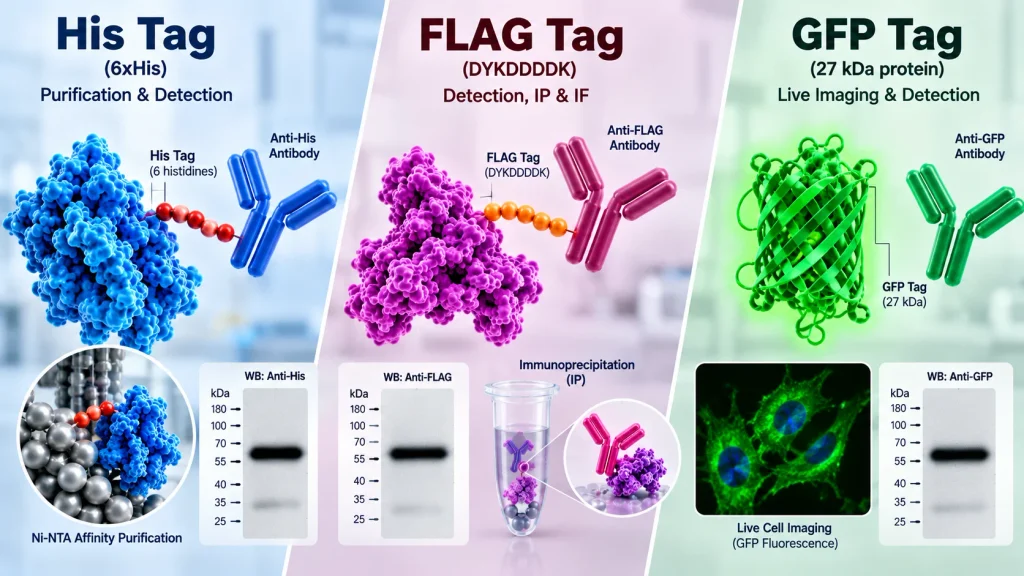
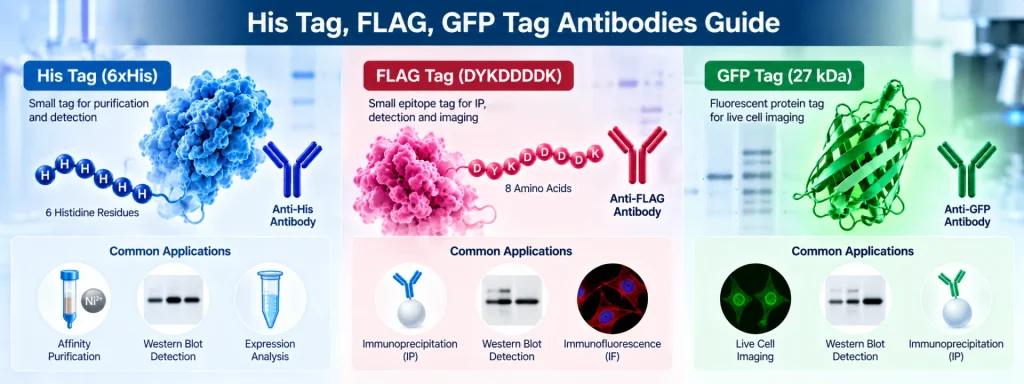
The His tag, usually six histidine residues in a row, is one of the most common tags used in recombinant protein work.
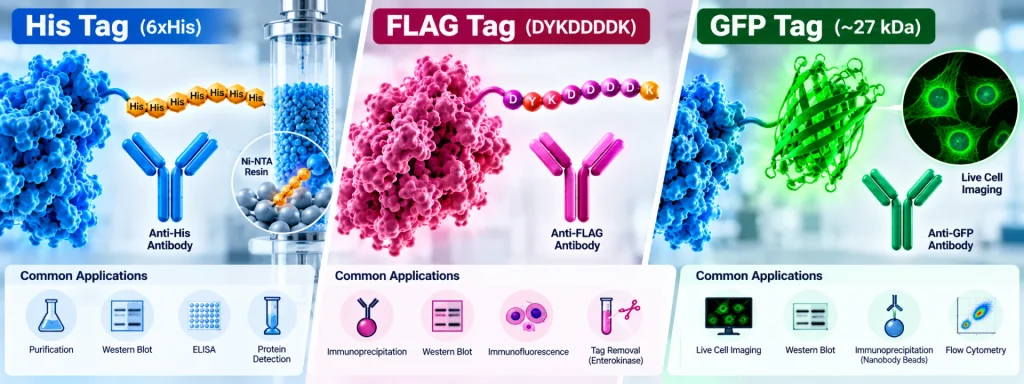
It binds tightly to nickel or cobalt resin, which makes it extremely useful for affinity purification.
His tag antibodies are typically used to confirm successful purification and expression by western blot, rather than for purification itself, since metal affinity chromatography already does that job efficiently.
Because the tag is so small, it rarely interferes with protein folding or function, which is one reason it remains a default choice for bacterial expression systems.
FLAG Tag Antibodies
FLAG tag is an eight amino acid sequence, DYKDDDDK, that was one of the first epitope tags developed for research use.
Anti FLAG antibodies are widely used for western blot, immunoprecipitation, and immunofluorescence, and they perform reliably across many cell types and species.
The FLAG sequence contains an enterokinase cleavage site, which means the tag can be removed from the protein after purification if needed.
• 1x FLAG tag is smaller and less likely to disrupt protein function, good for simple detection
• 3x FLAG tag offers higher affinity, useful for demanding pulldown or purification work
Because FLAG tag antibodies are monoclonal and highly specific, background is usually low compared to some other tags, making FLAG a strong choice for co immunoprecipitation experiments.
GFP Tag Antibodies
GFP is different from the other tags on this list. Instead of a short peptide, it is a full 27 kilodalton protein originally derived from jellyfish.
Because GFP glows green under blue or UV light, it is most often used for live cell imaging, without needing any antibody at all.
That said, anti GFP antibodies are still useful in several situations.
• Western blot confirmation of GFP fusion protein expression and size
• Immunoprecipitation of GFP tagged proteins, often using nanobody coated beads designed specifically for GFP capture
• Boosting weak fluorescent signal in fixed cell imaging through immunofluorescence
GFP tag antibodies are generally less effective for standard affinity purification compared to His or FLAG, but specialized nanobody based resins have largely solved this limitation.
Other Common Tags Worth Knowing
Beyond His, FLAG, and GFP, a few other tags appear regularly in the literature and are worth understanding.
HA Tag
Derived from human influenza hemagglutinin, the HA tag is nine amino acids long and works well for IP, western blot, and immunofluorescence.
One limitation worth noting, the HA tag is cleaved by caspase 3 and caspase 7, so it is not reliable in apoptotic cell studies.
Myc Tag
Derived from the human c-myc oncogene, the Myc tag is ten amino acids long and behaves similarly to FLAG and HA in most detection applications.
Tag Comparison at a Glance
Tag
Size
Best Applications
Key Note
His tag (6xHis)
Small, 6 amino acids
Purification, western blot
Can give background in His rich cells
FLAG tag
Small, 8 amino acids
IP, western blot, IF
Enterokinase site allows tag removal
GFP tag
Large, 27 kDa protein
Live imaging, FRET, flow cytometry
Also usable for IP with nanobody beads
HA tag
Small, 9 amino acids
IP, western blot, IF
Avoid in apoptotic cell studies
Myc tag
Small, 10 amino acids
IP, western blot, IF
Derived from c-myc oncogene
Choosing the Right Tag for Your Experiment
The right tag depends mostly on what you plan to do with the tagged protein.
• For affinity purification, His tag remains the simplest and most cost effective option
• For immunoprecipitation and detection, FLAG, HA, and Myc all perform reliably
• For live cell imaging or tracking localization, GFP is the natural choice
• For very large proteins, smaller peptide tags like FLAG or HA are less likely to disrupt folding than GFP
Many researchers combine tags, for example using a His tag for purification and a FLAG tag for downstream detection, giving flexibility at every stage of the workflow.
Common Issues With Tag Antibodies
• Endogenous background: some antibodies, particularly anti His, can detect naturally histidine rich proteins
• Tag masking: if the tag is buried inside a folded protein structure, antibody access may be blocked
• Steric interference: a large tag like GFP can sometimes interfere with the function of the fusion partner
• Cleavage sensitivity: tags like HA can be cleaved by cellular enzymes under certain conditions
Running a no tag control alongside your tagged sample is the simplest way to confirm that any signal you see is coming from the tag, not from background binding.
Frequently Asked Questions
What is the difference between His tag and FLAG tag
His tag is used mainly for purification, while FLAG tag is preferred for detection and immunoprecipitation.
Can GFP tag antibodies be used for immunoprecipitation
Yes, especially with nanobody based beads designed specifically for GFP capture.
Why does my His tag antibody show extra bands
Some endogenous proteins are naturally histidine rich and can cross react with anti His antibodies.
Is FLAG tag bigger than His tag
FLAG tag is eight amino acids, slightly larger than the six amino acid His tag.
Which tag is best for live cell imaging
GFP is the standard choice since it is fluorescent and does not require an antibody for imaging.
Can I use more than one tag on the same protein
Yes, combining tags such as His and FLAG is common for purification followed by detection.
Does the HA tag work in all cell types
Mostly, but it should be avoided in apoptotic cell studies due to caspase cleavage.
Fast & Free Shipping
Free shipping on orders $999+
Quality Guarantee
Advenit post multos Scudilo Scutariorum tribunus velament
Secure Payment
We accept credit cards, PayPal, and bank wires
Lifetime Customer Support
Responsive and knowledgable customer service via email, text or phone