What Are cDNA Clones and When Do Researchers Use Them
Almost every overexpression study, protein interaction experiment, or functional genomics project starts with the same question, where do you get the gene sequence to work with.
For most researchers, the answer is a cDNA clone or an ORF clone, two related but distinct tools that are often confused with each other.
This guide explains what cDNA clones actually are, how they differ from ORF clones, and when each one is the right choice for your research.
What Is a cDNA Clone
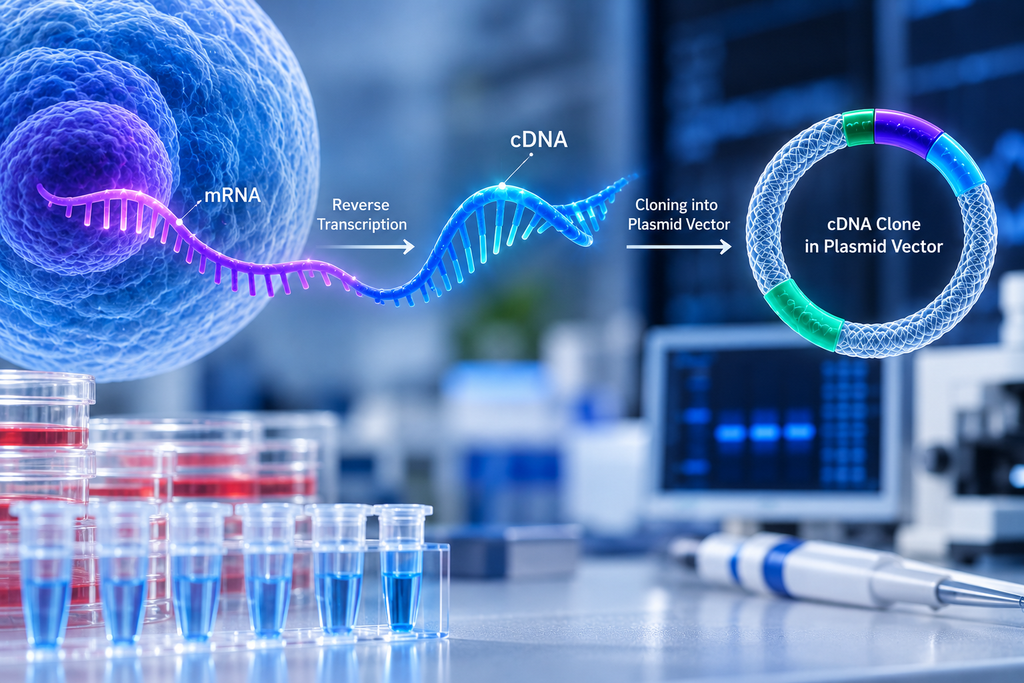
A cDNA clone is a piece of complementary DNA, made by reverse transcribing messenger RNA, that has been inserted into a plasmid vector and propagated in bacteria.
Because cDNA is synthesized from mature mRNA, it represents the spliced, processed version of a gene, without the introns found in genomic DNA.
A full length cDNA clone typically includes the complete coding sequence along with the 5 prime and 3 prime untranslated regions, sometimes called UTRs, that flank the protein coding portion of the transcript.
These UTRs are not just filler. They often contain regulatory elements that influence mRNA stability, translation efficiency, and in some cases localization within the cell.
What Is an ORF Clone
An ORF clone, where ORF stands for open reading frame, contains only the protein coding sequence of a gene, starting at the start codon and ending at the stop codon.
The 5 prime and 3 prime UTRs present in a full length cDNA clone are deliberately removed.
This distinction matters because UTRs can sometimes interfere with protein expression, particularly when researchers want to create fusion proteins with tags at either end of the coding sequence.
A 5 prime UTR may contain an upstream start codon or secondary structure that reduces translation efficiency, and the native stop codon at the end of a cDNA can block expression of C terminal protein fusions, which is exactly the kind of problem ORF clones are designed to avoid.
cDNA Clones vs ORF Clones, the Key Difference
cDNA Clones
· Contain the full transcript, including 5 prime and 3 prime UTRs
· Better reflect native gene regulation, since UTR elements remain intact
· Useful for studying gene expression in a context closer to the natural transcript
· Can be more complex to use for fusion tagging due to the presence of UTR sequences and the native stop codon
ORF Clones
· Contain only the coding sequence, with UTRs removed
· Optimized for protein expression and overexpression studies
· Easier to use for N terminal and C terminal tagging, since the native stop codon can be removed
· The standard choice for most functional genomics and protein production projects
In short, cDNA clones are ideal when the research question involves the gene in something closer to its native form, while ORF clones are the practical choice when the goal is simply to produce protein efficiently.
How cDNA and ORF Clones Are Made
The process begins with mRNA isolated from a relevant tissue or cell type, which is reverse transcribed into complementary DNA using reverse transcriptase.
For ORF clones specifically, researchers design primers that amplify just the coding sequence, often using PCR with primers anchored at the start and stop codons identified from a reference sequence.
The amplified product is then inserted into an entry or expression vector, frequently using Gateway cloning technology, which allows the same coding sequence to be transferred efficiently between different expression vectors without repeating the cloning process from scratch.
Every clone produced this way needs to be sequence verified before use, since PCR amplification and bacterial propagation can introduce errors such as point mutations or partial deletions.
Large scale clone resources, including international cDNA consortium projects, have generated tens of thousands of sequence verified human, mouse, and rat clones, making it possible for most researchers to obtain a ready made clone rather than building one from scratch.
When Researchers Use cDNA Clones
Gene Expression Studies
cDNA clones, with their UTRs intact, are useful when researchers want to study how a transcript is regulated, including stability and translation, rather than just producing protein.
Functional Genomics Research
Used broadly to characterize gene function, often as part of larger systematic efforts to assign biological roles to previously uncharacterized genes.
Splice Variant Studies
Since cDNA reflects the mature, processed transcript, cDNA clones are well suited to studying specific splice variants that differ from a gene's canonical reference sequence.
Library Based Screening
cDNA clone libraries, available for multiple species, support large scale screening approaches where many genes are tested simultaneously for a particular function or interaction.
When Researchers Use ORF Clones
Protein Overexpression Studies
The most common use case. ORF clones, cloned into a strong promoter driven expression vector, are introduced into cells by plasmid transfection or lentiviral transduction to produce high levels of a specific protein.
Tagged Protein Expression
Since the native stop codon can be excluded, ORF clones are the practical choice for generating fusion proteins with tags such as GFP, FLAG, or His, used for visualization, purification, or detection.
Protein Interaction Studies
ORF clones expressing tagged proteins are widely used in co immunoprecipitation and other interaction assays to identify binding partners within cellular pathways.
RNAi Rescue Experiments
After knocking down a gene with RNAi, researchers can reintroduce an RNAi resistant ORF clone to confirm that any observed phenotype is specifically due to loss of that gene's function, rather than an off target effect.
Drug Target Identification
Expressing disease associated ORF clones in cell based assays helps researchers identify and validate potential targets during early stage drug discovery.
Subcellular Localization Studies
Tagged ORF clones allow researchers to visualize where a protein localizes within the cell, providing functional clues that are difficult to obtain from sequence analysis alone.
Choosing Between Human, Mouse, and Rat Clones
Species selection depends entirely on your experimental model and research question.
· Human clones are the standard choice for disease relevant research intended to translate toward human biology, including drug target validation
· Mouse clones are typically used alongside in vivo mouse models, ensuring sequence compatibility with the animal system being studied
· Rat clones serve a similar role for research relying specifically on rat models, particularly common in certain physiology and pharmacology studies
Cross species experiments are possible, but always confirm sequence homology between species before assuming a human clone will behave identically in a mouse or rat cellular context.
Practical Considerations Before Ordering a Clone
Confirm Sequence Verification
Always check that the clone has been fully sequence verified against a reference database, and review the supplier's policy on guaranteed sequence accuracy.
Check Vector Compatibility
Confirm the clone is available in, or can be transferred into, the expression vector required for your specific application, whether that is mammalian expression, lentiviral delivery, or another system.
Consider Splice Variants
If your gene of interest has multiple known splice variants, confirm which specific variant the clone represents, since functional differences between variants can be significant.
Plan for Tagging Needs
If your project requires N terminal or C terminal tagging, an ORF clone without the native stop codon, or a clone already available in a tagged vector format, will save significant cloning work.
Common Mistakes When Selecting cDNA or ORF Clones
· Choosing a cDNA clone for a tagging project, then discovering the native stop codon blocks C terminal fusion expression
· Not confirming which splice variant a clone represents before starting a long term study
· Assuming all clones from a supplier are sequence verified without checking their specific validation policy
· Ordering a clone in the wrong vector format and underestimating the time needed to subclone into the correct expression system
· Using a human clone in a mouse cellular system without checking sequence homology first
· Skipping a quick restriction digest or sequencing check upon receipt to confirm clone identity before starting a major experiment
Frequently Asked Questions
What is the difference between a cDNA clone and an ORF clone?
A cDNA clone contains the full transcript sequence, including the 5 prime and 3 prime untranslated regions. An ORF clone contains only the protein coding sequence, with the UTRs removed, making it better suited for protein overexpression and tagging applications.
When should I use a cDNA clone instead of an ORF clone?
Choose a cDNA clone when your research question involves gene regulation, transcript stability, or studying the gene in a form closer to its native biology. Choose an ORF clone when your primary goal is efficient protein expression, particularly for tagged fusion proteins.
Are cDNA clones sequence verified?
Reputable suppliers sequence verify their clones against a reference database before release, though policies vary, and some clones may show minor discrepancies, such as natural polymorphisms, compared to the reference sequence. Always check the supplier's validation policy before relying on a clone for critical experiments.
Can I use a human ORF clone in mouse cells?
Technically yes, since the coding sequence will still be transcribed and translated, but biological compatibility depends on your specific research question. For studies requiring native regulatory context or precise sequence matching to an in vivo mouse model, a mouse specific clone is the more appropriate choice.
What is Gateway cloning and why is it used for ORF clones?
Gateway cloning is a recombination based cloning technology that allows a coding sequence, once placed into an entry vector, to be efficiently transferred into many different expression vectors without repeating traditional restriction enzyme cloning. This makes it significantly faster to move the same ORF clone into multiple expression systems for different applications.
Do ORF clones include the native stop codon?
ORF clones are typically available both with and without the native stop codon. Versions without the stop codon are designed specifically for generating C terminal tagged fusion proteins, since the native stop codon would otherwise terminate translation before the tag sequence.
Final Thoughts
cDNA clones and ORF clones solve different problems, even though they are often discussed together.
cDNA clones keep the full transcript intact for studies closer to native gene biology, while ORF clones strip away the UTRs to make protein expression and tagging straightforward.
Knowing which one your project actually needs, before you order, saves significant time and avoids unnecessary subcloning down the line.
AbTrivia offers a wide range of sequence verified human, mouse, and rat cDNA and ORF clones, ready to support gene expression, overexpression, and functional genomics research.
Fast & Free Shipping
Free shipping on orders $999+
Quality Guarantee
Advenit post multos Scudilo Scutariorum tribunus velament
Secure Payment
We accept credit cards, PayPal, and bank wires
Lifetime Customer Support
Responsive and knowledgable customer service via email, text or phone