How to Reconstitute and Store Lyophilized Recombinant Proteins
Lyophilized recombinant proteins are widely used in cell culture, immunology, and molecular biology research because they offer improved stability and easier storage. However, improper handling can affect their quality and performance. A reliable protein reconstitution protocol starts with choosing the right solvent, adding the correct buffer volume, and mixing gently until the powder dissolves. Proper protein storage conditions are equally important for maintaining biological activity. Repeated freezing and thawing can cause protein aggregation and reduce effectiveness. This guide explains how to reconstitute freeze-dried proteins, calculate concentrations, select suitable buffers, and maintain protein stability for consistent laboratory results.
1. What Are Lyophilized Recombinant Proteins and Why Are They Used?
Lyophilized recombinant proteins are purified proteins preserved through freeze-drying. The lyophilization process removes water under low pressure, helping reduce chemical reactions that can damage proteins during storage.
These freeze-dried proteins are widely used in research because dry formulations can offer improved stability and easier shipping. However, their protein shelf life still depends on the formulation and manufacturer's storage recommendations.
How Does Lyophilization Protect Recombinant Proteins?
Lyophilization freezes the protein solution and removes ice through sublimation. This reduces available water and slows many degradation reactions. Protective ingredients, such as sugars, may help maintain the protein's structure during drying.
Common Research Applications
Researchers use recombinant proteins in cell signaling, antibody development, and functional assays. For example, recombinant cytokines help study immune responses, while growth factors support cell culture experiments.
You can explore AbTriva's recombinant protein collection for research proteins produced using different expression systems.
2. What You Need Before Reconstituting Lyophilized Recombinant Proteins
Before starting lyophilized protein reconstitution, review the product datasheet and Certificate of Analysis (CoA). These documents provide important information about the recommended solvent, stock concentration, and storage conditions.
Prepare sterile pipette tips, suitable tubes, and the recommended reconstitution buffer. Use clean equipment and work carefully to prevent contamination or unnecessary sample loss.
Check the Product Datasheet and Certificate of Analysis
Always confirm the protein amount, formulation, and recommended solvent. Some proteins dissolve in water, while others require acidic solutions. Using an unsuitable buffer can reduce protein solubility or affect activity.
Prepare the Required Laboratory Materials
Use sterile water, compatible buffers, calibrated pipettes, and low-protein-binding tubes when appropriate. A brief centrifugation before opening helps collect powder from the vial cap and walls.
For example, AbTriva lists recombinant human IL-40 protein in lyophilized form. Review the lot-specific handling instructions before preparing any stock solution.
3. How to Properly Reconstitute Lyophilized Recombinant Proteins: Step-by-Step Protocol
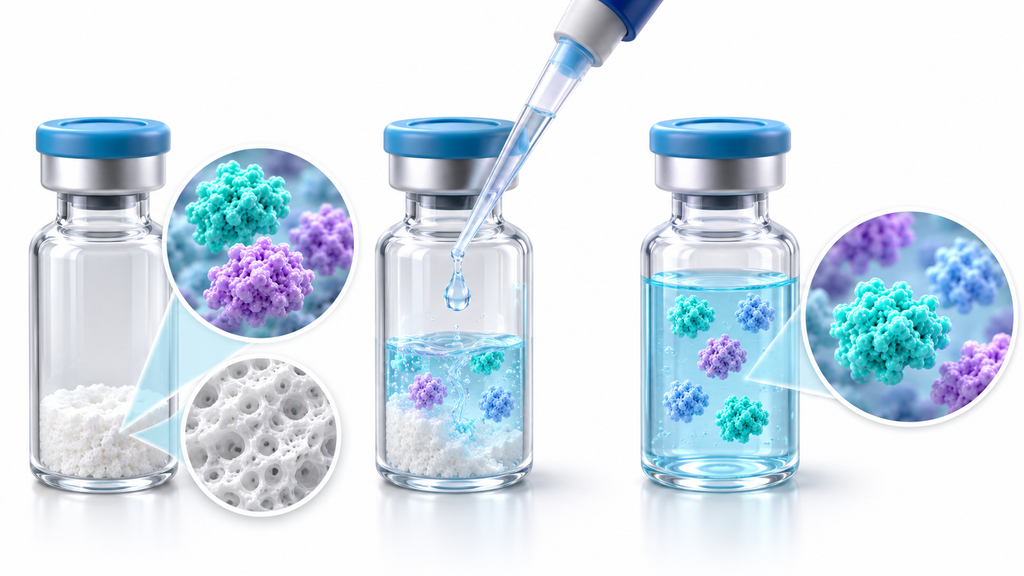
A reliable protein reconstitution protocol helps preserve activity and improve recovery. The basic process involves preparing the vial, adding the correct solvent, allowing the powder to dissolve, and preparing storage aliquots.
Lyophilized recombinant proteins can differ in their handling requirements. Follow the product-specific instructions rather than applying one solvent or incubation time to every protein.
Step 1: Allow the Vial to Reach Room Temperature
Let the sealed vial reach the recommended temperature before opening. This helps reduce condensation inside the container, which could introduce unwanted moisture into the dry powder.
Step 2: Collect the Powder at the Bottom
Briefly centrifuge or gently tap the vial before opening. Small protein amounts may form a thin, nearly invisible film on the container walls.
This step improves protein recovery during reconstitution.
Step 3: Add the Recommended Reconstitution Buffer
Carefully add the calculated solvent volume along the vial wall. Use the recommended buffer and concentration.
Sterile water for protein reconstitution is suitable only when specified by the manufacturer.
Step 4: Mix Gently and Allow Complete Dissolution
Let the solution stand for the recommended period, using gentle mixing if needed. Avoid vigorous shaking and vortexing because foam and air-liquid interfaces can promote protein denaturation.
R&D Systems describes a typical equilibration period of 15–30 minutes, although individual products may differ.
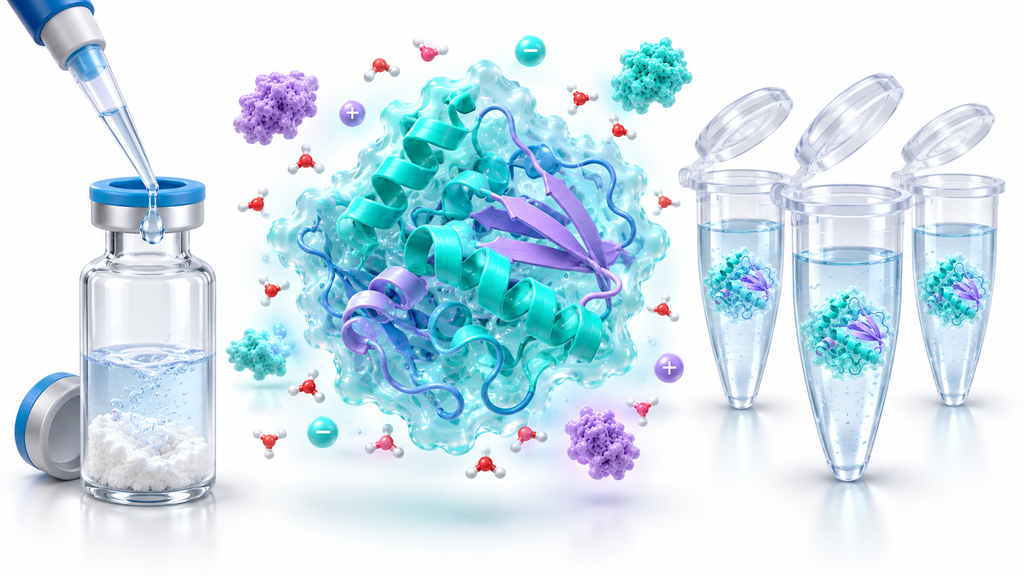
Step 5: Check the Solution and Prepare Aliquots
Inspect the solution for visible particles or incomplete dissolution. Don't assume every cloudy sample is unusable, but investigate unexpected precipitation before proceeding.
Divide the solution into suitable protein aliquots for later experiments.
Protein Reconstitution Concentration Calculator
Calculate the required volume using:
Volume (mL) = Protein amount (mg) ÷ Desired concentration (mg/mL)
For example, imagine you have 100 µg of protein and need a 0.1 mg/mL stock.
100 µg = 0.1 mg
0.1 mg ÷ 0.1 mg/mL = 1 mL
Therefore, add 1 mL of the recommended solvent to obtain a nominal concentration of 100 µg/mL.
Protein Amount
Desired Concentration
Buffer Volume
10 µg
100 µg/mL
100 µL
25 µg
100 µg/mL
250 µL
50 µg
100 µg/mL
500 µL
100 µg
100 µg/mL
1,000 µL
These calculations assume the labeled amount represents the protein of interest. Confirm whether the vial contains additional carrier material.
For a real product example, review the formulation information for recombinant human neurturin, which is listed in liquid or lyophilized form.
4. How to Choose the Right Solvent and Buffer for Protein Reconstitution
The correct solvent depends on the protein's structure, charge, and formulation. Protein solubility and pH are closely related because changes in pH can affect molecular charge and interactions.
Buffer ionic strength and protein solubility also influence dissolution. Some proteins require low-salt conditions or acidic solvents before dilution into a neutral working buffer.
Sterile Water, PBS, and Acidic Solutions
Sterile water works for proteins validated for water-based reconstitution. PBS maintains a near-neutral environment, while dilute acetic acid or hydrochloric acid may improve the dissolution of certain proteins.
When Should You Use Carrier Proteins?
Carrier proteins, including bovine serum albumin (BSA), can reduce protein loss through adsorption to containers. However, BSA may interfere with labeling, purification, or protein analysis.
Use carrier-free formulations when required by the assay.
Trehalose and Glycerol as Stabilizers
A trehalose solution may protect proteins during drying or storage. Glycerol for protein storage can help stabilize selected liquid formulations, but its concentration must be validated.
AbTriva's recombinant human SRSF3 protein lists trehalose in its lyophilization formulation and glycerol-related storage information.
Reconstitution Buffer Selection Table
Solvent or Additive
Common Purpose
Important Consideration
Sterile water
Dissolve compatible proteins
Not suitable for every protein
PBS
Maintain near-neutral pH
Salt may affect solubility
Dilute acetic acid
Support selected acidic reconstitution methods
Confirm downstream compatibility
BSA
Improve stability and reduce adsorption
May interfere with analysis
Trehalose
Help protect protein structure
Use validated concentrations
Glycerol
Stabilize selected liquid proteins
May affect downstream assays
Always check the protein's own instructions before combining solvents or adding stabilizers.
5. Common Challenges During Protein Reconstitution and How to Avoid Them
Common problems include incomplete protein dissolution, aggregation, and unexpected loss of biological activity. These problems may result from unsuitable buffers, incorrect concentrations, or harsh mixing.
Poor protein resuspension can also leave material attached to the vial. Gentle handling and adequate dissolution time help reduce avoidable sample loss.
Protein Aggregation and Poor Solubility
Protein aggregation occurs when protein molecules associate and form larger particles. It may result from unsuitable pH, excessive concentration, temperature changes, or unfolding.
Use the recommended buffer rather than trying random additives.
Low Protein Recovery After Reconstitution
Low protein recovery can occur when small protein amounts bind to plastic surfaces or remain trapped in undissolved material.
Suitable low-binding containers and validated carrier-containing diluents may improve recovery.
Loss of Biological Activity
Reduced protein activity may occur even when a solution looks clear. Improper storage, harsh mixing, or repeated freezing can change protein structure.
6. How to Store Reconstituted Recombinant Proteins for Long-Term Stability
Proper protein storage conditions help maintain experimental consistency. Storage requirements depend on the protein, buffer composition, concentration, and intended application.
For lyophilized recombinant proteins, dry and reconstituted forms may have different storage recommendations. Always follow the product datasheet rather than assuming the same temperature works for both.
Short-Term Storage at 2–8°C
Some reconstituted proteins tolerate refrigerated storage for several days. However, protein storage at 2–8°C is product-dependent and shouldn't be treated as a universal one-week guarantee.
Long-Term Storage at −20°C or −80°C
Long-term protein storage commonly involves frozen, single-use aliquots. Some formulations support storage at −20°C, while more sensitive proteins may require −80°C.
Check the specified duration and temperature for your product.
Why Protein Aliquoting Matters
Protein aliquoting allows you to thaw only what each experiment needs. This reduces unnecessary freeze-thaw cycles, which may affect protein structure, concentration, and activity.
For example, compare AbTriva's recombinant human NAPB protein formulation with the exact storage instructions supplied for your purchased lot.
7. Best Practices for Maintaining Protein Stability and Preventing Degradation
Maintaining protein stability requires consistent temperature control, careful handling, and a suitable solution environment. Even correctly prepared stocks may deteriorate if exposed to unsuitable conditions.
Protein degradation can result from chemical changes, protease contamination, aggregation, or structural instability. Good storage practices help preserve activity, but they don't replace experimental quality checks.
Avoid Repeated Freeze-Thaw Cycles
Repeated freezing and thawing can expose proteins to changing pH, ice interfaces, and concentration effects.
Prepare working-sized aliquots and avoid refreezing thawed material unless the manufacturer has validated that practice.
Maintain Suitable Protein Concentrations
Very dilute solutions may experience greater adsorption losses, while highly concentrated stocks may aggregate.
Choose a protein concentration supported by the manufacturer's stability data and your experimental needs.
Use Suitable Containers and Storage Buffers
Low-binding polypropylene tubes may reduce adsorption. Use sterile handling for cell culture reagents and label each aliquot with its concentration, buffer, date, and lot number.
AbTriva's recombinant human KRT78 protein is another example of a lyophilized product with formulation details that require review.
Verify Protein Quality Before Critical Experiments
A clear solution doesn't guarantee full biological activity of proteins. When appropriate, confirm performance through a functional assay, purity assessment, or validated analytical method.
For enzyme studies, AbTriva's alpha-galactosidase A research reagents illustrate the importance of selecting a suitable protein and activity-testing approach.
For broader reagent selection, the AbTriva protein collection includes recombinant and native proteins used in different research applications.
8. Frequently Asked Questions About Reconstituting and Storing Lyophilized Proteins
Researchers often ask how much solvent to add, which temperature to use, and whether stabilizers are necessary. The answers depend on the particular protein formulation.
The following questions cover practical recombinant protein reconstitution and storage decisions. Always use manufacturer instructions when they differ from general recommendations.
How Do You Reconstitute Lyophilized Proteins?
Add the manufacturer-recommended solvent at the specified concentration. Mix gently, allow the powder to dissolve, and prepare aliquots for storage. Avoid vigorous shaking and follow product-specific instructions.
How Much Buffer Should You Add to Lyophilized Protein?
Divide the protein mass by your desired concentration. For example, dissolving 50 µg in 500 µL produces a nominal concentration of 100 µg/mL. Use the recommended solvent.
Can You Store Reconstituted Proteins at −80°C?
Yes, many recombinant proteins can be stored at −80°C in suitable aliquots. However, the correct temperature, buffer, and storage period depend on the product's validated stability information.
Should You Add BSA During Protein Reconstitution?
Add BSA only when the product instructions recommend it. Some proteins benefit from carriers during dilution or storage, but BSA may interfere with labeling, analytical assays, or carrier-free applications.
How Do You Prevent Protein Degradation During Storage?
Use validated storage buffers, maintain appropriate temperatures, prepare single-use aliquots, and avoid repeated freezing and thawing. Check protein activity when long-term storage could affect experimental results.
Conclusion
Proper reconstitution and storage are essential for maintaining the quality of lyophilized recombinant proteins. Start with the product's Certificate of Analysis, choose the recommended solvent, and calculate the correct buffer volume. Mix gently and prepare suitable aliquots.
To preserve activity, follow validated storage temperatures and avoid repeated freeze-thaw cycles. Careful handling helps maintain protein stability, reduce sample loss, and improve the reliability of your research results.
Fast & Free Shipping
Free shipping on orders $999+
Quality Guarantee
Advenit post multos Scudilo Scutariorum tribunus velament
Secure Payment
We accept credit cards, PayPal, and bank wires
Lifetime Customer Support
Responsive and knowledgable customer service via email, text or phone