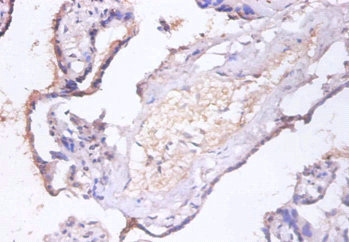
-
Chinese (Simplified)
-
English
-
German
-
Korean
-
Spanish
Chinese (Simplified)
English
German
Korean
Spanish
Sign up for an account to enjoy easy online shopping and instant order tracking.
The antibody against CHMP2A was raised in rabbit using the Recombinant Human Charged multivesicular body protein 2a protein (1-222AA) as the immunogen. This antibody exists as a non-conjugated isotype IgG, purified by protein G with a purity greater than 95%. This antibody has been validated on ELISA, WB, IHC.
$299.00
| Cat.No | ADC-54372A | Clonality | Polyclonal |
|---|---|---|---|
| Host Species | Rabbit | Target Name | CHMP2A |
| Form | Liquid | Species Reactivity | Human |
| Isotype | IgG | Storage Buffer | 0.01M PBS, 0.03% Proclin 300; Constituents: 50% Glycerol, PH 7.4 |
| Purification Method | >95%, Protein G purified | Conjugate | Non-conjugated |
| Application | ELISA, IHC, WB | Storage | Upon receipt |
| Immunogen Description | Recombinant Human Charged multivesicular body protein 2a protein (1-222AA) | Target Species | Human |
|---|---|---|---|
| Immunogen Sequence | Complete sequences for the immunogen, target protein, and peptides are available upon request. | Uniprot ID | O43633 |
Uniprot Id
O43633
Target Species
Human
Target Name
CHMP2A
Target Full Name
Charged multivesicular body protein 2a
Target Function
Probable core component of the endosomal sorting required for transport complex III (ESCRT-III) which is involved in multivesicular bodies (MVBs) formation and sorting of endosomal cargo proteins into MVBs. MVBs contain intraluminal vesicles (ILVs) that are generated by invagination and scission from the limiting membrane of the endosome and mostly are delivered to lysosomes enabling degradation of membrane proteins, such as stimulated growth factor receptors, lysosomal enzymes and lipids. The MVB pathway appears to require the sequential function of ESCRT-O, -I,-II and -III complexes. ESCRT-III proteins mostly dissociate from the invaginating membrane before the ILV is released. The ESCRT machinery also functions in topologically equivalent membrane fission events, such as the terminal stages of cytokinesis. Together with SPAST, the ESCRT-III complex promotes nuclear envelope sealing and mitotic spindle disassembly during late anaphase. ESCRT-III proteins are believed to mediate the necessary vesicle extrusion and/or membrane fission activities, possibly in conjunction with the AAA ATPase VPS4.; (Microbial infection) The ESCRT machinery functions in topologically equivalent membrane fission events, such as the budding of enveloped viruses (HIV-1 and other lentiviruses). Involved in HIV-1 p6- and p9-dependent virus release.
Target Subcellular Location
Late endosome membrane; Peripheral membrane protein; Cytoplasmic side. Note=Localizes to the midbody of dividing cells. Localized in two distinct rings on either side of the Fleming body.
Target Protein Families
SNF7 family
Target Research Area
Transport
Target Synonyms
BC 2; BC2; Charged multivesicular body protein 2a; CHM2A_HUMAN; CHMP2; CHMP2a; Chromatin modifying protein 2a; Chromatin-modifying protein 2a; hVps2 1; hVps2-1; putative breast adenocarcinoma marker; Putative breast adenocarcinoma marker BC-2; Putative breast adenocarcinoma marker BC2; Vacuolar protein sorting associated protein 2 1; Vacuolar protein sorting-associated protein 2-1; Vps2 1; VPS2; Vps2-1; VPS2A
Target Background
CHMP2A belongs to the chromatin-modifying protein/charged multivesicular body protein (CHMP) family. These proteins are components of ESCRT-III (endosomal sorting complex required for transport III), a complex involved in degradation of surface receptor proteins and formation of endocytic multivesicular bodies (MVBs). Some CHMPs have both nuclear and cytoplasmic/vesicular distributions, and one such CHMP, CHMP1A (MIM 164010), is required for both MVB formation and regulation of cell cycle progression (Tsang et al., 2006 [PubMed 16730941]).
Notification