• Contact info@abtriva.com for inquiries and orders.
  • Chinese (Simplified)

  • English

  • German

  • Korean

  • Spanish

United States (English / $ USD)

Rabbit anti-Human B7-H4 / B7S1 / B7x Polyclonal Antibody

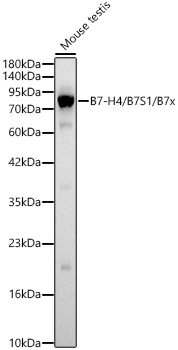
The antibody against B7-H4 / B7S1 / B7x was raised in Rabbit using the recombinant fusion protein containing a sequence corresponding to amino acids 25-259 of human B7-H4 / B7S1 / B7x (NP_078902.2) as the immunogen. The polyclonal antibody exists as a isotype IgG, by affinity purification. This antibody has been validated on WB, ELISA.

ADA-08240A

The antibody against B7-H4 / B7S1 / B7x was raised in Rabbit using the recombinant fusion protein containing a sequence corresponding to amino acids 25-259 of human B7-H4 / B7S1 / B7x (NP_078902.2) as the immunogen. The polyclonal antibody exists as a isotype IgG, by affinity purification. This antibody has been validated on WB, ELISA.

Number
Order Exclusive Products Now

Request a Quote
High Purity LevelsPrecision and ReliabilityCustomization Options

Specifications


Cat.No ADA-08240A ClonalityPolyclonal
Host SpeciesRabbitTarget NameB7-H4 / B7S1 / B7x
Target SynonymsVTCN1; B7-H4; B7H4; B7S1; B7X; B7h.5; PRO1291; VCTN1; V-set domain-containing T-cell activation inhibitor 1; B7-H4 / B7S1 / B7xFormLiquid
Species ReactivityMouseIsotypeIgG
Storage Buffer50% Glycerol, PBS with 0.05% proclin300, pH7.3.Purification MethodAffinity purification
Positive SamplesMouse testisApplicationELISA, WB

Immunogen Information


Immunogen DescriptionRecombinant fusion protein containing a sequence corresponding to amino acids 25-259 of human B7-H4 / B7S1 / B7x (NP_078902.2).Target SpeciesHuman
Uniprot IDQ7Z7D3Immunogen Sequence
Background Information
  • Uniprot Id

    Q7Z7D3

  • Target Species

    Human

  • Target Name

    VTCN1

  • Target Full Name

    V-set domain-containing T-cell activation inhibitor 1

  • Target Function

    Negatively regulates T-cell-mediated immune response by inhibiting T-cell activation, proliferation, cytokine production and development of cytotoxicity. When expressed on the cell surface of tumor macrophages, plays an important role, together with regulatory T-cells (Treg), in the suppression of tumor-associated antigen-specific T-cell immunity. Involved in promoting epithelial cell transformation.

  • Target Subcellular Location

    Cell membrane; Single-pass type I membrane protein.

  • Target Protein Families

    Immunoglobulin superfamily, BTN/MOG family

  • Target Tissue Specificity

    Overexpressed in breast, ovarian, endometrial, renal cell (RCC) and non-small-cell lung cancers (NSCLC). Expressed on activated T- and B-cells, monocytes and dendritic cells, but not expressed in most normal tissues (at protein level). Widely expressed, i

  • Target Research Area

    Immunology

  • Target Synonyms

    B7 family member, H4; B7 H4; B7 homolog 4; B7 superfamily member 1; B7 superfamily, member 1; B7-H4; B7h.5; B7h4; B7S1; B7x; BC032925; Immune costimulatory protein B7-H4; Immune costimulatory protein B7H4; MGC41287; PRO1291; Protein B7S1; RP11 229A19.4; T cell costimulatory molecule B7x; T-cell costimulatory molecule B7x; V set domain-containing T cell activation inhibitor 1; V-set domain-containing T-cell activation inhibitor 1; VCTN1; Vtcn1; VTCN1_HUMAN

  • Target Background

    This gene encodes a protein belonging to the B7 costimulatory protein family. Proteins in this family are present on the surface of antigen-presenting cells and interact with ligand bound to receptors on the surface of T cells. Studies have shown that high levels of the encoded protein has been correlated with tumor progression. A pseudogene of this gene is located on chromosome 20. Multiple transcript variants encoding different isoforms have been found for this gene.

Inquire Rabbit anti-Human B7-H4 / B7S1 / B7x Polyclonal Antibody Now


AbTriva respects your privacy and protects your personal data in accordance with AbTriva. For more information, please see our data protection statement. *

Notification