• Contact info@abtriva.com for inquiries and orders.
  • Chinese (Simplified)

  • English

  • German

  • Korean

  • Spanish

United States (English / $ USD)

Mouse anti-Human CA9 Monoclonal Antibody

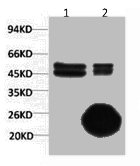
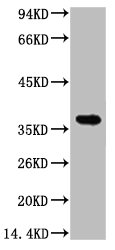
The antibody against CA9 was raised in mouse using the Synthetic Peptide as the immunogen. This antibody exists as a non-conjugated isotype IgG. This antibody has been validated on ELISA, WB, IP.

ADC-55699A

The antibody against CA9 was raised in mouse using the Synthetic Peptide as the immunogen. This antibody exists as a non-conjugated isotype IgG. This antibody has been validated on ELISA, WB, IP.

$167.00

Number
Order Exclusive Products Now

Request a Quote
High Purity LevelsPrecision and ReliabilityCustomization Options

Specifications


Cat.No ADC-55699A ClonalityMonoclonal
Host SpeciesMouseTarget NameCA9
FormLiquidSpecies ReactivityHuman
IsotypeIgGStorage BufferPH 7.4, containing 0.02% sodium azide as Preservative and 50% Glycerol., PBS
ConjugateNon-conjugatedApplicationELISA, WB, IP
StorageUpon receipt

Immunogen Information


Immunogen DescriptionSynthetic PeptideTarget SpeciesHuman
Immunogen SequenceComplete sequences for the immunogen, target protein, and peptides are available upon request.Uniprot IDQ16790
Background Information
  • Uniprot Id

    Q16790

  • Target Species

    Human

  • Target Name

    CA9

  • Target Full Name

    Carbonic anhydrase 9

  • Target Function

    Reversible hydration of carbon dioxide. Participates in pH regulation. May be involved in the control of cell proliferation and transformation. Appears to be a novel specific biomarker for a cervical neoplasia.

  • Target Subcellular Location

    Nucleus. Nucleus, nucleolus. Cell membrane; Single-pass type I membrane protein. Cell projection, microvillus membrane; Single-pass type I membrane protein. Note=Found on the surface microvilli and in the nucleus, particularly in nucleolus.

  • Target Protein Families

    Alpha-carbonic anhydrase family

  • Target Tissue Specificity

    Expressed primarily in carcinoma cells lines. Expression is restricted to very few normal tissues and the most abundant expression is found in the epithelial cells of gastric mucosa.

  • Target Research Area

    Metabolism

  • Target Synonyms

    CA-IX; CA9; CAH9_HUMAN; CAIX; Carbonate dehydratase IX; Carbonic anhydrase 9; Carbonic anhydrase IX; Carbonic dehydratase; G250; Membrane antigen MN; MN; P54/58N; pMW1; RCC associated protein G250; RCC-associated antigen G250; Renal cell carcinoma-associated antigen G250

  • Target Background

    Carbonic anhydrases (CAs) are a large family of zinc metalloenzymes that catalyze the reversible hydration of carbon dioxide. They participate in a variety of biological processes, including respiration, calcification, acid-base balance, bone resorption, and the formation of aqueous humor, cerebrospinal fluid, saliva, and gastric acid. They show extensive diversity in tissue distribution and in their subcellular localization. CA IX is a transmembrane protein and is one of only two tumor-associated carbonic anhydrase isoenzymes known. It is expressed in all clear-cell renal cell carcinoma, but is not detected in normal kidney or most other normal tissues. It may be involved in cell proliferation and transformation. This gene was mapped to 17q21.2 by fluorescence in situ hybridization, however, radiation hybrid mapping localized it to 9p13-p12.

Inquire Mouse anti-Human CA9 Monoclonal Antibody Now


AbTriva respects your privacy and protects your personal data in accordance with AbTriva. For more information, please see our data protection statement. *

Notification