-
Chinese (Simplified)
-
English
-
German
-
Korean
-
Spanish
Chinese (Simplified)
English
German
Korean
Spanish
Sign up for an account to enjoy easy online shopping and instant order tracking.
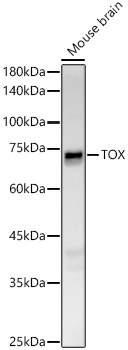
The antibody against TOX was raised in Rabbit using the recombinant fusion protein containing a sequence corresponding to amino acids 30-165 of human TOX (NP_055544.1) as the immunogen. The polyclonal antibody exists as a isotype IgG, by affinity purification. This antibody has been validated on WB, IHC-P, IF/ICC, ELISA.
| Cat.No | ADA-09388A | Clonality | Polyclonal |
|---|---|---|---|
| Host Species | Rabbit | Target Name | TOX |
| Target Synonyms | TOX1; TOX | Form | Liquid |
| Species Reactivity | Human, Mouse, Rat | Isotype | IgG |
| Storage Buffer | 50% Glycerol, PBS with 0.05% proclin300, pH7.3. | Purification Method | Affinity purification |
| Positive Samples | Mouse brain | Application | ELISA, WB, IF/ICC, IHC-P |
| Immunogen Description | Recombinant fusion protein containing a sequence corresponding to amino acids 30-165 of human TOX (NP_055544.1). | Target Species | Human |
|---|---|---|---|
| Immunogen Sequence | YYCNKFDGENMYMSMTEPSQDYVPASQSYPGPSLESEDFNIPPITPPSLPDHSLVHLNEVESGYHSLCHPMNHNGLLPFHPQNMDLPEITVSNMLGQDGTLLSNSISVMPDIRNPEGTQYSSHPQMAAMRPRGQPA | Uniprot ID | O94900 |
Uniprot Id
O94900
Target Species
Human
Target Name
TOX
Target Full Name
Thymocyte selection-associated high mobility group box protein TOX
Target Function
Transcriptional regulator with a major role in neural stem cell commitment and corticogenesis as well as in lymphoid cell development and lymphoid tissue organogenesis. Binds to GC-rich DNA sequences in the proximity of transcription start sites and may alter chromatin structure, modifying access of transcription factors to DNA. During cortical development, controls the neural stem cell pool by inhibiting the switch from proliferative to differentiating progenitors. Beyond progenitor cells, promotes neurite outgrowth in newborn neurons migrating to reach the cortical plate. May activate or repress critical genes for neural stem cell fate such as SOX2, EOMES and ROBO2. Plays an essential role in the development of lymphoid tissue-inducer (LTi) cells, a subset necessary for the formation of secondary lymphoid organs: peripheral lymph nodes and Peyer's patches. Acts as a developmental checkpoint and regulates thymocyte positive selection toward T cell lineage commitment. Required for the development of various T cell subsets, including CD4-positive helper T cells, CD8-positive cytotoxic T cells, regulatory T cells and CD1D-dependent natural killer T (NKT) cells. Required for the differentiation of common lymphoid progenitors (CMP) to innate lymphoid cells (ILC). May regulate the NOTCH-mediated gene program, promoting differentiation of the ILC lineage. Required at the progenitor phase of NK cell development in the bone marrow to specify NK cell lineage commitment. Upon chronic antigen stimulation, diverts T cell development by promoting the generation of exhaustive T cells, while suppressing effector and memory T cell programming. May regulate the expression of genes encoding inhibitory receptors such as PDCD1 and induce the exhaustion program, to prevent the overstimulation of T cells and activation-induced cell death.
Target Subcellular Location
Nucleus.
Target Tissue Specificity
Expressed in NK cells. Highly expressed in tumor-infiltrating CD8-positive T cells (at protein level).
Target Synonyms
KIAA0808; Thymocyte selection-associated high mobility group box; Thymocyte selection-associated high mobility group box protein TOX; Thymus high mobility group box protein TOX; Thymus high mobility group box protein, mouse, homolog of TOX1; TOX 1; Tox; TOX_HUMAN; TOX1
Target Background
The protein encoded by this gene contains a HMG box DNA binding domain. HMG boxes are found in many eukaryotic proteins involved in chromatin assembly, transcription and replication. This protein may function to regulate T-cell development.
Notification