• Contact info@abtriva.com for inquiries and orders.
  • Chinese (Simplified)

  • English

  • German

  • Korean

  • Spanish

United States (English / $ USD)

Rabbit anti-Human p63 Polyclonal Antibody

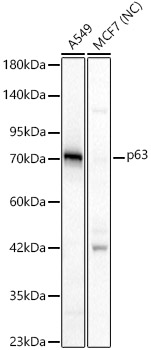
The antibody against p63 was raised in Rabbit using a synthetic peptide corresponding to a sequence within amino acids 166-362 of human p63 (NP_001108452.1) as the immunogen. The polyclonal antibody exists as a isotype IgG, by affinity purification. This antibody has been validated on WB, IHC-P, IF/ICC, ELISA.

ADA-11627A

The antibody against p63 was raised in Rabbit using a synthetic peptide corresponding to a sequence within amino acids 166-362 of human p63 (NP_001108452.1) as the immunogen. The polyclonal antibody exists as a isotype IgG, by affinity purification. This antibody has been validated on WB, IHC-P, IF/ICC, ELISA.

Number
Order Exclusive Products Now

Request a Quote
High Purity LevelsPrecision and ReliabilityCustomization Options

Specifications


Cat.No ADA-11627A ClonalityPolyclonal
Host SpeciesRabbitTarget Namep63
Target SynonymsAIS; KET; LMS; NBP; RHS; p40; p51; p63; EEC3; OFC8; p73H; p73L; SHFM4; TP53L; TP73L; p53CP; TP53CP; B(p51A); B(p51B)FormLiquid
Species ReactivityHuman, Mouse, RatIsotypeIgG
Storage Buffer50% Glycerol, PBS with 0.01% thimerosal, pH7.3.Purification MethodAffinity purification
Positive SamplesA-431, Mouse skin, Rat skinApplicationELISA, WB, IF/ICC, IHC-P

Immunogen Information


Immunogen DescriptionA synthetic peptide corresponding to a sequence within amino acids 166-362 of human p63 (NP_001108452.1).Target SpeciesHuman
Immunogen SequencePPSHLIRVEGNSHAQYVEDPITGRQSVLVPYEPPQVGTEFTTVLYNFMCNSSCVGGMNRRPILIIVTLETRDGQVLGRRCFEARICACPGRDRKADEDSIRKQQVSDSTKNGDGTKRPFRQNTHGIQMTSIKKRRSPDDELLYLPVRGRETYEMLLKIKESLELMQYLPQHTIETYRQQQQQQHQHLLQKQTSIQSPUniprot IDQ9H3D4
Background Information
  • Uniprot Id

    Q9H3D4

  • Target Species

    Human

  • Target Name

    TP63

  • Target Full Name

    Tumor protein 63

  • Target Function

    Acts as a sequence specific DNA binding transcriptional activator or repressor. The isoforms contain a varying set of transactivation and auto-regulating transactivation inhibiting domains thus showing an isoform specific activity. Isoform 2 activates RIPK4 transcription. May be required in conjunction with TP73/p73 for initiation of p53/TP53 dependent apoptosis in response to genotoxic insults and the presence of activated oncogenes. Involved in Notch signaling by probably inducing JAG1 and JAG2. Plays a role in the regulation of epithelial morphogenesis. The ratio of DeltaN-type and TA*-type isoforms may govern the maintenance of epithelial stem cell compartments and regulate the initiation of epithelial stratification from the undifferentiated embryonal ectoderm. Required for limb formation from the apical ectodermal ridge. Activates transcription of the p21 promoter.

  • Target Involvement

    Acro-dermato-ungual-lacrimal-tooth syndrome (ADULT syndrome); Ankyloblepharon-ectodermal defects-cleft lip/palate (AEC); Ectrodactyly, ectodermal dysplasia, and cleft lip/palate syndrome 3 (EEC3); Split-hand/foot malformation 4 (SHFM4); Limb-mammary syndrome (LMS); Ectodermal dysplasia, Rapp-Hodgkin type (EDRH); Non-syndromic orofacial cleft 8 (OFC8)

  • Target Subcellular Location

    Nucleus.

  • Target Protein Families

    P53 family

  • Target Tissue Specificity

    Widely expressed, notably in heart, kidney, placenta, prostate, skeletal muscle, testis and thymus, although the precise isoform varies according to tissue type. Progenitor cell layers of skin, breast, eye and prostate express high levels of DeltaN-type i

  • Target Research Area

    Apoptosis

  • Target Synonyms

    AIS; Amplified in squamous cell carcinoma ; B(p51A); B(p51B); Chronic ulcerative stomatitis protein; CUSP; DN p63 alpha 1; DNp63; EEC3; id:ibd3516; Keratinocyte transcription factor ; Keratinocyte transcription factor KET; KET; LMS; MGC115972; MGC192897; NBP; OFC8; OTTHUMP00000209732; OTTHUMP00000209733; OTTHUMP00000209734; OTTHUMP00000209735; OTTHUMP00000209737; OTTHUMP00000209738; OTTHUMP00000209739; OTTHUMP00000209740; OTTHUMP00000209741; OTTHUMP00000209742; OTTHUMP00000209743; OTTHUMP00000209744; p40; p51; P51/P63; p53-related protein p63; p53CP; p63; P63_HUMAN; p73H; p73L; RHS; SHFM4; TAp63alpha; TP53CP; TP53L; TP63; TP73L; Transformation related protein 63; Transformation-related protein 63; Trp53rp1; Trp63; Tumor protein 63; Tumor protein p53-competing protein ; Tumor protein p53-like ; Tumor protein p63; Tumor protein p63 deltaN isoform delta; Tumor protein p73; Tumor protein p73-like

  • Target Background

    This gene encodes a member of the p53 family of transcription factors. The functional domains of p53 family proteins include an N-terminal transactivation domain, a central DNA-binding domain and an oligomerization domain. Alternative splicing of this gene and the use of alternative promoters results in multiple transcript variants encoding different isoforms that vary in their functional properties. These isoforms function during skin development and maintenance, adult stem/progenitor cell regulation, heart development and premature aging. Some isoforms have been found to protect the germline by eliminating oocytes or testicular germ cells that have suffered DNA damage. Mutations in this gene are associated with ectodermal dysplasia, and cleft lip/palate syndrome 3 (EEC3); split-hand/foot malformation 4 (SHFM4); ankyloblepharon-ectodermal defects-cleft lip/palate; ADULT syndrome (acro-dermato-ungual-lacrimal-tooth); limb-mammary syndrome; Rap-Hodgkin syndrome (RHS); and orofacial cleft 8.

Inquire Rabbit anti-Human p63 Polyclonal Antibody Now


AbTriva respects your privacy and protects your personal data in accordance with AbTriva. For more information, please see our data protection statement. *

Notification