• Contact info@abtriva.com for inquiries and orders.
  • Chinese (Simplified)

  • English

  • German

  • Korean

  • Spanish

United States (English / $ USD)

Rabbit anti-Human ACD Polyclonal Antibody

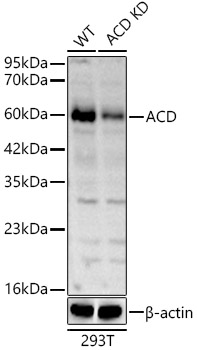
The antibody against ACD was raised in Rabbit using the recombinant fusion protein containing a sequence corresponding to amino acids 1-220 of human ACD (NP_001075955.1) as the immunogen. The polyclonal antibody exists as a isotype IgG, by affinity purification. This antibody has been validated on WB, ELISA.

ADA-02222A

The antibody against ACD was raised in Rabbit using the recombinant fusion protein containing a sequence corresponding to amino acids 1-220 of human ACD (NP_001075955.1) as the immunogen. The polyclonal antibody exists as a isotype IgG, by affinity purification. This antibody has been validated on WB, ELISA.

Number
Order Exclusive Products Now

Request a Quote
High Purity LevelsPrecision and ReliabilityCustomization Options

Specifications


Cat.No ADA-02222A ClonalityPolyclonal
Host SpeciesRabbitTarget NameACD
Target SynonymsPIP1; PTOP; TPP1; TINT1; ACDFormLiquid
Species ReactivityHumanIsotypeIgG
Storage Buffer50% Glycerol, PBS with 0.01% thimerosal, pH7.3.Purification MethodAffinity purification
Positive Samples293TApplicationELISA, WB

Immunogen Information


Immunogen DescriptionRecombinant fusion protein containing a sequence corresponding to amino acids 1-220 of human ACD (NP_001075955.1).Target SpeciesHuman
Uniprot IDQ96AP0Immunogen Sequence
Background Information
  • Uniprot Id

    Q96AP0

  • Target Species

    Human

  • Target Name

    ACD

  • Target Full Name

    Adrenocortical dysplasia protein homolog

  • Target Function

    Component of the shelterin complex (telosome) that is involved in the regulation of telomere length and protection. Shelterin associates with arrays of double-stranded TTAGGG repeats added by telomerase and protects chromosome ends. Without its protective activity, telomeres are no longer hidden from the DNA damage surveillance and chromosome ends are inappropriately processed by DNA repair pathways. Promotes binding of POT1 to single-stranded telomeric DNA. Modulates the inhibitory effects of POT1 on telomere elongation. The ACD-POT1 heterodimer enhances telomere elongation by recruiting telomerase to telomeres and increasing its processivity. May play a role in organogenesis.

  • Target Involvement

    Dyskeratosis congenita, autosomal dominant, 6 (DKCA6); Dyskeratosis congenita, autosomal recessive, 7 (DKCB7)

  • Target Subcellular Location

    Nucleus. Chromosome, telomere.

  • Target Synonyms

    Acd; ACD_HUMAN; Adrenocortical dysplasia homolog; Adrenocortical dysplasia protein homolog; PIP1; POT1 and TIN2 organizing protein; POT1 and TIN2-interacting protein; TIN2 interacting protein 1; TINT1; TPP1

  • Target Background

    This gene encodes a protein that is involved in telomere function. This protein is one of six core proteins in the telosome/shelterin telomeric complex, which functions to maintain telomere length and to protect telomere ends. Through its interaction with other components, this protein plays a key role in the assembly and stabilization of this complex, and it mediates the access of telomerase to the telomere. Multiple transcript variants encoding different isoforms have been found for this gene. This gene, which is also referred to as TPP1, is distinct from the unrelated TPP1 gene on chromosome 11, which encodes tripeptidyl-peptidase I.

Inquire Rabbit anti-Human ACD Polyclonal Antibody Now


AbTriva respects your privacy and protects your personal data in accordance with AbTriva. For more information, please see our data protection statement. *

Notification