• Contact info@abtriva.com for inquiries and orders.
  • Chinese (Simplified)

  • English

  • German

  • Korean

  • Spanish

United States (English / $ USD)

Rabbit anti-Human ALDH7A1 Polyclonal Antibody

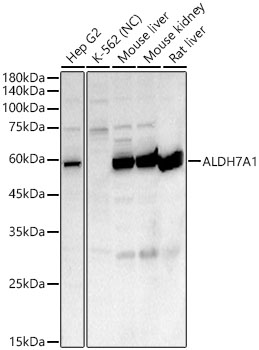
The antibody against ALDH7A1 was raised in Rabbit using the recombinant fusion protein containing a sequence corresponding to amino acids 430-539 of human ALDH7A1 (NP_001173.2) as the immunogen. The polyclonal antibody exists as a isotype IgG, by affinity purification. This antibody has been validated on WB, IHC-P, IF/ICC, ELISA.

ADA-08952A

The antibody against ALDH7A1 was raised in Rabbit using the recombinant fusion protein containing a sequence corresponding to amino acids 430-539 of human ALDH7A1 (NP_001173.2) as the immunogen. The polyclonal antibody exists as a isotype IgG, by affinity purification. This antibody has been validated on WB, IHC-P, IF/ICC, ELISA.

Number
Order Exclusive Products Now

Request a Quote
High Purity LevelsPrecision and ReliabilityCustomization Options

Specifications


Cat.No ADA-08952A ClonalityPolyclonal
Host SpeciesRabbitTarget NameALDH7A1
Target SynonymsEPD; PDE; ATQ1; ALDH7A1FormLiquid
Species ReactivityHuman, Mouse, RatIsotypeIgG
Storage Buffer50% Glycerol, PBS with 0.02% sodium azide, pH7.3.Purification MethodAffinity purification
Positive SamplesMouse kidney, Hep G2, Mouse liver, Rat liverApplicationELISA, WB, IF/ICC, IHC-P

Immunogen Information


Immunogen DescriptionRecombinant fusion protein containing a sequence corresponding to amino acids 430-539 of human ALDH7A1 (NP_001173.2).Target SpeciesHuman
Immunogen SequenceAPILYVFKFKNEEEVFAWNNEVKQGLSSSIFTKDLGRIFRWLGPKGSDCGIVNVNIPTSGAEIGGAFGGEKHTGGGRESGSDAWKQYMRRSTCTINYSKDLPLAQGIKFQUniprot IDP49419
Background Information
  • Uniprot Id

    P49419

  • Target Species

    Human

  • Target Name

    ALDH7A1

  • Target Full Name

    Alpha-aminoadipic semialdehyde dehydrogenase

  • Target Function

    Multifunctional enzyme mediating important protective effects. Metabolizes betaine aldehyde to betaine, an important cellular osmolyte and methyl donor. Protects cells from oxidative stress by metabolizing a number of lipid peroxidation-derived aldehydes. Involved in lysine catabolism.

  • Target Involvement

    Pyridoxine-dependent epilepsy (PDE)

  • Target Subcellular Location

    Cytoplasm, cytosol. Nucleus.; [Isoform 1]: Mitochondrion.

  • Target Protein Families

    Aldehyde dehydrogenase family

  • Target Tissue Specificity

    Abundant in hepatoma cells and fetal cochlea, ovary, eye, heart, adrenal gland, liver and kidney. Low levels present in adult peripheral blood leukocytes and fetal brain, thymus, spleen, skeletal muscle, lung and tongue.

  • Target Synonyms

    26g turgor protein homolog; AL7A1_HUMAN; Aldehyde dehydrogenase 7 A1; Aldehyde dehydrogenase 7 family, member A1; Aldehyde dehydrogenase family 7 member A1; ALDH7A1; Alpha AASA dehydrogenase; Alpha aminoadipic semialdehyde dehydrogenase; Alpha-AASA dehydrogenase; Alpha-aminoadipic semialdehyde dehydrogenase; Antiquitin 1; Antiquitin; Antiquitin-1; ATQ1; Betaine aldehyde dehydrogenase; Delta1 piperideine 6 carboxylate dehydrogenease; Delta1-piperideine-6-carboxylate dehydrogenase; EPD; P6c dehydrogenase; PDE

  • Target Background

    The protein encoded by this gene is a member of subfamily 7 in the aldehyde dehydrogenase gene family. These enzymes are thought to play a major role in the detoxification of aldehydes generated by alcohol metabolism and lipid peroxidation. This particular member has homology to a previously described protein from the green garden pea, the 26g pea turgor protein. It is also involved in lysine catabolism that is known to occur in the mitochondrial matrix. Recent reports show that this protein is found both in the cytosol and the mitochondria, and the two forms likely arise from the use of alternative translation initiation sites. An additional variant encoding a different isoform has also been found for this gene. Mutations in this gene are associated with pyridoxine-dependent epilepsy. Several related pseudogenes have also been identified.

Inquire Rabbit anti-Human ALDH7A1 Polyclonal Antibody Now


AbTriva respects your privacy and protects your personal data in accordance with AbTriva. For more information, please see our data protection statement. *

Notification