• Contact info@abtriva.com for inquiries and orders.
  • Chinese (Simplified)

  • English

  • German

  • Korean

  • Spanish

United States (English / $ USD)

Rabbit anti-Human CA125 Polyclonal Antibody

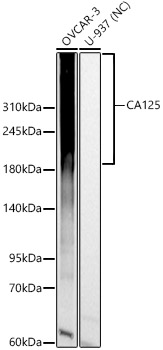
The antibody against CA125 was raised in Rabbit using the recombinant fusion protein containing a sequence corresponding to amino acids 12660-12923 of human CA125 (NP_078966.2) as the immunogen. The polyclonal antibody exists as a isotype IgG, by affinity purification. This antibody has been validated on WB, ELISA.

ADA-08249A

The antibody against CA125 was raised in Rabbit using the recombinant fusion protein containing a sequence corresponding to amino acids 12660-12923 of human CA125 (NP_078966.2) as the immunogen. The polyclonal antibody exists as a isotype IgG, by affinity purification. This antibody has been validated on WB, ELISA.

Number
Order Exclusive Products Now

Request a Quote
High Purity LevelsPrecision and ReliabilityCustomization Options

Specifications


Cat.No ADA-08249A ClonalityPolyclonal
Host SpeciesRabbitTarget NameCA125
Target SynonymsMUC16; CA125; mucin-16FormLiquid
Species ReactivityHumanIsotypeIgG
Storage Buffer50% Glycerol, PBS with 0.05% proclin300, pH7.3.Purification MethodAffinity purification
Positive SamplesOVCAR-3ApplicationELISA, WB

Immunogen Information


Immunogen DescriptionRecombinant fusion protein containing a sequence corresponding to amino acids 12660-12923 of human CA125 (NP_078966.2).Target SpeciesHuman
Uniprot IDQ8WXI7Immunogen Sequence
Background Information
  • Uniprot Id

    Q8WXI7

  • Target Species

    Human

  • Target Name

    MUC16

  • Target Full Name

    Mucin-16

  • Target Function

    Thought to provide a protective, lubricating barrier against particles and infectious agents at mucosal surfaces.

  • Target Subcellular Location

    Cell membrane; Single-pass type I membrane protein. Secreted, extracellular space. Note=May be liberated into the extracellular space following the phosphorylation of the intracellular C-terminus which induces the proteolytic cleavage and liberation of the extracellular domain.

  • Target Tissue Specificity

    Expressed in corneal and conjunctival epithelia (at protein level). Overexpressed in ovarian carcinomas and ovarian low malignant potential (LMP) tumors as compared to the expression in normal ovarian tissue and ovarian adenomas.

  • Target Research Area

    Cancer

  • Target Synonyms

    Ovarian cancer-related tumor marker CA125 (CA-125) (Ovarian carcinoma antigen CA125)

  • Target Background

    This gene encodes a protein that is a member of the mucin family. Mucins are high molecular weight, O-glycosylated proteins that play an important role in forming a protective mucous barrier, and are found on the apical surfaces of the epithelia. The encoded protein is a membrane-tethered mucin that contains an extracellular domain at its amino terminus, a large tandem repeat domain, and a transmembrane domain with a short cytoplasmic domain. The amino terminus is highly glycosylated, while the repeat region contains 156 amino acid repeats unit that are rich in serines, threonines, and prolines. Interspersed within the repeats are Sea urchin sperm protein Enterokinase and Agrin (SEA) modules, leucine-rich repeats and ankyrin (ANK) repeats. These regions together form the ectodomain, and there is a potential cleavage site found near an SEA module close to the transmembrane domain. This protein is thought to play a role in forming a barrier, protecting epithelial cells from pathogens. Products of this gene have been used as a marker for different cancers, with higher expression levels associated with poorer outcomes.

Inquire Rabbit anti-Human CA125 Polyclonal Antibody Now


AbTriva respects your privacy and protects your personal data in accordance with AbTriva. For more information, please see our data protection statement. *

Notification