-
Chinese (Simplified)
-
English
-
German
-
Korean
-
Spanish
Chinese (Simplified)
English
German
Korean
Spanish
Sign up for an account to enjoy easy online shopping and instant order tracking.
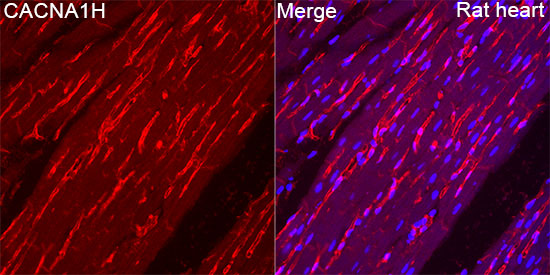
The antibody against CACNA1H was raised in Rabbit using a synthetic peptide corresponding to a sequence within amino acids 2250-2353 of human CACNA1H (NP_066921.2?) as the immunogen. The polyclonal antibody exists as a isotype IgG, by affinity purification. This antibody has been validated on IF/ICC, ELISA.
| Cat.No | ADA-08463A | Clonality | Polyclonal |
|---|---|---|---|
| Host Species | Rabbit | Target Name | CACNA1H |
| Target Synonyms | ECA6; EIG6; HALD4; Cav3.2; CACNA1HB; CACNA1H | Form | Liquid |
| Species Reactivity | Rat | Isotype | IgG |
| Storage Buffer | 50% Glycerol, PBS with 0.05% proclin300, pH7.3. | Purification Method | Affinity purification |
| Application | ELISA, IF/ICC |
| Immunogen Description | A synthetic peptide corresponding to a sequence within amino acids 2250-2353 of human CACNA1H (NP_066921.2?). | Target Species | Human |
|---|---|---|---|
| Immunogen Sequence | RWGQASCRAEHLTVPSFAFEPLDLGVPSGDPFLDGSHSVTPESRASSSGAIVPLEPPESEPPMPVGDPPEKRRGLYLTVPQCPLEKPGSPSATPAPGGGADDPV | Uniprot ID | O95180 |
Uniprot Id
O95180
Target Species
Human
Target Name
CACNA1H
Target Full Name
Voltage-dependent T-type calcium channel subunit alpha-1H
Target Function
Voltage-sensitive calcium channel that gives rise to T-type calcium currents. T-type calcium channels belong to the 'low-voltage activated (LVA)' group. A particularity of this type of channel is an opening at quite negative potentials, and a voltage-dependent inactivation. T-type channels serve pacemaking functions in both central neurons and cardiac nodal cells and support calcium signaling in secretory cells and vascular smooth muscle. They may also be involved in the modulation of firing patterns of neurons. In the adrenal zona glomerulosa, participates in the signaling pathway leading to aldosterone production in response to either AGT/angiotensin II, or hyperkalemia.
Target Involvement
Epilepsy, idiopathic generalized 6 (EIG6); Epilepsy, childhood absence 6 (ECA6); Hyperaldosteronism, familial, 4 (HALD4)
Target Subcellular Location
Cell membrane; Multi-pass membrane protein.
Target Protein Families
Calcium channel alpha-1 subunit (TC 1.A.1.11) family, CACNA1H subfamily
Target Tissue Specificity
Expressed in the adrenal glomerulosa (at protein level). In nonneuronal tissues, the highest expression levels are found in the kidney, liver, and heart. In the brain, most abundant in the amygdala, caudate nucleus, and putamen. In the heart, expressed in
Target Synonyms
Alpha1 3.2; Alpha13.2; CAC1H_HUMAN; CACNA 1H; CACNA1 H; CACNA1 HB; Cacna1h; CACNA1HB; Calcium channel alpha13.2 subunit; Calcium channel voltage dependent T type alpha 1H subunit; Calcium channel; voltage-dependent; T type; alpha 1Hb subunit; Cav 3.2; Cav T.2; Cav3.2; CavT.2; EIG 6; EIG6; Low voltage activated calcium channel alpha 13.2 subunit; Low voltage activated calcium channel alpha1 3.2 subunit; Low-voltage-activated calcium channel alpha1 3.2 subunit; MNCb 1209; T type Cav3.2; Voltage dependent t type calcium channel alpha 1H subunit; Voltage gated calcium channel alpha subunit Cav 3.2; Voltage gated calcium channel alpha subunit Cav T.2; Voltage gated calcium channel alpha subunit Cav3.2; Voltage gated calcium channel alpha subunit CavT.2; Voltage-dependent T-type calcium channel subunit alpha-1H; Voltage-gated calcium channel subunit alpha Cav3.2
Target Background
This gene encodes a T-type member of the alpha-1 subunit family, a protein in the voltage-dependent calcium channel complex. Calcium channels mediate the influx of calcium ions into the cell upon membrane polarization and consist of a complex of alpha-1, alpha-2/delta, beta, and gamma subunits in a 1:1:1:1 ratio. The alpha-1 subunit has 24 transmembrane segments and forms the pore through which ions pass into the cell. There are multiple isoforms of each of the proteins in the complex, either encoded by different genes or the result of alternative splicing of transcripts. Alternate transcriptional splice variants, encoding different isoforms, have been characterized for the gene described here. Studies suggest certain mutations in this gene lead to childhood absence epilepsy (CAE).
Notification