-
Chinese (Simplified)
-
English
-
German
-
Korean
-
Spanish
Chinese (Simplified)
English
German
Korean
Spanish
Sign up for an account to enjoy easy online shopping and instant order tracking.
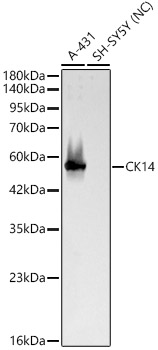
The antibody against CK14 was raised in Rabbit using a synthetic peptide corresponding to a sequence within amino acids 372-472 of human CK14 (NP_000517.3) as the immunogen. The polyclonal antibody exists as a isotype IgG, by affinity purification. This antibody has been validated on WB, ELISA.
| Cat.No | ADA-08236A | Clonality | Polyclonal |
|---|---|---|---|
| Host Species | Rabbit | Target Name | CK14 |
| Target Synonyms | KRT14; CK14; EBS3; EBS4; K14; NFJ; keratin 14 | Form | Liquid |
| Species Reactivity | Human | Isotype | IgG |
| Storage Buffer | 50% Glycerol, PBS with 0.05% proclin300, pH7.3. | Purification Method | Affinity purification |
| Positive Samples | A431 | Application | ELISA, WB |
| Immunogen Description | A synthetic peptide corresponding to a sequence within amino acids 372-472 of human CK14 (NP_000517.3). | Target Species | Human |
|---|---|---|---|
| Immunogen Sequence | QIQEMIGSVEEQLAQLRCEMEQQNQEYKILLDVKTRLEQEIATYRRLLEGEDAHLSSSQFSSGSQSSRDVTSSSRQIRTKVMDVHDGKVVSTHEQVLRTKN | Uniprot ID | P02533 |
Uniprot Id
P02533
Target Species
Human
Target Name
KRT14
Target Full Name
Keratin, type I cytoskeletal 14
Target Function
The nonhelical tail domain is involved in promoting KRT5-KRT14 filaments to self-organize into large bundles and enhances the mechanical properties involved in resilience of keratin intermediate filaments in vitro.
Target Involvement
Epidermolysis bullosa simplex, Dowling-Meara type (DM-EBS); Epidermolysis bullosa simplex, Weber-Cockayne type (WC-EBS); Epidermolysis bullosa simplex, Koebner type (K-EBS); Epidermolysis bullosa simplex, autosomal recessive 1 (EBSB1); Naegeli-Franceschetti-Jadassohn syndrome (NFJS); Dermatopathia pigmentosa reticularis (DPR)
Target Subcellular Location
Cytoplasm. Nucleus. Note=Expressed in both as a filamentous pattern.
Target Protein Families
Intermediate filament family
Target Tissue Specificity
Expressed in the corneal epithelium (at protein level). Detected in the basal layer, lowered within the more apically located layers specifically in the stratum spinosum, stratum granulosum but is not detected in stratum corneum. Strongly expressed in the
Target Research Area
Signal Transduction
Target Synonyms
CK 14; CK-14; ck14; Cytokeratin 14; Cytokeratin-14; Cytokeratin14; Dowling Meara; EBS3; EBS4; Epidermolysis bullosa simplex; K14; K1C14_HUMAN; Keratin 14 (epidermolysis bullosa simplex, Dowling-Meara, Koebner); Keratin 14; Keratin; Keratin type I cytoskeletal 14; Keratin, type I cytoskeletal 14; Keratin-14; Keratin14; Koebner; Krt 14; Krt14; NFJ; OTTHUMP00000164624; type I cytoskeletal 14
Target Background
This gene encodes a member of the keratin family, the most diverse group of intermediate filaments. This gene product, a type I keratin, is usually found as a heterotetramer with two keratin 5 molecules, a type II keratin. Together they form the cytoskeleton of epithelial cells. Mutations in the genes for these keratins are associated with epidermolysis bullosa simplex. At least one pseudogene has been identified at 17p12-p11.
Notification