• Contact info@abtriva.com for inquiries and orders.
  • Chinese (Simplified)

  • English

  • German

  • Korean

  • Spanish

United States (English / $ USD)

Rabbit anti-Human KANK1 Polyclonal Antibody

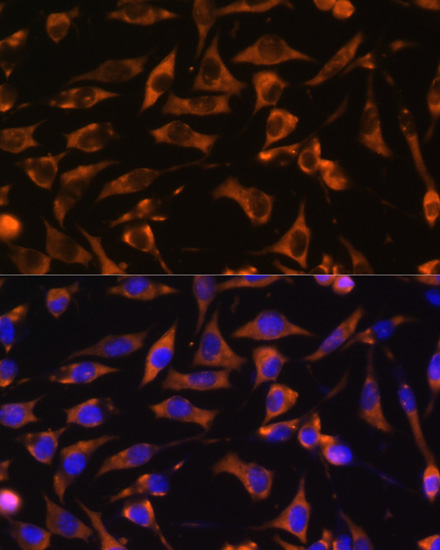
The antibody against KANK1 was raised in Rabbit using a synthetic peptide corresponding to a sequence within amino acids 900-1000 of human KANK1 (NP_055973.2) as the immunogen. The polyclonal antibody exists as a isotype IgG, by affinity purification. This antibody has been validated on IF/ICC, ELISA.

ADA-05815A

The antibody against KANK1 was raised in Rabbit using a synthetic peptide corresponding to a sequence within amino acids 900-1000 of human KANK1 (NP_055973.2) as the immunogen. The polyclonal antibody exists as a isotype IgG, by affinity purification. This antibody has been validated on IF/ICC, ELISA.

Number
Order Exclusive Products Now

Request a Quote
High Purity LevelsPrecision and ReliabilityCustomization Options

Specifications


Cat.No ADA-05815A ClonalityPolyclonal
Host SpeciesRabbitTarget NameKANK1
Target SynonymsKANK; CPSQ2; ANKRD15; KANK1FormLiquid
Species ReactivityMouseIsotypeIgG
Storage Buffer50% Glycerol, PBS with 0.01% thimerosal, pH7.3.Purification MethodAffinity purification
ApplicationELISA, IF/ICC

Immunogen Information


Immunogen DescriptionA synthetic peptide corresponding to a sequence within amino acids 900-1000 of human KANK1 (NP_055973.2).Target SpeciesHuman
Immunogen SequenceGNYLGYTCKCGGLQSGSPLSSQTSQPEQEVGTSEGKPISSLDAFPTQEGTLSPVNLTDDQIAAGLYACTNNESTLKSIMKKKDGNKDSNGAKKNLQFVGINUniprot IDQ14678
Background Information
  • Uniprot Id

    Q14678

  • Target Species

    Human

  • Target Name

    KANK1

  • Target Full Name

    KN motif and ankyrin repeat domain-containing protein 1

  • Target Function

    Involved in the control of cytoskeleton formation by regulating actin polymerization. Inhibits actin fiber formation and cell migration. Inhibits RhoA activity; the function involves phosphorylation through PI3K/Akt signaling and may depend on the competetive interaction with 14-3-3 adapter proteins to sequester them from active complexes. Inhibits the formation of lamellipodia but not of filopodia; the function may depend on the competetive interaction with BAIAP2 to block its association with activated RAC1. Inhibits fibronectin-mediated cell spreading; the function is partially mediated by BAIAP2. Inhibits neurite outgrowth. Involved in the establishment and persistence of cell polarity during directed cell movement in wound healing. In the nucleus, is involved in beta-catenin-dependent activation of transcription. Potential tumor suppressor for renal cell carcinoma. Regulates Rac signaling pathways.

  • Target Involvement

    Cerebral palsy, spastic quadriplegic 2 (CPSQ2)

  • Target Subcellular Location

    Cell projection, ruffle membrane. Cytoplasm. Nucleus.; [Isoform 1]: Cytoplasm. Nucleus.; [Isoform 2]: Cytoplasm. Nucleus.

  • Target Tissue Specificity

    Widely expressed. Isoform 1 is predominantly expressed in heart and kidney. Isoform 2 probably is widely expressed at basic levels.

  • Target Synonyms

    ANKRD 15; Ankyrin repeat domain 15; Ankyrin repeat domain containing protein 15; Ankyrin repeat domain-containing protein 15; DKFZp451G231; KANK; KANK1; KANK1_HUMAN; KIAA0172; Kidney ankyrin repeat containing protein; Kidney ankyrin repeat-containing protein; KN motif and ankyrin repeat domain-containing protein 1; MGC43128

  • Target Background

    The protein encoded by this gene belongs to the Kank family of proteins, which contain multiple ankyrin repeat domains. This family member functions in cytoskeleton formation by regulating actin polymerization. This gene is a candidate tumor suppressor for renal cell carcinoma. Mutations in this gene cause cerebral palsy spastic quadriplegic type 2, a central nervous system development disorder. A t(5;9) translocation results in fusion of the platelet-derived growth factor receptor beta gene (PDGFRB) on chromosome 5 with this gene in a myeloproliferative neoplasm featuring severe thrombocythemia. Alternative splicing of this gene results in multiple transcript variants. A related pseudogene has been identified on chromosome 20.

Inquire Rabbit anti-Human KANK1 Polyclonal Antibody Now


AbTriva respects your privacy and protects your personal data in accordance with AbTriva. For more information, please see our data protection statement. *

Notification