-
Chinese (Simplified)
-
English
-
German
-
Korean
-
Spanish
Chinese (Simplified)
English
German
Korean
Spanish
Sign up for an account to enjoy easy online shopping and instant order tracking.
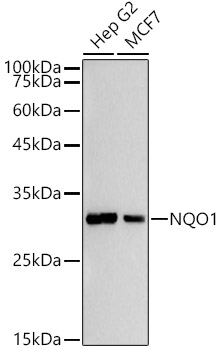
The antibody against NQO1 was raised in Rabbit using the recombinant fusion protein containing a sequence corresponding to amino acids 1-274 of human NQO1 (NP_000894.1) as the immunogen. The polyclonal antibody exists as a isotype IgG, by affinity purification. This antibody has been validated on WB, IHC-P, ELISA.
| Cat.No | ADA-07944A | Clonality | Polyclonal |
|---|---|---|---|
| Host Species | Rabbit | Target Name | NQO1 |
| Target Synonyms | DTD; QR1; DHQU; DIA4; NMOR1; NMORI; NQO1 | Form | Liquid |
| Species Reactivity | Human | Isotype | IgG |
| Storage Buffer | 50% Glycerol, PBS with 0.05% proclin300, pH7.3. | Purification Method | Affinity purification |
| Positive Samples | Hep G2, MCF7 | Application | ELISA, WB, IHC-P |
| Immunogen Description | Recombinant fusion protein containing a sequence corresponding to amino acids 1-274 of human NQO1 (NP_000894.1). | Target Species | Human |
|---|---|---|---|
| Uniprot ID | P15559 | Immunogen Sequence |
Uniprot Id
P15559
Target Species
Human
Target Name
NQO1
Target Full Name
NAD(P)H dehydrogenase [quinone] 1
Target Function
The enzyme apparently serves as a quinone reductase in connection with conjugation reactions of hydroquinons involved in detoxification pathways as well as in biosynthetic processes such as the vitamin K-dependent gamma-carboxylation of glutamate residues in prothrombin synthesis.
Target Subcellular Location
Cytoplasm.
Target Protein Families
NAD(P)H dehydrogenase (quinone) family
Target Synonyms
Azoreductase; Cytochrome b 5 reductase; DHQU; DIA 4; DIA4; Diaphorase (NADH/NADPH) (cytochrome b 5 reductase); Diaphorase (NADH/NADPH); Diaphorase 4; Dioxin inducible 1; DT diaphorase; DT-diaphorase; DTD; Menadione reductase; NAD(P)H dehydrogenase [quinone] 1; NAD(P)H dehydrogenase quinone 1; NAD(P)H menadione oxidoreductase 1 dioxin inducible; NAD(P)H quinone dehydrogenase 1; NAD(P)H: menadione oxidoreductase 1 dioxin inducible 1; NAD(P)H:menadione oxidoreductase 1; NAD(P)H:Quinone acceptor oxidoreductase type 1; NAD(P)H:quinone oxidoreductase 1; NAD(P)H:quinone oxireductase; NMOR 1; NMOR I; NMOR1; NMORI; NQO 1; NQO1; NQO1_HUMAN; Phylloquinone reductase; QR 1; QR1; Quinone reductase 1
Target Background
This gene is a member of the NAD(P)H dehydrogenase (quinone) family and encodes a cytoplasmic 2-electron reductase. This FAD-binding protein forms homodimers and reduces quinones to hydroquinones. This protein's enzymatic activity prevents the one electron reduction of quinones that results in the production of radical species. Mutations in this gene have been associated with tardive dyskinesia (TD), an increased risk of hematotoxicity after exposure to benzene, and susceptibility to various forms of cancer. Altered expression of this protein has been seen in many tumors and is also associated with Alzheimer's disease (AD). Alternate transcriptional splice variants, encoding different isoforms, have been characterized.
Notification