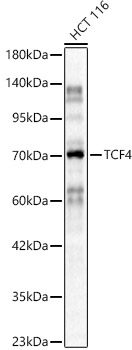
-
Chinese (Simplified)
-
English
-
German
-
Korean
-
Spanish
Chinese (Simplified)
English
German
Korean
Spanish
Sign up for an account to enjoy easy online shopping and instant order tracking.
The antibody against TCF4 was raised in Rabbit using the recombinant fusion protein containing a sequence corresponding to amino acids 1-210 of human TCF4 (NP_003190.1) as the immunogen. The polyclonal antibody exists as a isotype IgG, by affinity purification. This antibody has been validated on WB, IHC-P, IF/ICC, ELISA.
| Cat.No | ADA-09822A | Clonality | Polyclonal |
|---|---|---|---|
| Host Species | Rabbit | Target Name | TCF4 |
| Target Synonyms | E2-2; FCD2; ITF2; PTHS; SEF2; CDG2T; FECD3; ITF-2; SEF-2; TCF-4; SEF2-1; SEF2-1A; SEF2-1B; SEF2-1D; bHLHb19; TCF4 | Form | Liquid |
| Species Reactivity | Human, Mouse, Rat | Isotype | IgG |
| Storage Buffer | 50% Glycerol, PBS with 0.01% thimerosal, pH7.3. | Purification Method | Affinity purification |
| Positive Samples | HCT 116 | Application | ELISA, WB, IF/ICC, IHC-P |
| Immunogen Description | Recombinant fusion protein containing a sequence corresponding to amino acids 1-210 of human TCF4 (NP_003190.1). | Target Species | Human |
|---|---|---|---|
| Uniprot ID | P15884 | Immunogen Sequence |
Uniprot Id
P15884
Target Species
Human
Target Name
TCF4
Target Full Name
Transcription factor 4
Target Function
Transcription factor that binds to the immunoglobulin enhancer Mu-E5/KE5-motif. Involved in the initiation of neuronal differentiation. Activates transcription by binding to the E box (5'-CANNTG-3'). Binds to the E-box present in the somatostatin receptor 2 initiator element (SSTR2-INR) to activate transcription. Preferentially binds to either 5'-ACANNTGT-3' or 5'-CCANNTGG-3'.
Target Involvement
Pitt-Hopkins syndrome (PTHS); Corneal dystrophy, Fuchs endothelial, 3 (FECD3)
Target Subcellular Location
Nucleus.
Target Tissue Specificity
Expressed in adult heart, brain, placenta, skeletal muscle and to a lesser extent in the lung. In developing embryonic tissues, expression mostly occurs in the brain.
Target Synonyms
bHLHb19; Class B basic helix-loop-helix protein 19; E2 2; FECD3; Immunoglobulin transcription factor 2; ITF 2; ITF-2; ITF2; ITF2_HUMAN; MGC149723; MGC149724; PTHS; SEF 2; SEF-2; SEF2 1; SEF2 1A; SEF2 1B; SEF2 1D; SEF2; SL3 3 enhancer factor 2; SL3-3 enhancer factor 2; TCF 4; TCF-4; TCF4; Transcription factor 4; Transcription factor 4, isoform C; Transcription factor 4, isoform D; Transcription factor 4, isoform E; Transcription factor 4, isoform L; Transcription factor 4, isoform M; Transcription factor 4, isoform R
Target Background
This gene encodes transcription factor 4, a basic helix-loop-helix transcription factor. The encoded protein recognizes an Ephrussi-box ('E-box') binding site ('CANNTG') - a motif first identified in immunoglobulin enhancers. This gene is broadly expressed, and may play an important role in nervous system development. Defects in this gene are a cause of Pitt-Hopkins syndrome. In addition, an intronic CTG repeat normally numbering 10-37 repeat units can expand to >50 repeat units and cause Fuchs endothelial corneal dystrophy. Multiple alternatively spliced transcript variants that encode different proteins have been described.
Notification