-
Chinese (Simplified)
-
English
-
German
-
Korean
-
Spanish
Chinese (Simplified)
English
German
Korean
Spanish
Sign up for an account to enjoy easy online shopping and instant order tracking.
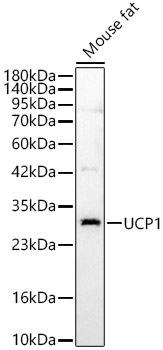
The antibody against UCP1 was raised in Rabbit using a synthetic peptide corresponding to a sequence within amino acids 100-200 of human UCP1 (NP_068605.1) as the immunogen. The polyclonal antibody exists as a isotype IgG, by affinity purification. This antibody has been validated on WB, IHC-P, ELISA.
| Cat.No | ADA-02612A | Clonality | Polyclonal |
|---|---|---|---|
| Host Species | Rabbit | Target Name | UCP1 |
| Target Synonyms | UCP; SLC25A7; UCP1 | Form | Liquid |
| Species Reactivity | Human, Mouse, Rat | Isotype | IgG |
| Storage Buffer | 50% Glycerol, PBS with 0.01% thimerosal, pH7.3. | Purification Method | Affinity purification |
| Positive Samples | Mouse fat | Application | ELISA, WB, IHC-P |
| Immunogen Description | A synthetic peptide corresponding to a sequence within amino acids 100-200 of human UCP1 (NP_068605.1). | Target Species | Human |
|---|---|---|---|
| Immunogen Sequence | QEFLTAGKETAPSLGSKILAGLTTGGVAVFIGQPTEVVKVRLQAQSHLHGIKPRYTGTYNAYRIIATTEGLTGLWKGTTPNLMRSVIINCTELVTYDLMKE | Uniprot ID | P25874 |
Uniprot Id
P25874
Target Species
Human
Target Name
UCP1
Target Full Name
Mitochondrial brown fat uncoupling protein 1
Target Function
Mitochondrial protein responsible for thermogenic respiration, a specialized capacity of brown adipose tissue and beige fat that participates in non-shivering adaptive thermogenesis to temperature and diet variations and more generally to the regulation of energy balance. Functions as a long-chain fatty acid/LCFA and proton symporter, simultaneously transporting one LCFA and one proton through the inner mitochondrial membrane. However, LCFAs remaining associated with the transporter via their hydrophobic tails, it results in an apparent transport of protons activated by LCFAs. Thereby, dissipates the mitochondrial proton gradient and converts the energy of substrate oxydation into heat instead of ATP. Regulates the production of reactive oxygen species/ROS by mitochondria.
Target Subcellular Location
Mitochondrion inner membrane; Multi-pass membrane protein.
Target Protein Families
Mitochondrial carrier (TC 2.A.29) family
Target Tissue Specificity
Brown adipose tissue.
Target Research Area
Transport
Target Synonyms
mitochondrial brown fat uncoupling protein; Mitochondrial brown fat uncoupling protein 1; SLC25A7; Solute carrier family 25 member 7; Thermogenin; UCP 1; UCP; UCP1; UCP1_HUMAN; uncoupling protein 1 (mitochondrial, proton carrier); Uncoupling protein 1
Target Background
Mitochondrial uncoupling proteins (UCP) are members of the family of mitochondrial anion carrier proteins (MACP). UCPs separate oxidative phosphorylation from ATP synthesis with energy dissipated as heat, also referred to as the mitochondrial proton leak. UCPs facilitate the transfer of anions from the inner to the outer mitochondrial membrane and the return transfer of protons from the outer to the inner mitochondrial membrane. They also reduce the mitochondrial membrane potential in mammalian cells. Tissue specificity occurs for the different UCPs and the exact methods of how UCPs transfer H+/OH- are not known. UCPs contain the three homologous protein domains of MACPs. This gene is expressed only in brown adipose tissue, a specialized tissue which functions to produce heat.
Notification