• Contact info@abtriva.com for inquiries and orders.
  • Chinese (Simplified)

  • English

  • German

  • Korean

  • Spanish

United States (English / $ USD)

Rabbit anti-Human K63-linkage Specific Ubiquitin Monoclonal Antibody

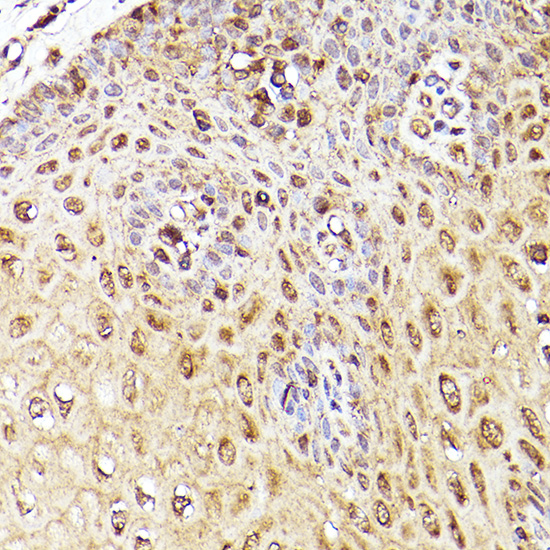
The antibody against K63-linkage Specific Ubiquitin was raised in Rabbit using a synthetic peptide corresponding to a sequence within amino acids 206-225 of human K63-linkage Specific Ubiquitin (NP_001268645.1) as the immunogen. The monoclonal antibody exists as a isotype IgG, by affinity purification. This antibody has been validated on IHC-P, IF/ICC, ELISA.

ADA-14481A

The antibody against K63-linkage Specific Ubiquitin was raised in Rabbit using a synthetic peptide corresponding to a sequence within amino acids 206-225 of human K63-linkage Specific Ubiquitin (NP_001268645.1) as the immunogen. The monoclonal antibody exists as a isotype IgG, by affinity purification. This antibody has been validated on IHC-P, IF/ICC, ELISA.

Number
Order Exclusive Products Now

Request a Quote
High Purity LevelsPrecision and ReliabilityCustomization Options

Specifications


Cat.No ADA-14481A ClonalityMonoclonal
Host SpeciesRabbitTarget NameK63-linkage Specific Ubiquitin
Target SynonymsHEL-S-50; K63-linkage Specific UbiquitinFormLiquid
Species ReactivityHuman, Mouse, RatIsotypeIgG
Storage Buffer50% Glycerol, 0.05% BSA, PBS with 0.02% sodium azide, pH7.3.Purification MethodAffinity purification
ApplicationELISA, IF/ICC, IHC-P

Immunogen Information


Immunogen DescriptionA synthetic peptide corresponding to a sequence within amino acids 206-225 of human K63-linkage Specific Ubiquitin (NP_001268645.1).Target SpeciesHuman
Immunogen SequenceRTLSDYNIQKESTLHLVLRLUniprot IDP0CG47
Background Information
  • Uniprot Id

    P0CG47

  • Target Species

    Human

  • Target Name

    UBB

  • Target Full Name

    Polyubiquitin-B

  • Target Function

    Exists either covalently attached to another protein, or free (unanchored). When covalently bound, it is conjugated to target proteins via an isopeptide bond either as a monomer (monoubiquitin), a polymer linked via different Lys residues of the ubiquitin (polyubiquitin chains) or a linear polymer linked via the initiator Met of the ubiquitin (linear polyubiquitin chains). Polyubiquitin chains, when attached to a target protein, have different functions depending on the Lys residue of the ubiquitin that is linked: Lys-6-linked may be involved in DNA repair; Lys-11-linked is involved in ERAD (endoplasmic reticulum-associated degradation) and in cell-cycle regulation; Lys-29-linked is involved in lysosomal degradation; Lys-33-linked is involved in kinase modification; Lys-48-linked is involved in protein degradation via the proteasome; Lys-63-linked is involved in endocytosis, DNA-damage responses as well as in signaling processes leading to activation of the transcription factor NF-kappa-B. Linear polymer chains formed via attachment by the initiator Met lead to cell signaling. Ubiquitin is usually conjugated to Lys residues of target proteins, however, in rare cases, conjugation to Cys or Ser residues has been observed. When polyubiquitin is free (unanchored-polyubiquitin), it also has distinct roles, such as in activation of protein kinases, and in signaling.

  • Target Subcellular Location

    [Ubiquitin]: Cytoplasm. Nucleus.

  • Target Protein Families

    Ubiquitin family

  • Target Synonyms

    UBB; UBB_HUMAN; Ubiquitin

  • Target Background

    This gene encodes ubiquitin, one of the most conserved proteins known. Ubiquitin has a major role in targeting cellular proteins for degradation by the 26S proteosome. It is also involved in the maintenance of chromatin structure, the regulation of gene expression, and the stress response. Ubiquitin is synthesized as a precursor protein consisting of either polyubiquitin chains or a single ubiquitin moiety fused to an unrelated protein. This gene consists of three direct repeats of the ubiquitin coding sequence with no spacer sequence. Consequently, the protein is expressed as a polyubiquitin precursor with a final amino acid after the last repeat. An aberrant form of this protein has been detected in patients with Alzheimer's disease and Down syndrome. Pseudogenes of this gene are located on chromosomes 1, 2, 13, and 17. Alternative splicing results in multiple transcript variants.

Inquire Rabbit anti-Human K63-linkage Specific Ubiquitin Monoclonal Antibody Now


ADV Biomart respects your privacy and protects your personal data in accordance with ADV Biomart. For more information, please see our data protection statement. *

Notification