-
Chinese (Simplified)
-
English
-
German
-
Korean
-
Spanish
Chinese (Simplified)
English
German
Korean
Spanish
Sign up for an account to enjoy easy online shopping and instant order tracking.
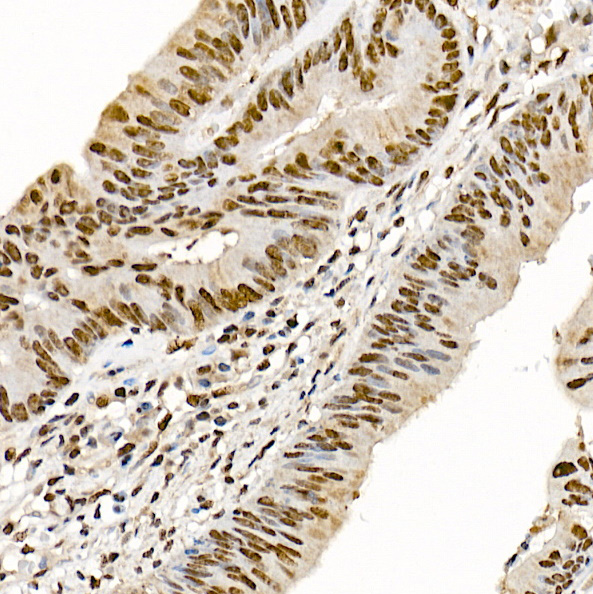
The antibody against SETMAR was raised in Rabbit using the recombinant fusion protein containing a sequence corresponding to amino acids 20-300 of human SETMAR (NP_006506.3) as the immunogen. The polyclonal antibody exists as a isotype IgG, by affinity purification. This antibody has been validated on IHC-P, ELISA.
| Cat.No | ADA-02864A | Clonality | Polyclonal |
|---|---|---|---|
| Host Species | Rabbit | Target Name | SETMAR |
| Target Synonyms | Mar1; METNASE; SETMAR | Form | Liquid |
| Species Reactivity | Human | Isotype | IgG |
| Storage Buffer | 50% Glycerol, PBS with 0.02% sodium azide, pH7.3. | Purification Method | Affinity purification |
| Application | ELISA, IHC-P |
| Immunogen Description | Recombinant fusion protein containing a sequence corresponding to amino acids 20-300 of human SETMAR (NP_006506.3). | Target Species | Human |
|---|---|---|---|
| Uniprot ID | Q53H47 | Immunogen Sequence |
Uniprot Id
Q53H47
Target Species
Human
Target Name
SETMAR
Target Full Name
Histone-lysine N-methyltransferase SETMAR
Target Function
Protein derived from the fusion of a methylase with the transposase of an Hsmar1 transposon that plays a role in DNA double-strand break repair, stalled replication fork restart and DNA integration. DNA-binding protein, it is indirectly recruited to sites of DNA damage through protein-protein interactions. Has also kept a sequence-specific DNA-binding activity recognizing the 19-mer core of the 5'-terminal inverted repeats (TIRs) of the Hsmar1 element and displays a DNA nicking and end joining activity. In parallel, has a histone methyltransferase activity and methylates 'Lys-4' and 'Lys-36' of histone H3. Specifically mediates dimethylation of H3 'Lys-36' at sites of DNA double-strand break and may recruit proteins required for efficient DSB repair through non-homologous end-joining. Also regulates replication fork processing, promoting replication fork restart and regulating DNA decatenation through stimulation of the topoisomerase activity of TOP2A.
Target Subcellular Location
Nucleus. Chromosome.
Target Protein Families
Class V-like SAM-binding methyltransferase superfamily; Mariner transposase family
Target Tissue Specificity
Widely expressed, with highest expression in placenta and ovary and lowest expression in skeletal muscle.
Target Synonyms
Histone lysine N methyltransferase; Histone lysine N methyltransferase SETMAR; Hsmar 1; Hsmar1; Mariner transposase Hsmar1; Metnase; SET domain and mariner transposase fusion; SET domain and mariner transposase fusion gene; SET domain and mariner transposase fusion gene containing protein; SET domain and mariner transposase fusion gene-containing protein; Setmar; SETMR_HUMAN
Target Background
This gene encodes a fusion protein that contains an N-terminal histone-lysine N-methyltransferase domain and a C-terminal mariner transposase domain. The encoded protein binds DNA and functions in DNA repair activities including non-homologous end joining and double strand break repair. The SET domain portion of this protein specifically methylates histone H3 lysines 4 and 36. This gene exists as a fusion gene only in anthropoid primates, other organisms lack mariner transposase domain. Alternate splicing results in multiple transcript variants.
Notification