• Contact info@abtriva.com for inquiries and orders.
  • Chinese (Simplified)

  • English

  • German

  • Korean

  • Spanish

United States (English / $ USD)

Rabbit anti-Human UHRF2 Polyclonal Antibody

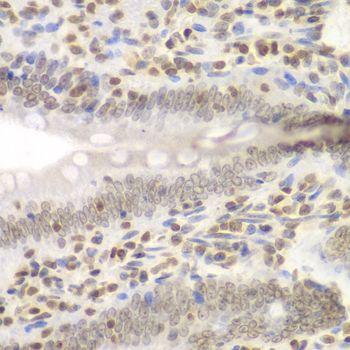
The antibody against UHRF2 was raised in Rabbit using the recombinant fusion protein containing a sequence corresponding to amino acids 441-622 of human UHRF2 (NP_690856.1) as the immunogen. The polyclonal antibody exists as a isotype IgG, by affinity purification. This antibody has been validated on WB, IHC-P, IF/ICC, ELISA.

ADA-06158A

The antibody against UHRF2 was raised in Rabbit using the recombinant fusion protein containing a sequence corresponding to amino acids 441-622 of human UHRF2 (NP_690856.1) as the immunogen. The polyclonal antibody exists as a isotype IgG, by affinity purification. This antibody has been validated on WB, IHC-P, IF/ICC, ELISA.

Number
Order Exclusive Products Now

Request a Quote
High Purity LevelsPrecision and ReliabilityCustomization Options

Specifications


Cat.No ADA-06158A ClonalityPolyclonal
Host SpeciesRabbitTarget NameUHRF2
Target SynonymsNIRF; URF2; RNF107; TDRD23; UHRF2FormLiquid
Species ReactivityHuman, Mouse, RatIsotypeIgG
Storage Buffer50% Glycerol, PBS with 0.02% sodium azide, pH7.3.Purification MethodAffinity purification
ApplicationELISA, WB, IF/ICC, IHC-P

Immunogen Information


Immunogen DescriptionRecombinant fusion protein containing a sequence corresponding to amino acids 441-622 of human UHRF2 (NP_690856.1).Target SpeciesHuman
Immunogen SequenceIVPSNHYGPIPGIPVGSTWRFRVQVSEAGVHRPHVGGIHGRSNDGAYSLVLAGGFADEVDRGDEFTYTGSGGKNLAGNKRIGAPSADQTLTNMNRALALNCDAPLDDKIGAESRNWRAGKPVRVIRSFKGRKISKYAPEEGNRYDGIYKVVKYWPEISSSHGFLVWRYLLRRDDVEPAPWTSUniprot IDQ96PU4
Background Information
  • Uniprot Id

    Q96PU4

  • Target Species

    Human

  • Target Name

    UHRF2

  • Target Full Name

    E3 ubiquitin-protein ligase UHRF2

  • Target Function

    E3 ubiquitin ligase that plays important roles in DNA methylation, histone modifications, cell cycle and DNA repair. Acts as a specific reader for 5-hydroxymethylcytosine (5hmC) and thereby recruits various substrates to these sites to ubiquitinate them. This activity also allows the maintenance of 5mC levels at specific genomic loci and regulates neuron-related gene expression. Participates in cell cycle regulation by ubiquitinating cyclins CCND1 and CCNE1 and thereby inducing G1 arrest. Ubiquitinates also PCNP leading to its degradation by the proteasome. Plays an active role in DNA damage repair by ubiquitinating p21/CDKN1A leading to its proteosomal degradation. Promotes also DNA repair by acting as an interstrand cross-links (ICLs) sensor. Mechanistically, cooperates with UHRF1 to ensure recruitment of FANCD2 to ICLs, leading to FANCD2 monoubiquitination and subsequent activation. Contributes to UV-induced DNA damage response by physically interacting with ATR in response to irradiation, thereby promoting ATR activation.

  • Target Involvement

    Associated with various cancers. DNA copy number loss is found in multiple kinds of malignancies originating from the brain, breast, stomach, kidney, hematopoietic tissue and lung.

  • Target Subcellular Location

    Nucleus. Chromosome.

  • Target Synonyms

    DKFZp434B0920; DKFZp686G0837; E3 ubiquitin-protein ligase UHRF2; MGC33463; Np95 like RING finger protein; Np95-like ring finger protein; Np95/ICBP90 like RING finger protein; Np95/ICBP90-like RING finger protein; Nuclear protein 97; Nuclear zinc finger protein Np97; RING finger protein 107; RNF 107; RP11-472F14.2; Ubiquitin like containing PHD and RING finger domains protein 2; Ubiquitin-like PHD and RING finger domain-containing protein 2; Ubiquitin-like-containing PHD and RING finger domains protein 2; Uhrf2; UHRF2_HUMAN; URF 2

  • Target Background

    This gene encodes a nuclear protein which is involved in cell-cycle regulation. The encoded protein is a ubiquitin-ligase capable of ubiquinating PCNP (PEST-containing nuclear protein), and together they may play a role in tumorigenesis. The encoded protein contains an NIRF_N domain, a PHD finger, a set- and ring-associated (SRA) domain, and a RING finger domain and several of these domains have been shown to be essential for the regulation of cell proliferation. This protein may also have a role in intranuclear degradation of polyglutamine aggregates. Alternative splicing results in multiple transcript variants some of which are non-protein coding.

Inquire Rabbit anti-Human UHRF2 Polyclonal Antibody Now


AbTriva respects your privacy and protects your personal data in accordance with AbTriva. For more information, please see our data protection statement. *

Notification