-
Chinese (Simplified)
-
English
-
German
-
Korean
-
Spanish
Chinese (Simplified)
English
German
Korean
Spanish
Sign up for an account to enjoy easy online shopping and instant order tracking.
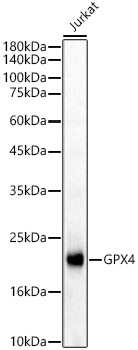
The antibody against GPX4 was raised in Rabbit using the recombinant fusion protein containing a sequence corresponding to amino acids 30-197 of GPX4 (NP_002076.2) as the immunogen. The polyclonal antibody exists as a isotype IgG, by affinity purification. This antibody has been validated on WB, IHC-P, IF/ICC, ELISA.
| Cat.No | ADA-12920A | Clonality | Polyclonal |
|---|---|---|---|
| Host Species | Rabbit | Target Name | GPX4 |
| Target Synonyms | MCSP; SMDS; GPx-4; PHGPx; snGPx; GSHPx-4; snPHGPx | Form | Liquid |
| Species Reactivity | Human, Mouse, Rat | Isotype | IgG |
| Storage Buffer | 50% Glycerol, PBS with 0.05% proclin300, pH7.3. | Purification Method | Affinity purification |
| Positive Samples | Jurkat | Application | ELISA, WB, IF/ICC, IHC-P |
| Immunogen Description | Recombinant fusion protein containing a sequence corresponding to amino acids 30-197 of GPX4 (NP_002076.2). | Immunogen Sequence | ASRDDWRCARSMHEFSAKDIDGHMVNLDKYRGFVCIVTNVASQUGKTEVNYTQLVDLHARYAECGLRILAFPCNQFGKQEPGSNEEIKEFAAGYNVKFDMFSKICVNGDDAHPLWKWMKIQPKGKGILGNAIKWNFTKFLIDKNGCVVKRYGPMEEPLVIEKDLPHYF |
|---|---|---|---|
| Uniprot ID | P36969 |
Uniprot Id
P36969
Target Species
Human
Target Name
GPX4
Target Full Name
Phospholipid hydroperoxide glutathione peroxidase GPX4
Target Function
Essential antioxidant peroxidase that directly reduces phospholipid hydroperoxide even if they are incorporated in membranes and lipoproteins. Can also reduce fatty acid hydroperoxide, cholesterol hydroperoxide and thymine hydroperoxide. Plays a key role in protecting cells from oxidative damage by preventing membrane lipid peroxidation. Required to prevent cells from ferroptosis, a non-apoptotic cell death resulting from an iron-dependent accumulation of lipid reactive oxygen species. The presence of selenocysteine (Sec) versus Cys at the active site is essential for life: it provides resistance to overoxidation and prevents cells against ferroptosis. The presence of Sec at the active site is also essential for the survival of a specific type of parvalbumin-positive interneurons, thereby preventing against fatal epileptic seizures. May be required to protect cells from the toxicity of ingested lipid hydroperoxides. Required for normal sperm development and male fertility. Essential for maturation and survival of photoreceptor cells. Plays a role in a primary T-cell response to viral and parasitic infection by protecting T-cells from ferroptosis and by supporting T-cell expansion. Plays a role of glutathione peroxidase in platelets in the arachidonic acid metabolism. Reduces hydroperoxy ester lipids formed by a 15-lipoxygenase that may play a role as down-regulator of the cellular 15-lipoxygenase pathway.
Target Involvement
Spondylometaphyseal dysplasia, Sedaghatian type (SMDS)
Target Subcellular Location
[Isoform Mitochondrial]: Mitochondrion.; [Isoform Cytoplasmic]: Cytoplasm.
Target Protein Families
Glutathione peroxidase family
Target Tissue Specificity
Present primarily in testis. Expressed in platelets (at protein level).
Target Research Area
Cancer
Target Synonyms
Glutathione peroxidase 4; GPX 4; GPX-4; GPX4; GPX4_HUMAN; GSHPx-4; MCSP; mitochondrial; PHGPx; Phospholipid hydroperoxidase; Phospholipid hydroperoxide glutathione peroxidase; Phospholipid hydroperoxide glutathione peroxidase mitochondrial; snGPx; snPHGPx; Sperm nucleus glutathione peroxidase
Target Background
The protein encoded by this gene belongs to the glutathione peroxidase family, members of which catalyze the reduction of hydrogen peroxide, organic hydroperoxides and lipid hydroperoxides, and thereby protect cells against oxidative damage. Several isozymes of this gene family exist in vertebrates, which vary in cellular location and substrate specificity. This isozyme has a high preference for lipid hydroperoxides and protects cells against membrane lipid peroxidation and cell death. It is also required for normal sperm development; thus, it has been identified as a 'moonlighting' protein because of its ability to serve dual functions as a peroxidase, as well as a structural protein in mature spermatozoa. Mutations in this gene are associated with Sedaghatian type of spondylometaphyseal dysplasia (SMDS). This isozyme is also a selenoprotein, containing the rare amino acid selenocysteine (Sec) at its active site. Sec is encoded by the UGA codon, which normally signals translation termination. The 3' UTRs of selenoprotein mRNAs contain a conserved stem-loop structure, designated the Sec insertion sequence (SECIS) element, that is necessary for the recognition of UGA as a Sec codon, rather than as a stop signal. Transcript variants resulting from alternative splicing or use of alternate promoters have been described to encode isoforms with different subcellular localization.
Notification