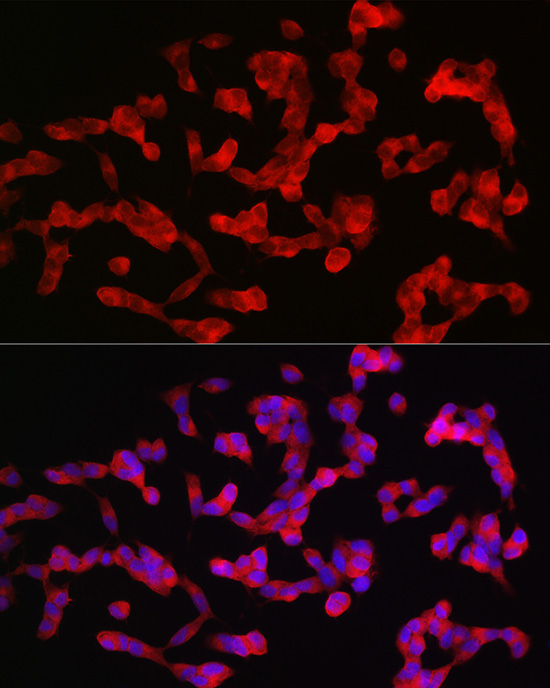
-
Chinese (Simplified)
-
English
-
German
-
Korean
-
Spanish
Chinese (Simplified)
English
German
Korean
Spanish
Sign up for an account to enjoy easy online shopping and instant order tracking.
The antibody against ANK3 was raised in Rabbit using the recombinant fusion protein containing a sequence corresponding to amino acids 833-977 of human ANK3 (NP_066267.2) as the immunogen. The polyclonal antibody exists as a isotype IgG, by affinity purification. This antibody has been validated on IF/ICC, ELISA.
| Cat.No | ADA-10237A | Clonality | Polyclonal |
|---|---|---|---|
| Host Species | Rabbit | Target Name | ANK3 |
| Target Synonyms | MRT37; ANKYRIN-G; ANK3 | Form | Liquid |
| Species Reactivity | Human, Mouse | Isotype | IgG |
| Storage Buffer | 50% Glycerol, PBS with 0.01% thimerosal, pH7.3. | Purification Method | Affinity purification |
| Application | ELISA, IF/ICC |
| Immunogen Description | Recombinant fusion protein containing a sequence corresponding to amino acids 833-977 of human ANK3 (NP_066267.2). | Target Species | Human |
|---|---|---|---|
| Immunogen Sequence | KMNVPETMNEVLDMSDDEVRKANAPEMLSDGEYISDVEEGEDAMTGDTDKYLGPQDLKELGDDSLPAEGYMGFSLGARSASLRSFSSDRSYTLNRSSYARDSMMIEELLVPSKEQHLTFTREFDSDSLRHYSWAADTLDNVNLVS | Uniprot ID | Q12955 |
Uniprot Id
Q12955
Target Species
Human
Target Name
ANK3
Target Full Name
Ankyrin-3
Target Function
In skeletal muscle, required for costamere localization of DMD and betaDAG1. Membrane-cytoskeleton linker. May participate in the maintenance/targeting of ion channels and cell adhesion molecules at the nodes of Ranvier and axonal initial segments. Regulates KCNA1 channel activity in function of dietary Mg(2+) levels, and thereby contributes to the regulation of renal Mg(2+) reabsorption.; May be part of a Golgi-specific membrane cytoskeleton in association with beta-spectrin.
Target Involvement
Mental retardation, autosomal recessive 37 (MRT37)
Target Subcellular Location
Cytoplasm, cytoskeleton. Cell projection, axon. Cell membrane, sarcolemma. Cell junction, synapse, postsynaptic cell membrane. Lysosome. Cell membrane, sarcolemma, T-tubule.; [Isoform 5]: Cytoplasm, cytoskeleton. Golgi apparatus.
Target Tissue Specificity
Expressed in brain, neurons, muscles and other tissues.
Target Research Area
Neuroscience
Target Synonyms
ANK-3; ANK3; ANK3_HUMAN; ankyrin 3 (G); Ankyrin 3; node of Ranvier (ankyrin G); Ankyrin 3; node of Ranvier; Ankyrin G; Ankyrin G119; Ankyrin-3; Ankyrin-G; brain specific ankyrin G; CHANK3; FLJ45464; OTTHUMP00000217458; OTTHUMP00000217575; RP11 369L1.1
Target Background
Ankyrins are a family of proteins that are believed to link the integral membrane proteins to the underlying spectrin-actin cytoskeleton and play key roles in activities such as cell motility, activation, proliferation, contact, and the maintenance of specialized membrane domains. Multiple isoforms of ankyrin with different affinities for various target proteins are expressed in a tissue-specific, developmentally regulated manner. Most ankyrins are typically composed of three structural domains: an amino-terminal domain containing multiple ankyrin repeats; a central region with a highly conserved spectrin binding domain; and a carboxy-terminal regulatory domain which is the least conserved and subject to variation. Ankyrin 3 is an immunologically distinct gene product from ankyrins 1 and 2, and was originally found at the axonal initial segment and nodes of Ranvier of neurons in the central and peripheral nervous systems. Multiple transcript variants encoding different isoforms have been found for this gene.
Notification