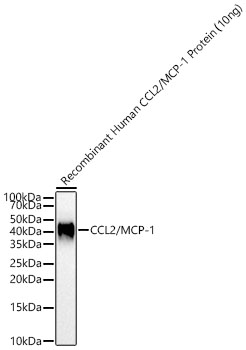
-
Chinese (Simplified)
-
English
-
German
-
Korean
-
Spanish
Chinese (Simplified)
English
German
Korean
Spanish
Sign up for an account to enjoy easy online shopping and instant order tracking.
The antibody against CCL2/MCP-1 was raised in Rabbit using the recombinant fusion protein containing a sequence corresponding to amino acids 22-99 of human CCL2/MCP-1 (NP_002973.1) as the immunogen. The polyclonal antibody exists as a isotype IgG, by affinity purification. This antibody has been validated on WB, ELISA.
| Cat.No | ADA-07925A | Clonality | Polyclonal |
|---|---|---|---|
| Host Species | Rabbit | Target Name | CCL2/MCP-1 |
| Target Synonyms | HC11; MCAF; MCP1; MCP-1; SCYA2; GDCF-2; SMC-CF; HSMCR30; CCL2/MCP-1 | Form | Liquid |
| Species Reactivity | Human | Isotype | IgG |
| Storage Buffer | 50% Glycerol, PBS with 0.05% proclin300, pH7.3. | Purification Method | Affinity purification |
| Positive Samples | Recombinant Human CCL2/MCP-1 Protein | Application | ELISA, WB |
| Immunogen Description | Recombinant fusion protein containing a sequence corresponding to amino acids 22-99 of human CCL2/MCP-1 (NP_002973.1). | Target Species | Human |
|---|---|---|---|
| Immunogen Sequence | LAQPDAINAPVTCCYNFTNRKISVQRLASYRRITSSKCPKEAVIFKTIVAKEICADPKQKWVQDSMDHLDKQTQTPKT | Uniprot ID | P13500 |
Uniprot Id
P13500
Target Species
Human
Target Name
CCL2
Target Full Name
C-C motif chemokine 2
Target Function
Acts as a ligand for C-C chemokine receptor CCR2. Signals through binding and activation of CCR2 and induces a strong chemotactic response and mobilization of intracellular calcium ions. Exhibits a chemotactic activity for monocytes and basophils but not neutrophils or eosinophils. May be involved in the recruitment of monocytes into the arterial wall during the disease process of atherosclerosis.
Target Subcellular Location
Secreted.
Target Protein Families
Intercrine beta (chemokine CC) family
Target Tissue Specificity
Expressed in the seminal plasma, endometrial fluid and follicular fluid (at protein level). Expressed in monocytes.
Target Research Area
Immunology
Target Synonyms
C-C motif chemokine 2; CCL2; CCL2_HUMAN; Chemokine (C C motif) ligand 2; GDCF 2; GDCF-2; GDCF2; HC11; HSMCR30; JE; MCAF; MCP 1; MCP-1; MCP1; MGC9434; Monocyte chemoattractant protein 1; Monocyte chemotactic and activating factor; Monocyte chemotactic protein 1; Monocyte secretory protein JE; SCYA2; Small inducible cytokine A2 (monocyte chemotactic protein 1; homologous to mouse Sig je); Small inducible cytokine A2; Small inducible cytokine subfamily A (Cys Cys); member 2; Small-inducible cytokine A2; SMC CF; SMC-CF; SMCCF
Target Background
This gene is one of several cytokine genes clustered on the q-arm of chromosome 17. Chemokines are a superfamily of secreted proteins involved in immunoregulatory and inflammatory processes. The superfamily is divided into four subfamilies based on the arrangement of N-terminal cysteine residues of the mature peptide. This chemokine is a member of the CC subfamily which is characterized by two adjacent cysteine residues. This cytokine displays chemotactic activity for monocytes and basophils but not for neutrophils or eosinophils. It has been implicated in the pathogenesis of diseases characterized by monocytic infiltrates, like psoriasis, rheumatoid arthritis and atherosclerosis. It binds to chemokine receptors CCR2 and CCR4. Elevated expression of the encoded protein is associated with severe acute respiratory syndrome coronavirus 2 (SARS‐CoV‐2) infection.
Notification