-
Chinese (Simplified)
-
English
-
German
-
Korean
-
Spanish
Chinese (Simplified)
English
German
Korean
Spanish
Sign up for an account to enjoy easy online shopping and instant order tracking.
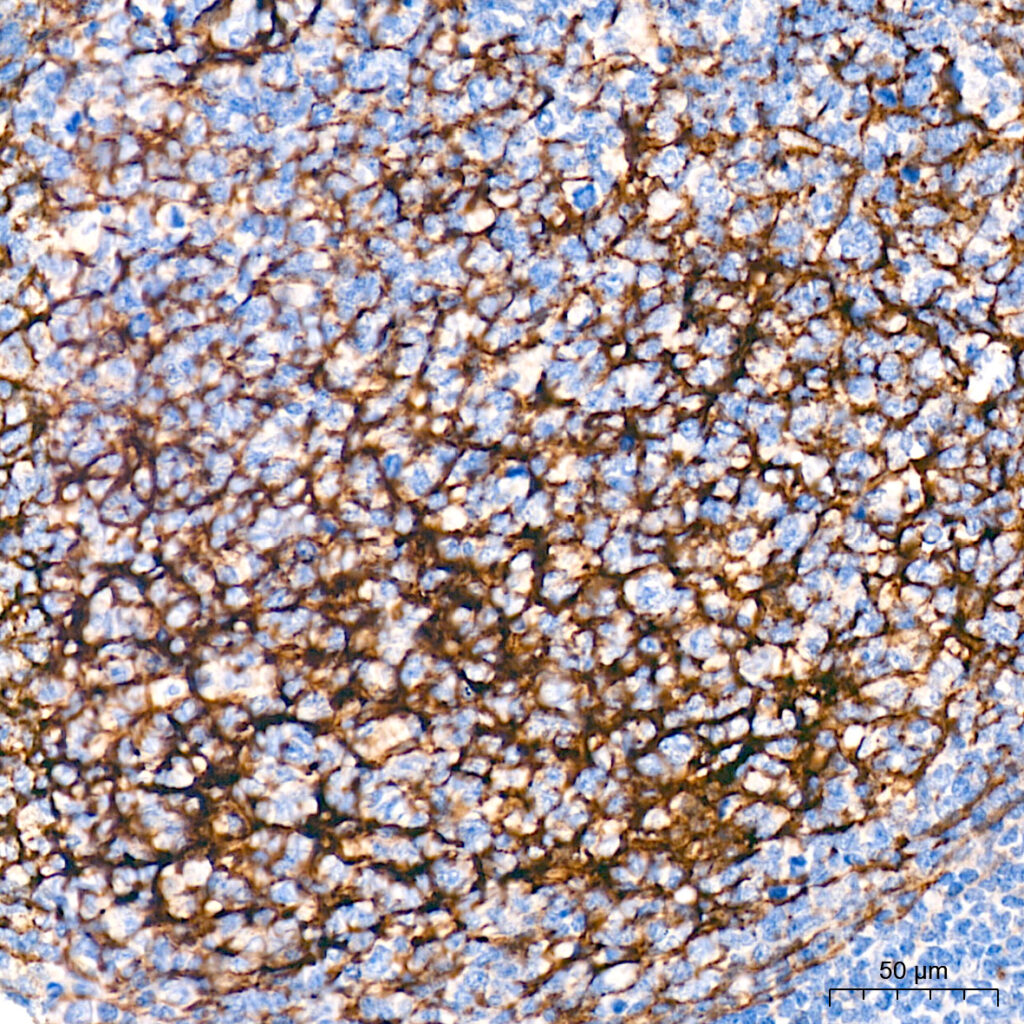
The antibody against CD271 was raised in Rabbit using the recombinant Protein corresponding to a sequence within amino acids 330-427 of human CD271 (NP_002498.1) as the immunogen. The polyclonal antibody exists as a isotype IgG, by affinity purification. This antibody has been validated on IHC-P, ELISA.
| Cat.No | ADA-08478A | Clonality | Polyclonal |
|---|---|---|---|
| Host Species | Rabbit | Target Name | CD271 |
| Target Synonyms | CD271; p75NTR; TNFRSF16; p75(NTR); Gp80-LNGFR; p75NTR/NGFR | Form | Liquid |
| Species Reactivity | Human | Isotype | IgG |
| Storage Buffer | 50% Glycerol, PBS with 0.05% proclin300, pH7.3. | Purification Method | Affinity purification |
| Application | ELISA, IHC-P |
| Immunogen Description | Recombinant Protein corresponding to a sequence within amino acids 330-427 of human CD271 (NP_002498.1). | Target Species | Human |
|---|---|---|---|
| Immunogen Sequence | KGDGGLYSSLPPAKREEVEKLLNGSAGDTWRHLAGELGYQPEHIDSFTHEACPVRALLASWATQDSATLDALLAALRRIQRADLVESLCSESTATSPV | Uniprot ID | P08138 |
Uniprot Id
P08138
Target Species
Human
Target Name
NGFR
Target Full Name
Tumor necrosis factor receptor superfamily member 16
Target Function
Low affinity receptor which can bind to NGF, BDNF, NTF3, and NTF4. Forms a heterodimeric receptor with SORCS2 that binds the precursor forms of NGF, BDNF and NTF3 with high affinity, and has much lower affinity for mature NGF and BDNF. Plays an important role in differentiation and survival of specific neuronal populations during development. Can mediate cell survival as well as cell death of neural cells. Plays a role in the inactivation of RHOA. Plays a role in the regulation of the translocation of GLUT4 to the cell surface in adipocytes and skeletal muscle cells in response to insulin, probably by regulating RAB31 activity, and thereby contributes to the regulation of insulin-dependent glucose uptake. Necessary for the circadian oscillation of the clock genes ARNTL/BMAL1, PER1, PER2 and NR1D1 in the suprachiasmatic nucleus (SCmgetaN) of the brain and in liver and of the genes involved in glucose and lipid metabolism in the liver.
Target Subcellular Location
Cell membrane; Single-pass type I membrane protein. Perikaryon. Cell projection, growth cone. Cell projection, dendritic spine.
Target Synonyms
CD271; CD271 antigen; Gp80 LNGFR; Gp80-LNGFR; Low affinity nerve growth factor receptor; Low affinity neurotrophin receptor p75NTR; Low-affinity nerve growth factor receptor; Nerve growth factor receptor; Nerve growth factor receptor TNFR superfamily member 16; NGF receptor; Ngfr; p75 ICD; p75 Neurotrophin receptor; p75 NTR; p75(NTR); p75NTR; TNFR Superfamily Member 16; TNFRSF16; TNR16_HUMAN; Tumor necrosis factor receptor superfamily member 16
Target Background
Nerve growth factor receptor contains an extracellular domain containing four 40-amino acid repeats with 6 cysteine residues at conserved positions followed by a serine/threonine-rich region, a single transmembrane domain, and a 155-amino acid cytoplasmic domain. The cysteine-rich region contains the nerve growth factor binding domain.
Notification