-
Chinese (Simplified)
-
English
-
German
-
Korean
-
Spanish
Chinese (Simplified)
English
German
Korean
Spanish
Sign up for an account to enjoy easy online shopping and instant order tracking.
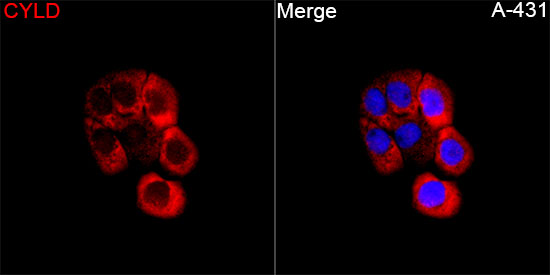
The antibody against CYLD was raised in Rabbit using the recombinant fusion protein containing a sequence corresponding to amino acids 1-127 of human CYLD (NP_056062.1) as the immunogen. The polyclonal antibody exists as a isotype IgG, by affinity purification. This antibody has been validated on IF/ICC, ELISA.
| Cat.No | ADA-08545A | Clonality | Polyclonal |
|---|---|---|---|
| Host Species | Rabbit | Target Name | CYLD |
| Target Synonyms | EAC; MFT; SBS; TEM; BRSS; CDMT; MFT1; CYLD1; CYLDI; USPL2; FTDALS8 | Form | Liquid |
| Species Reactivity | Human, Mouse | Isotype | IgG |
| Storage Buffer | 50% Glycerol, PBS with 0.05% proclin300, pH7.3. | Purification Method | Affinity purification |
| Application | ELISA, IF/ICC |
| Immunogen Description | Recombinant fusion protein containing a sequence corresponding to amino acids 1-127 of human CYLD (NP_056062.1). | Target Species | Human |
|---|---|---|---|
| Immunogen Sequence | MSSGLWSQEKVTSPYWEERIFYLLLQECSVTDKQTQKLLKVPKGSIGQYIQDRSVGHSRIPSAKGKKNQIGLKILEQPHAVLFVDEKDVVEINEKFTELLLAITNCEERFSLFKNRNRLSKGLQIDV | Uniprot ID | Q9NQC7 |
Uniprot Id
Q9NQC7
Target Species
Human
Target Name
CYLD
Target Full Name
Ubiquitin carboxyl-terminal hydrolase CYLD
Target Function
Deubiquitinase that specifically cleaves 'Lys-63'- and linear 'Met-1'-linked polyubiquitin chains and is involved in NF-kappa-B activation and TNF-alpha-induced necroptosis. Negatively regulates NF-kappa-B activation by deubiquitinating upstream signaling factors. Contributes to the regulation of cell survival, proliferation and differentiation via its effects on NF-kappa-B activation. Negative regulator of Wnt signaling. Inhibits HDAC6 and thereby promotes acetylation of alpha-tubulin and stabilization of microtubules. Plays a role in the regulation of microtubule dynamics, and thereby contributes to the regulation of cell proliferation, cell polarization, cell migration, and angiogenesis. Required for normal cell cycle progress and normal cytokinesis. Inhibits nuclear translocation of NF-kappa-B. Plays a role in the regulation of inflammation and the innate immune response, via its effects on NF-kappa-B activation. Dispensable for the maturation of intrathymic natural killer cells, but required for the continued survival of immature natural killer cells. Negatively regulates TNFRSF11A signaling and osteoclastogenesis. Involved in the regulation of ciliogenesis, allowing ciliary basal bodies to migrate and dock to the plasma membrane; this process does not depend on NF-kappa-B activation. Ability to remove linear ('Met-1'-linked) polyubiquitin chains regulates innate immunity and TNF-alpha-induced necroptosis: recruited to the LUBAC complex via interaction with SPATA2 and restricts linear polyubiquitin formation on target proteins. Regulates innate immunity by restricting linear polyubiquitin formation on RIPK2 in response to NOD2 stimulation. Involved in TNF-alpha-induced necroptosis by removing linear ('Met-1'-linked) polyubiquitin chains from RIPK1, thereby regulating the kinase activity of RIPK1. Removes 'Lys-63' linked polyubiquitin chain of MAP3K7, which inhibits phosphorylation and blocks downstream activation of the JNK-p38 kinase cascades.
Target Involvement
Cylindromatosis, familial (FCYL); Multiple familial trichoepithelioma 1 (MFT1); Brooke-Spiegler syndrome (BRSS)
Target Subcellular Location
Cytoplasm. Cytoplasm, perinuclear region. Cytoplasm, cytoskeleton. Cell membrane; Peripheral membrane protein; Cytoplasmic side. Cytoplasm, cytoskeleton, microtubule organizing center, centrosome. Cytoplasm, cytoskeleton, spindle. Cytoplasm, cytoskeleton, cilium basal body.
Target Protein Families
Peptidase C19 family
Target Tissue Specificity
Detected in fetal brain, testis, and skeletal muscle, and at a lower level in adult brain, leukocytes, liver, heart, kidney, spleen, ovary and lung. Isoform 2 is found in all tissues except kidney.
Target Synonyms
BRSS; CDMT; Cyld; CYLD gene; CYLD_HUMAN; CYLD1; CYLDI; cylindromatosis (turban tumor syndrome); cylindromatosis 1; Deubiquitinating enzyme CYLD; EAC; HSPC057 ; KIAA0849; MFT; MFT1; Probable ubiquitin carboxyl terminal hydrolase CYLD; SBS; TEM; turban tumor syndrome; Ubiquitin carboxyl-terminal hydrolase CYLD; ubiquitin specific peptidase like 2; ubiquitin thioesterase CYLD; Ubiquitin thiolesterase CYLD; Ubiquitin-specific processing protease CYLD; Ubiquitin-specific-processing protease CYLD; USPL2
Target Background
This gene is encodes a cytoplasmic protein with three cytoskeletal-associated protein-glycine-conserved (CAP-GLY) domains that functions as a deubiquitinating enzyme. Mutations in this gene have been associated with cylindromatosis, multiple familial trichoepithelioma, and Brooke-Spiegler syndrome. Alternate transcriptional splice variants, encoding different isoforms, have been characterized.
Notification