-
Chinese (Simplified)
-
English
-
German
-
Korean
-
Spanish
Chinese (Simplified)
English
German
Korean
Spanish
Sign up for an account to enjoy easy online shopping and instant order tracking.
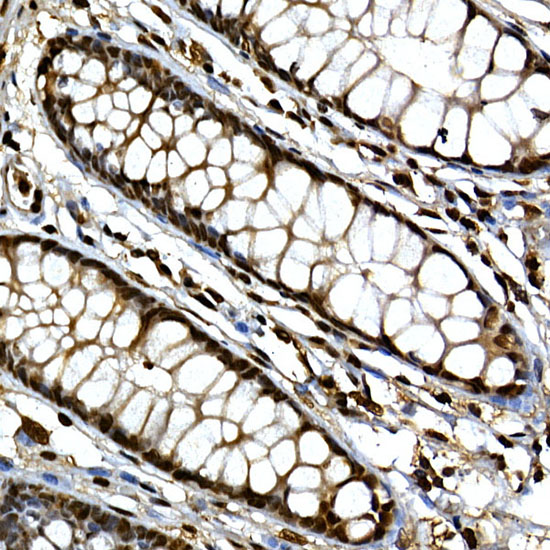
The antibody against GLI3 was raised in Rabbit using a synthetic peptide corresponding to a sequence within amino acids 681-788 of human GLI3 (NP_000159.3) as the immunogen. The polyclonal antibody exists as a isotype IgG, by affinity purification. This antibody has been validated on IHC-P, ELISA.
| Cat.No | ADA-10821A | Clonality | Polyclonal |
|---|---|---|---|
| Host Species | Rabbit | Target Name | GLI3 |
| Target Synonyms | PHS; ACLS; GCPS; PAPA; PAPB; PAP-A; PAPA1; PPDIV; GLI3FL; GLI3-190; GLI3 | Form | Liquid |
| Species Reactivity | Human, Mouse, Rat | Isotype | IgG |
| Storage Buffer | 50% Glycerol, PBS with 0.01% thimerosal, pH7.3. | Purification Method | Affinity purification |
| Positive Samples | Mouse thymus, Rat thymus | Application | ELISA, IHC-P |
| Immunogen Description | A synthetic peptide corresponding to a sequence within amino acids 681-788 of human GLI3 (NP_000159.3). | Target Species | Human |
|---|---|---|---|
| Immunogen Sequence | NTTSKREECLQVKTVKAEKPMTSQPSPGGQSSCSSQQSPISNYSNSGLELPLTDGGSIGDLSAIDETPIMDSTISTATTALALQARRNPAGTKWMEHVKLERLKQVNG | Uniprot ID | P10071 |
Uniprot Id
P10071
Target Species
Human
Target Name
GLI3
Target Full Name
Transcriptional activator GLI3
Target Function
Has a dual function as a transcriptional activator and a repressor of the sonic hedgehog (Shh) pathway, and plays a role in limb development. The full-length GLI3 form (GLI3FL) after phosphorylation and nuclear translocation, acts as an activator (GLI3A) while GLI3R, its C-terminally truncated form, acts as a repressor. A proper balance between the GLI3 activator and the repressor GLI3R, rather than the repressor gradient itself or the activator/repressor ratio gradient, specifies limb digit number and identity. In concert with TRPS1, plays a role in regulating the size of the zone of distal chondrocytes, in restricting the zone of PTHLH expression in distal cells and in activating chondrocyte proliferation. Binds to the minimal GLI-consensus sequence 5'-GGGTGGTC-3'.
Target Involvement
Greig cephalo-poly-syndactyly syndrome (GCPS); Pallister-Hall syndrome (PHS); Polydactyly, postaxial A1 (PAPA1); Polydactyly, postaxial B (PAPB); Polydactyly preaxial 4 (POP4)
Target Subcellular Location
Nucleus. Cytoplasm. Cell projection, cilium. Note=GLI3FL is localized predominantly in the cytoplasm while GLI3R resides mainly in the nucleus. Ciliary accumulation requires the presence of KIF7 and SMO. Translocation to the nucleus is promoted by interaction with ZIC1.
Target Protein Families
GLI C2H2-type zinc-finger protein family
Target Tissue Specificity
Is expressed in a wide variety of normal adult tissues, including lung, colon, spleen, placenta, testis, and myometrium.
Target Synonyms
ACLS; DNA binding protein; GCPS; Gli 3; GLI family zinc finger 3; GLI Kruppel family member GLI 3; GLI Kruppel family member GLI3 (Greig cephalopolysyndactyly syndrome); GLI Kruppel family member GLI3; GLI3; GLI3 C-terminally truncated form; GLI3 form of 190 kDa; GLI3 form of 83 kDa; GLI3 full length protein; GLI3-190; GLI3-83; GLI3_HUMAN; GLI3FL; Glioma associated oncogene family zinc finger 3; Oncogene GLI3; PAP A; PAPA 1; PAPA; PAPA1; PAPB; PHS; PPD IV; PPDIV; Transcriptional activator GLI3; Transcriptional repressor GLI3R; Zinc finger protein GLI 3; Zinc finger protein GLI3
Target Background
This gene encodes a protein which belongs to the C2H2-type zinc finger proteins subclass of the Gli family. They are characterized as DNA-binding transcription factors and are mediators of Sonic hedgehog (Shh) signaling. The protein encoded by this gene localizes in the cytoplasm and activates patched Drosophila homolog (PTCH) gene expression. It is also thought to play a role during embryogenesis. Mutations in this gene have been associated with several diseases, including Greig cephalopolysyndactyly syndrome, Pallister-Hall syndrome, preaxial polydactyly type IV, and postaxial polydactyly types A1 and B.
Notification