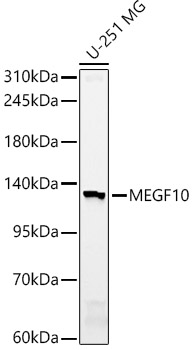
-
Chinese (Simplified)
-
English
-
German
-
Korean
-
Spanish
Chinese (Simplified)
English
German
Korean
Spanish
Sign up for an account to enjoy easy online shopping and instant order tracking.
The antibody against MEGF10 was raised in Rabbit using the recombinant fusion protein containing a sequence corresponding to amino acids 26-160 of human MEGF10 (NP_115822.1) as the immunogen. The polyclonal antibody exists as a isotype IgG, by affinity purification. This antibody has been validated on WB, ELISA.
| Cat.No | ADA-10358A | Clonality | Polyclonal |
|---|---|---|---|
| Host Species | Rabbit | Target Name | MEGF10 |
| Target Synonyms | SR-F3; EMARDD; CMYP10A; CMYP10B; MEGF10 | Form | Liquid |
| Species Reactivity | Human, Mouse, Rat | Isotype | IgG |
| Storage Buffer | 50% Glycerol, PBS with 0.05% proclin300, pH7.3. | Purification Method | Affinity purification |
| Positive Samples | U-251 MG | Application | ELISA, WB |
| Immunogen Description | Recombinant fusion protein containing a sequence corresponding to amino acids 26-160 of human MEGF10 (NP_115822.1). | Target Species | Human |
|---|---|---|---|
| Immunogen Sequence | ADYTISGTLPHSNGGNANSHYFTNPSYHTLTQCATSPHVNNRDRMTVTKSKNNQLFVNLKNVNPGKRGPVGDCTGTLPADWKHGGYLNELGAFGLDRSYMGKSLKDLGKNSEYNSSNCSLSSSENPYATIKDPPV | Uniprot ID | Q96KG7 |
Uniprot Id
Q96KG7
Target Species
Human
Target Name
MEGF10
Target Full Name
Multiple epidermal growth factor-like domains protein 10
Target Function
Membrane receptor involved in phagocytosis by macrophages and astrocytes of apoptotic cells. Receptor for C1q, an eat-me signal, that binds phosphatidylserine expressed on the surface of apoptotic cells. Cooperates with ABCA1 within the process of engulfment. Promotes the formation of large intracellular vacuoles and may be responsible for the uptake of amyloid-beta peptides. Necessary for astrocyte-dependent apoptotic neuron clearance in the developing cerebellum. Plays role in muscle cell proliferation, adhesion and motility. Is also an essential factor in the regulation of myogenesis. Controls the balance between skeletal muscle satellite cells proliferation and differentiation through regulation of the notch signaling pathway. May also function in the mosaic spacing of specific neuron subtypes in the retina through homotypic retinal neuron repulsion. Mosaics provide a mechanism to distribute each cell type evenly across the retina, ensuring that all parts of the visual field have access to a full set of processing elements.
Target Involvement
Myopathy, early-onset, areflexia, respiratory distress, and dysphagia (EMARDD)
Target Subcellular Location
Cell membrane; Single-pass type I membrane protein. Cell projection, phagocytic cup.
Target Protein Families
MEGF family
Target Synonyms
MEGF10; KIAA1780Multiple epidermal growth factor-like domains protein 10; Multiple EGF-like domains protein 10
Target Background
This gene encodes a member of the multiple epidermal growth factor-like domains protein family. The encoded protein plays a role in cell adhesion, motility and proliferation, and is a critical mediator of apoptotic cell phagocytosis as well as amyloid-beta peptide uptake in the brain. Expression of this gene may be associated with schizophrenia, and mutations in this gene are a cause of early-onset myopathy, areflexia, respiratory distress, and dysphagia (EMARDD) as well as congenital myopathy with minicores. Alternatively spliced transcript variants have been observed for this gene.
Notification