-
Chinese (Simplified)
-
English
-
German
-
Korean
-
Spanish
Chinese (Simplified)
English
German
Korean
Spanish
Sign up for an account to enjoy easy online shopping and instant order tracking.
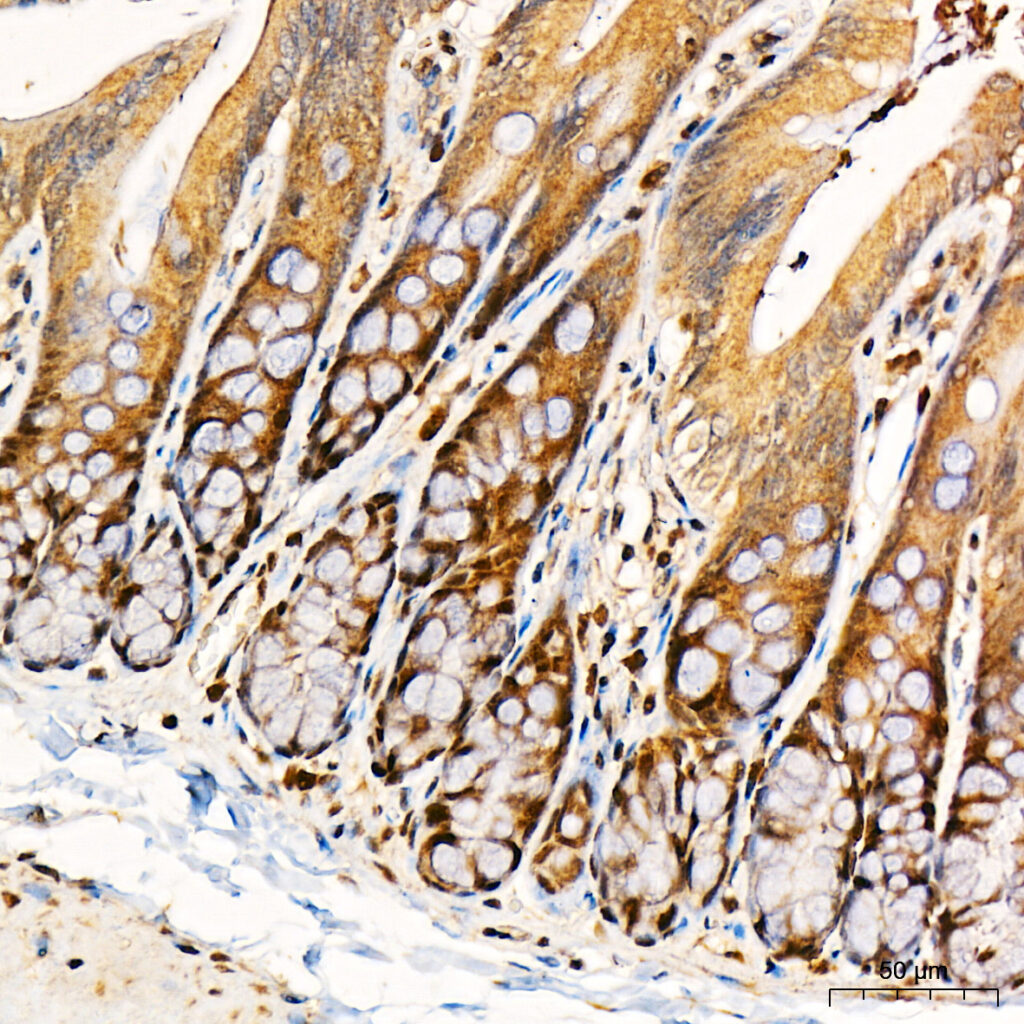
The antibody against PKR was raised in Rabbit using the recombinant fusion protein containing a sequence corresponding to amino acids 350-551 of human PKR(NP_002750.1) as the immunogen. The polyclonal antibody exists as a isotype IgG, by affinity purification. This antibody has been validated on IHC-P, IF/ICC, ELISA.
| Cat.No | ADA-08489A | Clonality | Polyclonal |
|---|---|---|---|
| Host Species | Rabbit | Target Name | PKR |
| Target Synonyms | PKR; PRKR; DYT33; LEUDEN; EIF2AK1; PPP1R83; PKR/EIF2AK2 | Form | Liquid |
| Species Reactivity | Human, Mouse, Rat | Isotype | IgG |
| Storage Buffer | 50% Glycerol, PBS with 0.05% proclin300, pH7.3. | Purification Method | Affinity purification |
| Application | ELISA, IF/ICC, IHC-P |
| Immunogen Description | Recombinant fusion protein containing a sequence corresponding to amino acids 350-551 of human PKR(NP_002750.1). | Uniprot ID | P19525 |
|---|---|---|---|
| Immunogen Sequence |
Uniprot Id
P19525
Target Species
Human
Target Name
EIF2AK2
Target Full Name
Interferon-induced, double-stranded RNA-activated protein kinase
Target Function
IFN-induced dsRNA-dependent serine/threonine-protein kinase that phosphorylates the alpha subunit of eukaryotic translation initiation factor 2 (EIF2S1/eIF-2-alpha) and plays a key role in the innate immune response to viral infection. Inhibits viral replication via the integrated stress response (ISR): EIF2S1/eIF-2-alpha phosphorylation in response to viral infection converts EIF2S1/eIF-2-alpha in a global protein synthesis inhibitor, resulting to a shutdown of cellular and viral protein synthesis, while concomitantly initiating the preferential translation of ISR-specific mRNAs, such as the transcriptional activator ATF4. Exerts its antiviral activity on a wide range of DNA and RNA viruses including hepatitis C virus (HCV), hepatitis B virus (HBV), measles virus (MV) and herpes simplex virus 1 (HHV-1). Also involved in the regulation of signal transduction, apoptosis, cell proliferation and differentiation: phosphorylates other substrates including p53/TP53, PPP2R5A, DHX9, ILF3, IRS1 and the HHV-1 viral protein US11. In addition to serine/threonine-protein kinase activity, also has tyrosine-protein kinase activity and phosphorylates CDK1 at 'Tyr-4' upon DNA damage, facilitating its ubiquitination and proteosomal degradation. Either as an adapter protein and/or via its kinase activity, can regulate various signaling pathways (p38 MAP kinase, NF-kappa-B and insulin signaling pathways) and transcription factors (JUN, STAT1, STAT3, IRF1, ATF3) involved in the expression of genes encoding proinflammatory cytokines and IFNs. Activates the NF-kappa-B pathway via interaction with IKBKB and TRAF family of proteins and activates the p38 MAP kinase pathway via interaction with MAP2K6. Can act as both a positive and negative regulator of the insulin signaling pathway (ISP). Negatively regulates ISP by inducing the inhibitory phosphorylation of insulin receptor substrate 1 (IRS1) at 'Ser-312' and positively regulates ISP via phosphorylation of PPP2R5A which activates FOXO1, which in turn up-regulates the expression of insulin receptor substrate 2 (IRS2). Can regulate NLRP3 inflammasome assembly and the activation of NLRP3, NLRP1, AIM2 and NLRC4 inflammasomes. Plays a role in the regulation of the cytoskeleton by binding to gelsolin (GSN), sequestering the protein in an inactive conformation away from actin.
Target Subcellular Location
Cytoplasm. Nucleus. Cytoplasm, perinuclear region.
Target Protein Families
Protein kinase superfamily, Ser/Thr protein kinase family, GCN2 subfamily
Target Tissue Specificity
Highly expressed in thymus, spleen and bone marrow compared to non-hematopoietic tissues such as small intestine, liver, or kidney tissues. Colocalizes with GSK3B and TAU in the Alzheimer disease (AD) brain. Elevated levels seen in breast and colon carcin
Target Research Area
Signal Transduction
Target Synonyms
Double stranded RNA activated protein kinase; E2AK2_HUMAN; eIF-2A protein kinase 2; EIF2AK1; EIF2AK2; Eukaryotic translation initiation factor 2 alpha kinase 2; Eukaryotic translation initiation factor 2-alpha kinase 2; HGNC:9437; Interferon induced double stranded RNA activated protein kinase; Interferon inducible elF2 alpha kinase ; Interferon inducible RNA dependent protein kinase; Interferon-induced; double-stranded RNA-activated protein kinase; Interferon-inducible RNA-dependent protein kinase; MGC126524; P1/eIF-2A protein kinase; P1/eIF2A protein kinase ; p68 kinase; PKR; PPP1R83; PRKR; Protein kinase interferon inducible double stranded RNA dependent; Protein kinase RNA activated; Protein kinase RNA-activated; Protein phosphatase 1 regulatory subunit 83; Serine/threonine protein kinase TIK ; Tyrosine protein kinase EIF2AK2
Target Background
The protein encoded by this gene is a serine/threonine protein kinase that is activated by autophosphorylation after binding to dsRNA. The activated form of the encoded protein can phosphorylate translation initiation factor EIF2S1, which in turn inhibits protein synthesis. This protein is also activated by manganese ions and heparin. The encoded protein plays an important role in the innate immune response against multiple DNA and RNA viruses.
Notification