-
Chinese (Simplified)
-
English
-
German
-
Korean
-
Spanish

Chinese (Simplified)
English
German
Korean
Spanish
Sign up for an account to enjoy easy online shopping and instant order tracking.
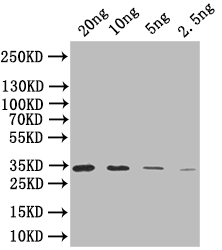
The antibody against SIGB was raised in rabbit using the Recombinant Arabidopsis thaliana SIGB protein (40-310aa) as the immunogen. This antibody exists as a non-conjugated isotype IgG, Affinity-chromatography purified. This antibody has been validated on ELISA, WB.
$299.00
| Cat.No | ADC-55407A | Clonality | Polyclonal |
|---|---|---|---|
| Host Species | Rabbit | Target Name | SIGB |
| Form | Liquid | Species Reactivity | Arabidopsis thaliana |
| Isotype | IgG | Storage Buffer | 0.01M PBS, 0.03% Proclin 300; Constituents: 50% Glycerol, PH 7.4 |
| Purification Method | Affinity-chromatography purified | Conjugate | Non-conjugated |
| Application | ELISA, WB | Storage | Upon receipt |
| Immunogen Description | Recombinant Arabidopsis thaliana SIGB protein (40-310aa) | Target Species | Arabidopsis thaliana (Mouse-ear cress) |
|---|---|---|---|
| Immunogen Sequence | Complete sequences for the immunogen, target protein, and peptides are available upon request. | Uniprot ID | O22056 |
Uniprot Id
O22056
Target Species
Arabidopsis thaliana
Target Name
SIGB
Target Function
Required for the transition of plastids into chloroplasts by coordinating nuclear and chloroplastic genomes under light conditions. Sigma factors are initiation factors that promote the attachment of plastid-encoded RNA polymerase (PEP) to specific initiation sites and are then released. Promotes the biosynthesis of plastid-encoded tRNAs (e.g. trnE-UUC and trnV-UAC).
Target Subcellular Location
Plastid, chloroplast.
Target Protein Families
Sigma-70 factor family
Target Tissue Specificity
Highly expressed in cotyledons, to a lesser extent in leaves, sepals and siliques, and barely expressed in roots. Present in seedlings.
Notification