-
Chinese (Simplified)
-
English
-
German
-
Korean
-
Spanish
Chinese (Simplified)
English
German
Korean
Spanish
Sign up for an account to enjoy easy online shopping and instant order tracking.
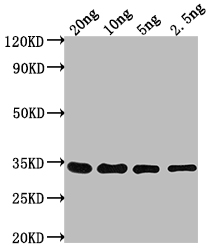
The antibody against CHD1 was raised in rabbit using the Recombinant Saccharomyces cerevisiae (strain ATCC 204508 / S288c) (Baker's yeast) CHD1 protein (29-121aa) as the immunogen. This antibody exists as a non-conjugated isotype IgG, Protein G Purified. This antibody has been validated on ELISA, WB.
The antibody against CHD1 was raised in rabbit using the Recombinant Saccharomyces cerevisiae (strain ATCC 204508 / S288c) (Baker’s yeast) CHD1 protein (29-121aa) as the immunogen. This antibody exists as a non-conjugated isotype IgG, Protein G Purified. This antibody has been validated on ELISA, WB.
$299.00
| Cat.No | ADC-55311A | Clonality | Polyclonal |
|---|---|---|---|
| Host Species | Rabbit | Target Name | CHD1 |
| Target Synonyms | Chromo domain-containing protein 1 (EC 3.6.4.-) (ATP-dependent helicase CHD1) CHD1 YER164W SYGP-ORF4 | Form | Liquid |
| Species Reactivity | Saccharomyces cerevisiae (strain ATCC 204508 / S288c) (Baker's yeast) | Isotype | IgG |
| Storage Buffer | 0.01M PBS, 0.03% Proclin 300; Constituents: 50% Glycerol, PH 7.4 | Purification Method | Protein G purified |
| Conjugate | Non-conjugated | Application | ELISA, WB |
| Storage | Upon receipt |
| Immunogen Description | Recombinant Saccharomyces cerevisiae (strain ATCC 204508 / S288c) (Baker's yeast) CHD1 protein (29-121aa) | Target Species | Saccharomyces cerevisiae (strain ATCC 204508 / S288c) (Baker's yeast) |
|---|---|---|---|
| Immunogen Sequence | Complete sequences for the immunogen, target protein, and peptides are available upon request. | Uniprot ID | P32657 |
Uniprot Id
P32657
Target Species
Yeast
Target Name
CHD1
Target Function
ATP-dependent chromatin-remodeling factor which functions as substrate recognition component of the transcription regulatory histone acetylation (HAT) complexes SAGA and SLIK. It recognizes H3K4me. SAGA is involved in RNA polymerase II-dependent transcriptional regulation of approximately 10% of yeast genes. At the promoters, SAGA is required for recruitment of the basal transcription machinery. It influences RNA polymerase II transcriptional activity through different activities such as TBP interaction (SPT3, SPT8 and SPT20) and promoter selectivity, interaction with transcription activators (GCN5, ADA2, ADA3 and TRA1), and chromatin modification through histone acetylation (GCN5) and deubiquitination (UBP8). SAGA acetylates nucleosomal histone H3 to some extent (to form H3K9ac, H3K14ac, H3K18ac and H3K23ac). SAGA interacts with DNA via upstream activating sequences (UASs). SLIK is proposed to have partly overlapping functions with SAGA. It preferentially acetylates methylated histone H3, at least after activation at the GAL1-10 locus. Acts in opposition to the FACT complex in regulating polymerase II transcription. Also required for efficient transcription by RNA polymerase I, and more specifically the pol I transcription termination step. Regulates negatively DNA replication. Not only involved in transcription-related chromatin-remodeling, but also required to maintain a specific chromatin configuration across the genome.
Target Subcellular Location
Nucleus.
Target Protein Families
SNF2/RAD54 helicase family
Notification