• Contact info@abtriva.com for inquiries and orders.
  • Chinese (Simplified)

  • English

  • German

  • Korean

  • Spanish

United States (English / $ USD)

Rabbit anti-Human VPRBP Polyclonal Antibody

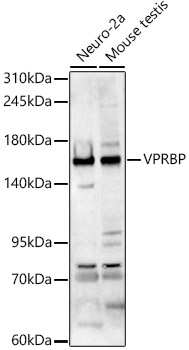
The antibody against VPRBP was raised in Rabbit using the recombinant fusion protein containing a sequence corresponding to amino acids 1058-1396 of human VPRBP (NP_055518.1) as the immunogen. The polyclonal antibody exists as a isotype IgG, by affinity purification. This antibody has been validated on WB, ELISA.

ADA-08245A

The antibody against VPRBP was raised in Rabbit using the recombinant fusion protein containing a sequence corresponding to amino acids 1058-1396 of human VPRBP (NP_055518.1) as the immunogen. The polyclonal antibody exists as a isotype IgG, by affinity purification. This antibody has been validated on WB, ELISA.

Number
Order Exclusive Products Now

Request a Quote
High Purity LevelsPrecision and ReliabilityCustomization Options

Specifications


Cat.No ADA-08245A ClonalityPolyclonal
Host SpeciesRabbitTarget NameVPRBP
Target SynonymsRIP; VPRBPFormLiquid
Species ReactivityMouseIsotypeIgG
Storage Buffer50% Glycerol, PBS with 0.05% proclin300, pH7.3.Purification MethodAffinity purification
Positive SamplesMouse testis, Neuro-2aApplicationELISA, WB

Immunogen Information


Immunogen DescriptionRecombinant fusion protein containing a sequence corresponding to amino acids 1058-1396 of human VPRBP (NP_055518.1).Target SpeciesHuman
Uniprot IDQ9Y4B6Immunogen Sequence
Background Information
  • Uniprot Id

    Q9Y4B6

  • Target Species

    Human

  • Target Name

    DCAF1

  • Target Full Name

    DDB1- and CUL4-associated factor 1

  • Target Function

    Acts both as a substrate recognition component of E3 ubiquitin-protein ligase complexes and as an atypical serine/threonine-protein kinase, playing key roles in various processes such as cell cycle, telomerase regulation and histone modification. Probable substrate-specific adapter of a DCX (DDB1-CUL4-X-box) E3 ubiquitin-protein ligase complex, named CUL4A-RBX1-DDB1-DCAF1/VPRBP complex, which mediates ubiquitination and proteasome-dependent degradation of proteins such as NF2. Involved in the turnover of methylated proteins: recognizes and binds methylated proteins via its chromo domain, leading to ubiquitination of target proteins by the RBX1-DDB1-DCAF1/VPRBP complex. The CUL4A-RBX1-DDB1-DCAF1/VPRBP complex is also involved in B-cell development: DCAF1 is recruited by RAG1 to ubiquitinate proteins, leading to limit error-prone repair during V(D)J recombination. Also part of the EDVP complex, an E3 ligase complex that mediates ubiquitination of proteins such as TERT, leading to TERT degradation and telomerase inhibition. Also acts as an atypical serine/threonine-protein kinase that specifically mediates phosphorylation of 'Thr-120' of histone H2A (H2AT120ph) in a nucleosomal context, thereby repressing transcription. H2AT120ph is present in the regulatory region of many tumor suppresor genes, down-regulates their transcription and is present at high level in a number of tumors. Involved in JNK-mediated apoptosis during cell competition process via its interaction with LLGL1 and LLGL2.; (Microbial infection) In case of infection by HIV-1 virus, it is recruited by HIV-1 Vpr in order to hijack the CUL4A-RBX1-DDB1-DCAF1/VPRBP function leading to arrest the cell cycle in G2 phase, and also to protect the viral protein from proteasomal degradation by another E3 ubiquitin ligase. The HIV-1 Vpr protein hijacks the CUL4A-RBX1-DDB1-DCAF1/VPRBP complex to promote ubiquitination and degradation of proteins such as TERT and ZIP/ZGPAT.; (Microbial infection) In case of infection by HIV-2 virus, it is recruited by HIV-2 Vpx in order to hijack the CUL4A-RBX1-DDB1-DCAF1/VPRBP function leading to enhanced efficiency of macrophage infection and promotion of the replication of cognate primate lentiviruses in cells of monocyte/macrophage lineage.

  • Target Subcellular Location

    Cytoplasm. Nucleus. Note=Associated with chromatin in a DDB1-independent and cell cycle-dependent manner: recruited to chromatin as DNA is being replicated and is released from chromatin before mitosis.

  • Target Protein Families

    VPRBP/DCAF1 family

  • Target Tissue Specificity

    Ubiquitously expressed.

  • Target Synonyms

    DCAF1; KIAA0800; RIP; VPRBPDDB1- and CUL4-associated factor 1; HIV-1 Vpr-binding protein; VprBP; Serine/threonine-protein kinase VPRBP; EC 2.7.11.1; Vpr-interacting protein

  • Target Background

    Enables estrogen receptor binding activity and histone kinase activity (H2A-T120 specific). Involved in cell competition in a multicellular organism; histone H2A-T120 phosphorylation; and negative regulation of transcription by RNA polymerase II. Located in fibrillar center and nucleoplasm. Part of Cul4-RING E3 ubiquitin ligase complex. Colocalizes with COP9 signalosome.

Inquire Rabbit anti-Human VPRBP Polyclonal Antibody Now


AbTriva respects your privacy and protects your personal data in accordance with AbTriva. For more information, please see our data protection statement. *

Notification