• Contact info@abtriva.com for inquiries and orders.
  • Chinese (Simplified)

  • English

  • German

  • Korean

  • Spanish

United States (English / $ USD)

Rabbit anti-Human APOC1 Polyclonal Antibody

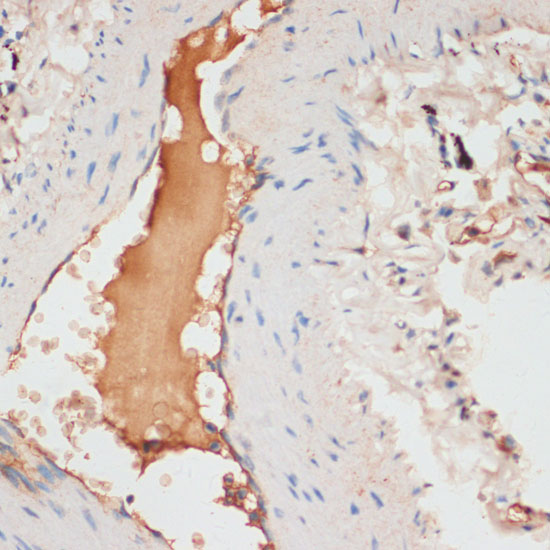
The antibody against APOC1 was raised in Rabbit using the recombinant fusion protein containing a sequence corresponding to amino acids 1-83 of human APOC1 (NP_001636.1) as the immunogen. The polyclonal antibody exists as a isotype IgG, by affinity purification. This antibody has been validated on IHC-P, ELISA.

ADA-09667A

The antibody against APOC1 was raised in Rabbit using the recombinant fusion protein containing a sequence corresponding to amino acids 1-83 of human APOC1 (NP_001636.1) as the immunogen. The polyclonal antibody exists as a isotype IgG, by affinity purification. This antibody has been validated on IHC-P, ELISA.

Number
Order Exclusive Products Now

Request a Quote
High Purity LevelsPrecision and ReliabilityCustomization Options

Specifications


Cat.No ADA-09667A ClonalityPolyclonal
Host SpeciesRabbitTarget NameAPOC1
Target SynonymsApo-CI; ApoC-I; apo-CIB; apoC-IB; APOC1FormLiquid
Species ReactivityHuman, RatIsotypeIgG
Storage Buffer50% Glycerol, PBS with 0.02% sodium azide, pH7.3.Purification MethodAffinity purification
ApplicationELISA, IHC-P

Immunogen Information


Immunogen DescriptionRecombinant fusion protein containing a sequence corresponding to amino acids 1-83 of human APOC1 (NP_001636.1).Target SpeciesHuman
Immunogen SequenceMRLFLSLPVLVVVLSIVLEGPAPAQGTPDVSSALDKLKEFGNTLEDKARELISRIKQSELSAKMREWFSETFQKVKEKLKIDSUniprot IDP02654
Background Information
  • Uniprot Id

    P02654

  • Target Species

    Human

  • Target Name

    APOC1

  • Target Full Name

    Apolipoprotein C-I

  • Target Function

    Inhibitor of lipoprotein binding to the low density lipoprotein (LDL) receptor, LDL receptor-related protein, and very low density lipoprotein (VLDL) receptor. Associates with high density lipoproteins (HDL) and the triacylglycerol-rich lipoproteins in the plasma and makes up about 10% of the protein of the VLDL and 2% of that of HDL. Appears to interfere directly with fatty acid uptake and is also the major plasma inhibitor of cholesteryl ester transfer protein (CETP). Binds free fatty acids and reduces their intracellular esterification. Modulates the interaction of APOE with beta-migrating VLDL and inhibits binding of beta-VLDL to the LDL receptor-related protein.

  • Target Subcellular Location

    Secreted.

  • Target Protein Families

    Apolipoprotein C1 family

  • Target Tissue Specificity

    Synthesized mainly in liver and to a minor degree in intestine. Also found in the lung and spleen.

  • Target Research Area

    Cardiovascular

  • Target Synonyms

    APO C1; Apo CI; Apo-CIB; Apo-CIB'; APOC 1; ApoC I; ApoC-IB; ApoC-IB'; APOC1; APOC1_HUMAN; APOC1B; Apolipoprotein C I; Apolipoprotein C I variant I; Apolipoprotein C-I; Apolipoprotein C1; Apolipoprotein CI; ApolipoproteinC I; ApolipoproteinCI; Truncated apolipoprotein C-I

  • Target Background

    This gene encodes a member of the apolipoprotein C1 family. This gene is expressed primarily in the liver, and it is activated when monocytes differentiate into macrophages. The encoded protein plays a central role in high density lipoprotein (HDL) and very low density lipoprotein (VLDL) metabolism. This protein has also been shown to inhibit cholesteryl ester transfer protein in plasma. A pseudogene of this gene is located 4 kb downstream in the same orientation, on the same chromosome. This gene is mapped to chromosome 19, where it resides within a apolipoprotein gene cluster. Alternative splicing and the use of alternative promoters results in multiple transcript variants.

Inquire Rabbit anti-Human APOC1 Polyclonal Antibody Now


AbTriva respects your privacy and protects your personal data in accordance with AbTriva. For more information, please see our data protection statement. *

Notification