• Contact info@abtriva.com for inquiries and orders.
  • Chinese (Simplified)

  • English

  • German

  • Korean

  • Spanish

United States (English / $ USD)

Rabbit anti-Human CD300LF Monoclonal Antibody

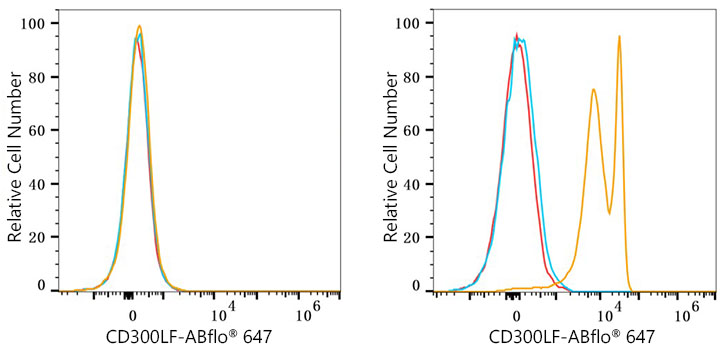
The antibody against CD300LF was raised in Rabbit using the recombinant fusion protein containing a sequence corresponding to amino acids 20-156 of human CD300F/IREM-1 (NP_620587.2) as the immunogen. The monoclonal antibody exists as a isotype IgG, by affinity purification. This antibody has been validated on FC, ELISA.

ADA-15577A

The antibody against CD300LF was raised in Rabbit using the recombinant fusion protein containing a sequence corresponding to amino acids 20-156 of human CD300F/IREM-1 (NP_620587.2) as the immunogen. The monoclonal antibody exists as a isotype IgG, by affinity purification. This antibody has been validated on FC, ELISA.

Number
Order Exclusive Products Now

Request a Quote
High Purity LevelsPrecision and ReliabilityCustomization Options

Specifications


Cat.No ADA-15577A ClonalityMonoclonal
Host SpeciesRabbitTarget NameCD300LF
Target SynonymsCD300LF; CD300f; CLM-1; CLM1; IREM-1; IREM1; IgSF13; LMIR3; NKIR; CMRF35-like molecule 1FormLiquid
Species ReactivityHumanIsotypeIgG
Storage Buffer50% Glycerol, 0.05% BSA, PBS with 0.05% proclin300, pH7.3.Purification MethodAffinity purification
ApplicationELISA, FC

Immunogen Information


Immunogen DescriptionRecombinant fusion protein containing a sequence corresponding to amino acids 20-156 of human CD300F/IREM-1 (NP_620587.2).Target SpeciesHuman
Immunogen SequenceTQITGPTTVNGLERGSLTVQCVYRSGWETYLKWWCRGAIWRDCKILVKTSGSEQEVKRDRVSIKDNQKNRTFTVTMEDLMKTDADTYWCGIEKTGNDLGVTVQVTIDPAPVTQEETSSSPTLTGHHLDNRHKLLKLSUniprot IDQ8TDQ1
Background Information
  • Uniprot Id

    Q8TDQ1

  • Target Species

    Human

  • Target Name

    CD300LF

  • Target Full Name

    CMRF35-like molecule 1

  • Target Function

    Acts as an inhibitory receptor for myeloid cells and mast cells. Positively regulates the phagocytosis of apoptotic cells (efferocytosis) via phosphatidylserine (PS) recognition; recognizes and binds PS as a ligand which is expressed on the surface of apoptotic cells. Plays an important role in the maintenance of immune homeostasis, by promoting macrophage-mediated efferocytosis and by inhibiting dendritic cell-mediated efferocytosis. Negatively regulates Fc epsilon receptor-dependent mast cell activation and allergic responses via binding to ceramide and sphingomyelin which act as ligands. May act as a coreceptor for interleukin 4 (IL-4). Associates with and regulates IL-4 receptor alpha-mediated responses by augmenting IL-4- and IL-13-induced signaling. Negatively regulates the Toll-like receptor (TLR) signaling mediated by MYD88 and TRIF through activation of PTPN6/SHP-1 and PTPN11/SHP-2. Inhibits osteoclast formation. Induces macrophage cell death upon engagement.

  • Target Subcellular Location

    Cell membrane; Single-pass type I membrane protein.

  • Target Protein Families

    CD300 family

  • Target Tissue Specificity

    Highly expressed in spleen, peripheral blood leukocyte and monocyte, and lung. Weakly expressed in thymus, heart, brain, placenta, liver, skeletal muscle, kidney, pancreas, prostate, testis, ovary, small intestine or colon. Expressed selectively in monocy

  • Target Research Area

    Immunology

  • Target Synonyms

    CD300 antigen like family member; CD300 antigen-like family member F; CD300 molecule like family member f; CD300f; CD300LF; CLM; CLM-1; CLM1; CLM1_HUMAN; CMRF35-like molecule 1; IGSF; IgSF13; Immune receptor expressed on myeloid cells 1; immune receptor expressed on myeloid cells; immunoglobin superfamily member; Immunoglobulin superfamily member 13; Immunoglobulin superfamily member; Inhibitory receptor IREM1; IREM; IREM-1; IREM1; Nepmucin; NK inhibitory receptor; NKIR; TREM; triggering receptors expressed on myeloid cells; UNQ3105/PRO10111

  • Target Background

    This gene encodes a member of the CD300 protein family. Members of this family are cell surface glycoproteins with a single IgV-like extracellular domain, and are involved in the regulation of immune response. The encoded protein is an inhibitory receptor. Alternative splicing results in multiple transcript variants.

Inquire Rabbit anti-Human CD300LF Monoclonal Antibody Now


AbTriva respects your privacy and protects your personal data in accordance with AbTriva. For more information, please see our data protection statement. *

Notification