• Contact info@abtriva.com for inquiries and orders.
  • Chinese (Simplified)

  • English

  • German

  • Korean

  • Spanish

United States (English / $ USD)

Rabbit anti-Human CETN2 Polyclonal Antibody

The antibody against CETN2 was raised in Rabbit using the recombinant fusion protein containing a sequence corresponding to amino acids 1-172 of human CETN2 (NP_004335.1) as the immunogen. The polyclonal antibody exists as a isotype IgG, by affinity purification. This antibody has been validated on WB, IF/ICC, ELISA.

ADA-07890A

The antibody against CETN2 was raised in Rabbit using the recombinant fusion protein containing a sequence corresponding to amino acids 1-172 of human CETN2 (NP_004335.1) as the immunogen. The polyclonal antibody exists as a isotype IgG, by affinity purification. This antibody has been validated on WB, IF/ICC, ELISA.

Number
Order Exclusive Products Now

Request a Quote
High Purity LevelsPrecision and ReliabilityCustomization Options

Specifications


Cat.No ADA-07890A ClonalityPolyclonal
Host SpeciesRabbitTarget NameCETN2
Target SynonymsCALT; CEN2; CETN2FormLiquid
Species ReactivityHuman, Mouse, RatIsotypeIgG
Storage Buffer50% Glycerol, PBS with 0.02% sodium azide, pH7.3.Purification MethodAffinity purification
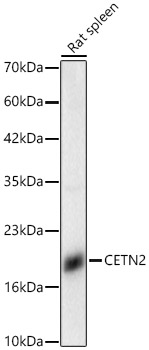
Positive SamplesRat spleenApplicationELISA, WB, IF/ICC

Immunogen Information


Immunogen DescriptionRecombinant fusion protein containing a sequence corresponding to amino acids 1-172 of human CETN2 (NP_004335.1).Target SpeciesHuman
Immunogen SequenceMASNFKKANMASSSQRKRMSPKPELTEEQKQEIREAFDLFDADGTGTIDVKELKVAMRALGFEPKKEEIKKMISEIDKEGTGKMNFGDFLTVMTQKMSEKDTKEEILKAFKLFDDDETGKISFKNLKRVAKELGENLTDEELQEMIDEADRDGDGEVSEQEFLRIMKKTSLYUniprot IDP41208
Background Information
  • Uniprot Id

    P41208

  • Target Species

    Human

  • Target Name

    CETN2

  • Target Full Name

    Centrin-2

  • Target Function

    Plays a fundamental role in microtubule organizing center structure and function. Required for centriole duplication and correct spindle formation. Has a role in regulating cytokinesis and genome stability via cooperation with CALM1 and CCP110.; Involved in global genome nucleotide excision repair (GG-NER) by acting as component of the XPC complex. Cooperatively with RAD23B appears to stabilize XPC. In vitro, stimulates DNA binding of the XPC:RAD23B dimer.; The XPC complex is proposed to represent the first factor bound at the sites of DNA damage and together with other core recognition factors, XPA, RPA and the TFIIH complex, is part of the pre-incision (or initial recognition) complex. The XPC complex recognizes a wide spectrum of damaged DNA characterized by distortions of the DNA helix such as single-stranded loops, mismatched bubbles or single-stranded overhangs. The orientation of XPC complex binding appears to be crucial for inducing a productive NER. XPC complex is proposed to recognize and to interact with unpaired bases on the undamaged DNA strand which is followed by recruitment of the TFIIH complex and subsequent scanning for lesions in the opposite strand in a 5'-to-3' direction by the NER machinery. Cyclobutane pyrimidine dimers (CPDs) which are formed upon UV-induced DNA damage esacpe detection by the XPC complex due to a low degree of structural perurbation. Instead they are detected by the UV-DDB complex which in turn recruits and cooperates with the XPC complex in the respective DNA repair.; As a component of the TREX-2 complex, involved in the export of mRNAs to the cytoplasm through the nuclear pores.

  • Target Subcellular Location

    Cytoplasm, cytoskeleton, microtubule organizing center, centrosome. Cytoplasm, cytoskeleton, microtubule organizing center, centrosome, centriole. Nucleus envelope. Nucleus, nuclear pore complex. Nucleus.

  • Target Protein Families

    Centrin family

  • Target Research Area

    Cell Cycle

  • Target Synonyms

    20kD calcium binding protein; CALT; caltractin; Caltractin isoform 1; CEN2; centrin; centrin; EF hand protein; 2 ; Centrin-2; Centrin2; CETN2; CETN2_HUMAN; EF hand protein 2; EF-hand protein

  • Target Background

    Caltractin belongs to a family of calcium-binding proteins and is a structural component of the centrosome. The high level of conservation from algae to humans and its association with the centrosome suggested that caltractin plays a fundamental role in the structure and function of the microtubule-organizing center, possibly required for the proper duplication and segregation of the centrosome.

Inquire Rabbit anti-Human CETN2 Polyclonal Antibody Now


AbTriva respects your privacy and protects your personal data in accordance with AbTriva. For more information, please see our data protection statement. *

Notification