• Contact info@abtriva.com for inquiries and orders.
  • Chinese (Simplified)

  • English

  • German

  • Korean

  • Spanish

United States (English / $ USD)

Rabbit anti-Human COMMD1 Polyclonal Antibody

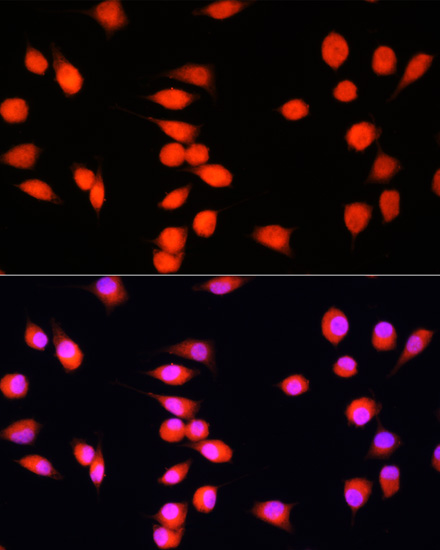
The antibody against COMMD1 was raised in Rabbit using the recombinant fusion protein containing a sequence corresponding to amino acids 1-190 of human COMMD1 (NP_689729.1) as the immunogen. The polyclonal antibody exists as a isotype IgG, by affinity purification. This antibody has been validated on IF/ICC, ELISA.

ADA-09367A

The antibody against COMMD1 was raised in Rabbit using the recombinant fusion protein containing a sequence corresponding to amino acids 1-190 of human COMMD1 (NP_689729.1) as the immunogen. The polyclonal antibody exists as a isotype IgG, by affinity purification. This antibody has been validated on IF/ICC, ELISA.

Number
Order Exclusive Products Now

Request a Quote
High Purity LevelsPrecision and ReliabilityCustomization Options

Specifications


Cat.No ADA-09367A ClonalityPolyclonal
Host SpeciesRabbitTarget NameCOMMD1
Target SynonymsMURR1; C2orf5; COMMD1FormLiquid
Species ReactivityHuman, Mouse, RatIsotypeIgG
Storage Buffer50% Glycerol, PBS with 0.02% sodium azide, pH7.3.Purification MethodAffinity purification
ApplicationELISA, IF/ICC

Immunogen Information


Immunogen DescriptionRecombinant fusion protein containing a sequence corresponding to amino acids 1-190 of human COMMD1 (NP_689729.1).Target SpeciesHuman
Immunogen SequenceMAAGELEGGKPLSGLLNALAQDTFHGYPGITEELLRSQLYPEVPPEEFRPFLAKMRGILKSIASADMDFNQLEAFLTAQTKKQGGITSDQAAVISKFWKSHKTKIRESLMNQSRWNSGLRGLSWRVDGKSQSRHSAQIHTPVAIIELELGKYGQESEFLCLEFDEVKVNQILKTLSEVEESISTLISQPNUniprot IDQ8N668
Background Information
  • Uniprot Id

    Q8N668

  • Target Species

    Human

  • Target Name

    COMMD1

  • Target Full Name

    COMM domain-containing protein 1

  • Target Function

    Proposed scaffold protein that is implicated in diverse physiological processes and whose function may be in part linked to its ability to regulate ubiquitination of specific cellular proteins. Can modulate activity of cullin-RING E3 ubiquitin ligase (CRL) complexes by displacing CAND1; in vitro promotes CRL E3 activity and dissociates CAND1 from CUL1 and CUL2. Promotes ubiquitination of NF-kappa-B subunit RELA and its subsequent proteasomal degradation. Down-regulates NF-kappa-B activity. Involved in the regulation of membrane expression and ubiquitination of SLC12A2. Modulates Na(+) transport in epithelial cells by regulation of apical cell surface expression of amiloride-sensitive sodium channel (ENaC) subunits and by promoting their ubiquitination presumably involving NEDD4L. Promotes the localization of SCNN1D to recycling endosomes. Promotes CFTR cell surface expression through regulation of its ubiquitination. Down-regulates SOD1 activity by interfering with its homodimerization. Plays a role in copper ion homeostasis. Involved in copper-dependent ATP7A trafficking between the trans-Golgi network and vesicles in the cell periphery; the function is proposed to depend on its association within the CCC complex and cooperation with the WASH complex on early endosomes. Can bind one copper ion per monomer. May function to facilitate biliary copper excretion within hepatocytes. Binds to phosphatidylinositol 4,5-bisphosphate (PtdIns(4,5)P2). Involved in the regulation of HIF1A-mediated transcription; competes with ARNT/Hif-1-beta for binding to HIF1A resulting in decreased DNA binding and impaired transcriptional activation by HIF-1. Negatively regulates neuroblastoma G1/S phase cell cycle progression and cell proliferation by stimulating ubiquitination of NF-kappa-B subunit RELA and NF-kappa-B degradation in a FAM107A- and actin-dependent manner.

  • Target Subcellular Location

    Nucleus. Cytoplasm. Endosome membrane. Cytoplasmic vesicle. Early endosome. Recycling endosome. Note=Shuttles between nucleus and cytosol. Detected in perinuclear foci that may be aggresomes containing misfolded, ubiquitinated proteins.

  • Target Tissue Specificity

    Ubiquitous. Highest expression in the liver, with lower expression in brain, lung, placenta, pancreas, small intestine, heart, skeletal muscle, kidney and placenta. Down-regulated in cancer tissues.

  • Target Research Area

    Epigenetics and Nuclear Signaling

  • Target Synonyms

    C2orf5; COMD1; COMD1_HUMAN; COMM domain-containing protein 1; COMMD1; Copper metabolism (Murr1) domain containing 1; Copper metabolism domain containing 1; Copper metabolism gene MURR1; Copper metabolism MURR1 domain-containing protein 1; MGC27155; MURR1; Protein Murr1

  • Target Background

    Enables several functions, including phosphatidylinositol-3, 4-bisphosphate binding activity; phospholipid binding activity; and protein homodimerization activity. Involved in several processes, including Golgi to plasma membrane transport; negative regulation of protein localization to cell surface; and regulation of cellular protein metabolic process. Acts upstream of or within negative regulation of NF-kappaB transcription factor activity. Located in cytosol; endosome; and nucleoplasm. Part of Cul2-RING ubiquitin ligase complex.

Inquire Rabbit anti-Human COMMD1 Polyclonal Antibody Now


AbTriva respects your privacy and protects your personal data in accordance with AbTriva. For more information, please see our data protection statement. *

Notification