• Contact info@abtriva.com for inquiries and orders.
  • Chinese (Simplified)

  • English

  • German

  • Korean

  • Spanish

United States (English / $ USD)

Rabbit anti-Human COP1 Polyclonal Antibody

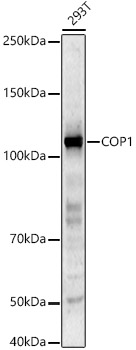
The antibody against COP1 was raised in Rabbit using the recombinant fusion protein containing a sequence corresponding to amino acids 582-731 of human COP1 (NP_071902.2) as the immunogen. The polyclonal antibody exists as a isotype IgG, by affinity purification. This antibody has been validated on WB, ELISA.

ADA-07968A

The antibody against COP1 was raised in Rabbit using the recombinant fusion protein containing a sequence corresponding to amino acids 582-731 of human COP1 (NP_071902.2) as the immunogen. The polyclonal antibody exists as a isotype IgG, by affinity purification. This antibody has been validated on WB, ELISA.

Number
Order Exclusive Products Now

Request a Quote
High Purity LevelsPrecision and ReliabilityCustomization Options

Specifications


Cat.No ADA-07968A ClonalityPolyclonal
Host SpeciesRabbitTarget NameCOP1
Target SynonymsFAP78; RFWD2; CFAP78; RNF200; COP1FormLiquid
Species ReactivityHumanIsotypeIgG
Storage Buffer50% Glycerol, PBS with 0.05% proclin300, pH7.3.Purification MethodAffinity purification
Positive Samples293TApplicationELISA, WB

Immunogen Information


Immunogen DescriptionRecombinant fusion protein containing a sequence corresponding to amino acids 582-731 of human COP1 (NP_071902.2).Target SpeciesHuman
Immunogen SequenceYYDLRNTKQPIMVFKGHRKAVSYAKFVSGEEIVSASTDSQLKLWNVGKPYCLRSFKGHINEKNFVGLASNGDYIACGSENNSLYLYYKGLSKTLLTFKFDTVKSVLDKDRKEDDTNEFVSAVCWRALPDGESNVLIAANSQGTIKVLELVUniprot IDQ8NHY2
Background Information
  • Uniprot Id

    Q8NHY2

  • Target Species

    Human

  • Target Name

    COP1

  • Target Full Name

    E3 ubiquitin-protein ligase COP1

  • Target Function

    E3 ubiquitin-protein ligase that mediates ubiquitination and subsequent proteasomal degradation of target proteins. E3 ubiquitin ligases accept ubiquitin from an E2 ubiquitin-conjugating enzyme in the form of a thioester and then directly transfers the ubiquitin to targeted substrates. Involved in JUN ubiquitination and degradation. Directly involved in p53 (TP53) ubiquitination and degradation, thereby abolishing p53-dependent transcription and apoptosis. Ubiquitinates p53 independently of MDM2 or RCHY1. Probably mediates E3 ubiquitin ligase activity by functioning as the essential RING domain subunit of larger E3 complexes. In contrast, it does not constitute the catalytic RING subunit in the DCX DET1-COP1 complex that negatively regulates JUN, the ubiquitin ligase activity being mediated by RBX1. Involved in 14-3-3 protein sigma/SFN ubiquitination and proteasomal degradation, leading to AKT activation and promotion of cell survival. Ubiquitinates MTA1 leading to its proteasomal degradation. Upon binding to TRIB1, ubiquitinates CEBPA, which lacks a canonical COP1-binding motif.

  • Target Subcellular Location

    Nucleus speckle. Cytoplasm. Note=In the nucleus, it forms nuclear speckles.

  • Target Protein Families

    COP1 family

  • Target Tissue Specificity

    Ubiquitously expressed at low level. Expressed at higher level in testis, placenta, skeletal muscle and heart.

  • Target Synonyms

    COP1; RFWD2; RNF200; E3 ubiquitin-protein ligase COP1; Constitutive photomorphogenesis protein 1 homolog; hCOP1; RING finger and WD repeat domain protein 2; RING finger protein 200; RING-type E3 ubiquitin transferase RFWD2

  • Target Background

    Enables ubiquitin protein ligase activity. Involved in positive regulation of proteasomal ubiquitin-dependent protein catabolic process; proteasome-mediated ubiquitin-dependent protein catabolic process; and response to ionizing radiation. Part of Cul4A-RING E3 ubiquitin ligase complex.

Inquire Rabbit anti-Human COP1 Polyclonal Antibody Now


AbTriva respects your privacy and protects your personal data in accordance with AbTriva. For more information, please see our data protection statement. *

Notification