-
Chinese (Simplified)
-
English
-
German
-
Korean
-
Spanish
Chinese (Simplified)
English
German
Korean
Spanish
Sign up for an account to enjoy easy online shopping and instant order tracking.
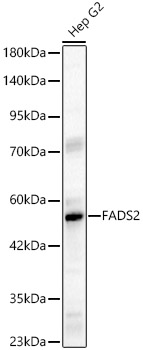
The antibody against FADS2 was raised in Rabbit using a synthetic peptide corresponding to a sequence within amino acids 1-100 of human FADS2 (NP_004256.1) as the immunogen. The polyclonal antibody exists as a isotype IgG, by affinity purification. This antibody has been validated on WB, ELISA.
| Cat.No | ADA-07919A | Clonality | Polyclonal |
|---|---|---|---|
| Host Species | Rabbit | Target Name | FADS2 |
| Target Synonyms | D6D; DES6; TU13; FADSD6; LLCDL2; SLL0262; FADS2 | Form | Liquid |
| Species Reactivity | Human | Isotype | IgG |
| Storage Buffer | 50% Glycerol, PBS with 0.05% proclin300, pH7.3. | Purification Method | Affinity purification |
| Positive Samples | Hep G2 | Application | ELISA, WB |
| Immunogen Description | A synthetic peptide corresponding to a sequence within amino acids 1-100 of human FADS2 (NP_004256.1). | Target Species | Human |
|---|---|---|---|
| Immunogen Sequence | MGKGGNQGEGAAEREVSVPTFSWEEIQKHNLRTDRWLVIDRKVYNITKWSIQHPGGQRVIGHYAGEDATDAFRAFHPDLEFVGKFLKPLLIGELAPEEPS | Uniprot ID | O95864 |
Uniprot Id
O95864
Target Species
Human
Target Name
FADS2
Target Full Name
Acyl-CoA 6-desaturase
Target Function
Involved in the biosynthesis of highly unsaturated fatty acids (HUFA) from the essential polyunsaturated fatty acids (PUFA) linoleic acid (LA) (18:2n-6) and alpha-linolenic acid (ALA) (18:3n-3) precursors, acting as a fatty acyl-coenzyme A (CoA) desaturase that introduces a cis double bond at carbon 6 of the fatty acyl chain. Catalyzes the first and rate limiting step in this pathway which is the desaturation of LA (18:2n-6) and ALA (18:3n-3) into gamma-linoleate (GLA) (18:3n-6) and stearidonate (18:4n-3), respectively. Subsequently, in the biosynthetic pathway of HUFA n-3 series, it desaturates tetracosapentaenoate (24:5n-3) to tetracosahexaenoate (24:6n-3), which is then converted to docosahexaenoate (DHA)(22:6n-3), an important lipid for nervous system function. Desaturates hexadecanate (palmitate) to produce 6Z-hexadecenoate (sapienate), a fatty acid unique to humans and major component of human sebum, that has been implicated in the development of acne and may have potent antibacterial activity. It can also desaturate (11E)-octadecenoate (trans-vaccenoate, the predominant trans fatty acid in human milk) at carbon 6 generating (6Z,11E)-octadecadienoate. In addition to Delta-6 activity, this enzyme exhibits Delta-8 activity with slight biases toward n-3 fatty acyl-CoA substrates
Target Subcellular Location
Endoplasmic reticulum membrane; Multi-pass membrane protein.
Target Protein Families
Fatty acid desaturase type 1 family
Target Tissue Specificity
Expressed in a wide array of tissues, highest expression is found in liver followed by brain, lung, heart, and retina. A lower level is found in breast tumor when compared with normal tissues; lowest levels were found in patients with poor prognostic inde
Target Research Area
Cardiovascular
Target Synonyms
D6D; Delta(6) desaturase; Delta(6) fatty acid desaturase; Delta-6 desaturase; DES 6; DES6; FADS 2; FADS2; FADS2_HUMAN; FADSD 6; FADSD6; Fatty acid desaturase 2; linoleoyl-CoA desaturase (delta-6-desaturase) like 2; LLCDL 2; LLCDL2; SLL0262; TU 13; TU13
Notification