-
Chinese (Simplified)
-
English
-
German
-
Korean
-
Spanish
Chinese (Simplified)
English
German
Korean
Spanish
Sign up for an account to enjoy easy online shopping and instant order tracking.
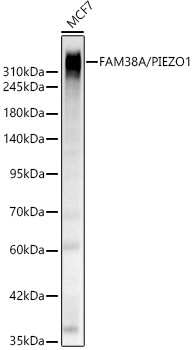
The antibody against FAM38A/PIEZO1 was raised in Rabbit using the recombinant fusion protein containing a sequence corresponding to amino acids 2230-2420 of human FAM38A/PIEZO1 (NP_001136336.2) as the immunogen. The polyclonal antibody exists as a isotype IgG, by affinity purification. This antibody has been validated on WB, IF/ICC, ELISA.
| Cat.No | ADA-09757A | Clonality | Polyclonal |
|---|---|---|---|
| Host Species | Rabbit | Target Name | FAM38A/PIEZO1 |
| Target Synonyms | ER; DHS; Mib; LMPH3; FAM38A; LMPHM6; FAM38A/PIEZO1 | Form | Liquid |
| Species Reactivity | Human, Mouse, Rat | Isotype | IgG |
| Storage Buffer | 50% Glycerol, PBS with 0.05% proclin300, pH7.3. | Purification Method | Affinity purification |
| Positive Samples | MCF7 | Application | ELISA, WB, IF/ICC |
| Immunogen Description | Recombinant fusion protein containing a sequence corresponding to amino acids 2230-2420 of human FAM38A/PIEZO1 (NP_001136336.2). | Target Species | Human |
|---|---|---|---|
| Immunogen Sequence | PSIIPFTAQAYEELSRQFDPQPLAMQFISQYSPEDIVTAQIEGSSGALWRISPPSRAQMKRELYNGTADITLRFTWNFQRDLAKGGTVEYANEKHMLALAPNSTARRQLASLLEGTSDQSVVIPNLFPKYIRAPNGPEANPVKQLQPNEEADYLGVRIQLRREQGAGATGFLEWWVIELQECRTDCNLLPM | Uniprot ID | Q92508 |
Uniprot Id
Q92508
Target Species
Human
Target Name
PIEZO1
Target Full Name
Piezo-type mechanosensitive ion channel component 1
Target Function
Pore-forming subunit of a mechanosensitive non-specific cation channel. Generates currents characterized by a linear current-voltage relationship that are sensitive to ruthenium red and gadolinium. Plays a key role in epithelial cell adhesion by maintaining integrin activation through R-Ras recruitment to the ER, most probably in its activated state, and subsequent stimulation of calpain signaling. In the kidney, may contribute to the detection of intraluminal pressure changes and to urine flow sensing. Acts as shear-stress sensor that promotes endothelial cell organization and alignment in the direction of blood flow through calpain activation. Plays a key role in blood vessel formation and vascular structure in both development and adult physiology. Acts as sensor of phosphatidylserine (PS) flipping at the plasma membrane and governs morphogenesis of muscle cells. In myoblasts, flippase-mediated PS enrichment at the inner leaflet of plasma membrane triggers channel activation and Ca2+ influx followed by Rho GTPases signal transduction, leading to assembly of cortical actomyosin fibers and myotube formation.
Target Involvement
Dehydrated hereditary stomatocytosis 1 with or without pseudohyperkalemia and/or perinatal edema (DHS1); Lymphedema, hereditary, 3 (LMPH3)
Target Subcellular Location
Endoplasmic reticulum membrane; Multi-pass membrane protein. Endoplasmic reticulum-Golgi intermediate compartment membrane. Cell membrane; Multi-pass membrane protein. Cell projection, lamellipodium membrane. Cell membrane; Multi-pass membrane protein.
Target Protein Families
PIEZO (TC 1.A.75) family
Target Tissue Specificity
Expressed in numerous tissues. In normal brain, expressed exclusively in neurons, not in astrocytes. In Alzheimer disease brains, expressed in about half of the activated astrocytes located around classical senile plaques. In Parkinson disease substantia
Target Research Area
Others
Target Synonyms
DHS; Fam38a; Family with sequence similarity 38 member A; KIAA0233; Membrane protein induced by beta-amyloid treatment; Mib; PIEZ1_HUMAN; Piezo-type mechanosensitive ion channel component 1; PIEZO1; Protein FAM38A; Protein FAM38B; Protein PIEZO1
Target Background
The protein encoded by this gene is a mechanically-activated ion channel that links mechanical forces to biological signals. The encoded protein contains 36 transmembrane domains and functions as a homotetramer. Defects in this gene have been associated with dehydrated hereditary stomatocytosis.
Notification