-
Chinese (Simplified)
-
English
-
German
-
Korean
-
Spanish

Chinese (Simplified)
English
German
Korean
Spanish
Sign up for an account to enjoy easy online shopping and instant order tracking.
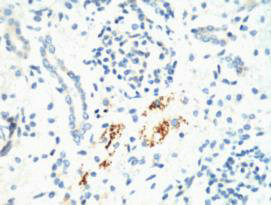
The antibody against KIF7 was raised in mouse using the Synthetic Peptide as the immunogen. This antibody exists as a non-conjugated isotype IgG. This antibody has been validated on ELISA, IHC.
$167.00
| Cat.No | ADC-55707A | Clonality | Monoclonal |
|---|---|---|---|
| Host Species | Mouse | Target Name | KIF7 |
| Target Synonyms | EQYK340 antibody; kif7 antibody; KIF7_HUMAN antibody; kinesin family member 7 antibody; kinesin like protein KIF7 antibody; Kinesin-like protein kif7 antibody; UNQ340 antibody | Form | Liquid |
| Species Reactivity | Human, Mouse, Rat | Isotype | IgG |
| Storage Buffer | PH 7.4, containing 0.02% sodium azide as Preservative and 50% Glycerol., PBS | Conjugate | Non-conjugated |
| Application | ELISA, IHC | Storage | Upon receipt |
| Immunogen Description | Synthetic Peptide | Target Species | Human |
|---|---|---|---|
| Immunogen Sequence | Complete sequences for the immunogen, target protein, and peptides are available upon request. | Uniprot ID | Q2M1P5 |
Uniprot Id
Q2M1P5
Target Species
Human
Target Name
KIF7
Target Full Name
Kinesin-like protein KIF7
Target Function
Essential for hedgehog signaling regulation: acts as both a negative and positive regulator of sonic hedgehog (Shh) and Indian hedgehog (Ihh) pathways, acting downstream of SMO, through both SUFU-dependent and -independent mechanisms. Involved in the regulation of microtubular dynamics. Required for proper organization of the ciliary tip and control of ciliary localization of SUFU-GLI2 complexes. Required for localization of GLI3 to cilia in response to Shh. Negatively regulates Shh signaling by preventing inappropriate activation of the transcriptional activator GLI2 in the absence of ligand. Positively regulates Shh signaling by preventing the processing of the transcription factor GLI3 into its repressor form. In keratinocytes, promotes the dissociation of SUFU-GLI2 complexes, GLI2 nuclear translocation and Shh signaling activation. Involved in the regulation of epidermal differentiation and chondrocyte development.
Target Involvement
Bardet-Biedl syndrome (BBS); Hydrolethalus syndrome 2 (HLS2); Acrocallosal syndrome (ACLS); Joubert syndrome 12 (JBTS12); Al-Gazali-Bakalinova syndrome (AGBK)
Target Subcellular Location
Cell projection, cilium. Cytoplasm, cytoskeleton, cilium basal body. Note=Localizes to the cilium tip.
Target Protein Families
TRAFAC class myosin-kinesin ATPase superfamily, Kinesin family, KIF27 subfamily
Target Tissue Specificity
Embryonic stem cells, melanotic melanoma and Jurkat T-cells. Expressed in heart, lung, liver, kidney, testis, retina, placenta, pancreas, colon, small intestin, prostate and thymus.
Target Synonyms
EQYK340; kif7; KIF7_HUMAN; kinesin family member 7; kinesin like protein KIF7; Kinesin-like protein kif7; UNQ340
Target Background
This gene encodes a cilia-associated protein belonging to the kinesin family. This protein plays a role in the sonic hedgehog (SHH) signaling pathway through the regulation of GLI transcription factors. It functions as a negative regulator of the SHH pathway by preventing inappropriate activation of GLI2 in the absence of ligand, and as a positive regulator by preventing the processing of GLI3 into its repressor form. Mutations in this gene have been associated with various ciliopathies.
Notification