-
Chinese (Simplified)
-
English
-
German
-
Korean
-
Spanish
Chinese (Simplified)
English
German
Korean
Spanish
Sign up for an account to enjoy easy online shopping and instant order tracking.
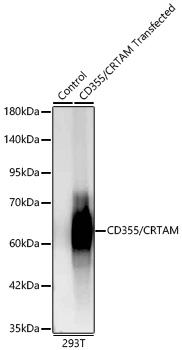
The antibody against CD355/CRTAM was raised in Rabbit using the recombinant fusion protein containing a sequence corresponding to amino acids 18-287 of human CD355/CRTAM (NP_062550.2) as the immunogen. The monoclonal antibody exists as a isotype IgG, by affinity purification. This antibody has been validated on WB, IF/ICC, FC, ELISA.
| Cat.No | ADA-15513A | Clonality | Monoclonal |
|---|---|---|---|
| Host Species | Rabbit | Target Name | CD355/CRTAM |
| Target Synonyms | CD355; CD355/CRTAM | Form | Liquid |
| Species Reactivity | Human | Isotype | IgG |
| Storage Buffer | 50% Glycerol, 0.05% BSA, PBS with 0.05% proclin300, pH7.3. | Purification Method | Affinity purification |
| Positive Samples | 293T transfected with CD355/CRTAM(Human) | Application | ELISA, WB, FC, IF/ICC |
| Immunogen Description | Recombinant fusion protein containing a sequence corresponding to amino acids 18-287 of human CD355/CRTAM (NP_062550.2). | Target Species | Human |
|---|---|---|---|
| Uniprot ID | O95727 | Immunogen Sequence |
Uniprot Id
O95727
Target Species
Human
Target Name
CRTAM
Target Full Name
Cytotoxic and regulatory T-cell molecule
Target Function
Mediates heterophilic cell-cell adhesion which regulates the activation, differentiation and tissue retention of various T-cell subsets. Interaction with CADM1 promotes natural killer (NK) cell cytotoxicity and IFNG/interferon-gamma secretion by CD8+ T-cells in vitro as well as NK cell-mediated rejection of tumors expressing CADM1 in vivo. Regulates CD8+ T-cell proliferation in response to T-cell receptor (TCR) activation. Appears to be dispensable for CD8+ T-cell-mediated cytotoxicity. Interaction with SCRIB promotes the late phase of cellular polarization of a subset of CD4+ T-cells, which in turn regulates TCR-mediated proliferation and IFNG, IL17 and IL22 production. By interacting with CADM1 on CD8+ dendritic cells, regulates the retention of activated CD8+ T-cells within the draining lymph node. Required for the intestinal retention of intraepithelial CD4+ CD8+ T-cells and, to a lesser extent, intraepithelial and lamina propria CD8+ T-cells and CD4+ T-cells. Interaction with CADM1 promotes the adhesion to gut-associated CD103+ dendritic cells, which may facilitate the expression of gut-homing and adhesion molecules on T-cells and the conversion of CD4+ T-cells into CD4+ CD8+ T-cells.
Target Subcellular Location
Cell membrane; Single-pass type I membrane protein.
Target Protein Families
Nectin family
Target Tissue Specificity
In the immune system, expression is restricted to activated class-I MHC-restricted cells, including NKT and CD8 T-cells. Strongly expressed in spleen, thymus, small intestine, peripheral blood leukocyte, and in Purkinje neurons in cerebellum. Expressed at
Target Synonyms
CRTAM; Cytotoxic and regulatory T-cell molecule; Class-I MHC-restricted T-cell-associated molecule; CD antigen CD355
Target Background
The CRTAM gene is upregulated in CD4 (see MIM 186940)-positive and CD8 (see CD8A; MIM 186910)-positive T cells and encodes a type I transmembrane protein with V and C1-like Ig domains (Yeh et al., 2008 [PubMed 18329370]).
Notification