• Contact info@abtriva.com for inquiries and orders.
  • Chinese (Simplified)

  • English

  • German

  • Korean

  • Spanish

United States (English / $ USD)

Histone H3.3 Recombinant Monoclonal Antibody

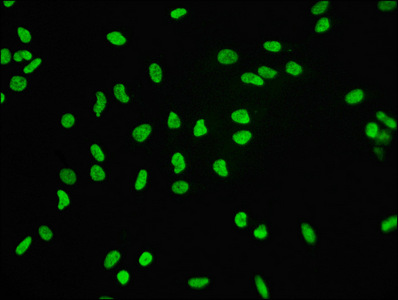
The recombinant antibody against H3F3A was produced using a synthesized peptide as the immunogen. This antibody exists as a non-conjugated isotype Rabbit IgG, Affinity-chromatography purified. This antibody has been validated on ELISA, IHC, IF.

ADC-56330A

The recombinant antibody against H3F3A was produced using a synthesized peptide as the immunogen. This antibody exists as a non-conjugated isotype Rabbit IgG, Affinity-chromatography purified. This antibody has been validated on ELISA, IHC, IF.

$350.00

Number
Order Exclusive Products Now

Request a Quote
High Purity LevelsPrecision and ReliabilityCustomization Options

Specifications


Cat.No ADC-56330A ClonalityMonoclonal
Target NameH3F3AFormLiquid
Species ReactivityHumanIsotypeRabbit IgG
Storage BufferPH 7.4, 0.02% sodium azide and 50% glycerol., 150mM NaCl, Rabbit IgG in phosphate buffered salinePurification MethodAffinity-chromatography purified
ConjugateNon-conjugatedApplicationELISA, IF, IHC
StorageUpon receipt

Immunogen Information


Immunogen DescriptionA synthesized peptideTarget SpeciesHuman
Immunogen SequenceComplete sequences for the immunogen, target protein, and peptides are available upon request.Uniprot IDP84243
Background Information
  • Uniprot Id

    P84243

  • Target Species

    Human

  • Target Name

    H3-3A

  • Target Full Name

    Histone H3.3

  • Target Function

    Variant histone H3 which replaces conventional H3 in a wide range of nucleosomes in active genes. Constitutes the predominant form of histone H3 in non-dividing cells and is incorporated into chromatin independently of DNA synthesis. Deposited at sites of nucleosomal displacement throughout transcribed genes, suggesting that it represents an epigenetic imprint of transcriptionally active chromatin. Nucleosomes wrap and compact DNA into chromatin, limiting DNA accessibility to the cellular machineries which require DNA as a template. Histones thereby play a central role in transcription regulation, DNA repair, DNA replication and chromosomal stability. DNA accessibility is regulated via a complex set of post-translational modifications of histones, also called histone code, and nucleosome remodeling.

  • Target Involvement

    Glioma (GLM)

  • Target Subcellular Location

    Nucleus. Chromosome.

  • Target Protein Families

    Histone H3 family

  • Target Research Area

    Epigenetics and Nuclear Signaling

  • Target Synonyms

    H3 histone family 3A; H3 histone family 3B; H3 histone; family 3B (H3.3B); H3.3; H3.3A; H3.3B; H33_HUMAN; H3F3; H3F3A; H3f3b; Histone H3.3; Histone H3.3Q; Histone H3.A; Histone H3.B; MGC87782; MGC87783

  • Target Background

    Histones are basic nuclear proteins that are responsible for the nucleosome structure of the chromosomal fiber in eukaryotes. Two molecules of each of the four core histones (H2A, H2B, H3, and H4) form an octamer, around which approximately 146 bp of DNA is wrapped in repeating units, called nucleosomes. The linker histone, H1, interacts with linker DNA between nucleosomes and functions in the compaction of chromatin into higher order structures. This gene contains introns and its mRNA is polyadenylated, unlike most histone genes. The protein encoded by this gene is a replication-independent histone that is a member of the histone H3 family. Pseudogenes of this gene have been identified on the X chromosome, and on chromosomes 5, 13 and 17.

Inquire Histone H3.3 Recombinant Monoclonal Antibody Now


AbTriva respects your privacy and protects your personal data in accordance with AbTriva. For more information, please see our data protection statement. *

Notification