-
Chinese (Simplified)
-
English
-
German
-
Korean
-
Spanish

Chinese (Simplified)
English
German
Korean
Spanish
Sign up for an account to enjoy easy online shopping and instant order tracking.
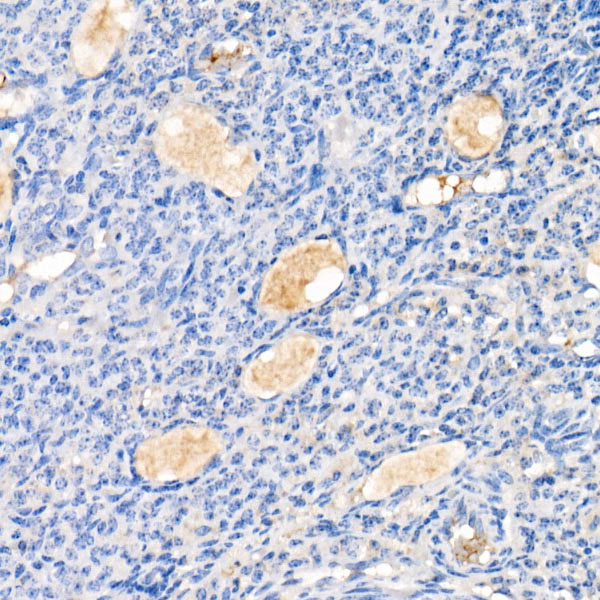
The antibody against AMH/MIS was raised in Rabbit using the recombinant protein of human AMH/MIS as the immunogen. The monoclonal antibody exists as a isotype IgG, by affinity purification. This antibody has been validated on IHC-P, ELISA.
| Cat.No | ADA-14536A | Clonality | Monoclonal |
|---|---|---|---|
| Host Species | Rabbit | Target Name | AMH/MIS |
| Target Synonyms | MIF; MIS; AMH/MIS | Form | Liquid |
| Species Reactivity | Human | Isotype | IgG |
| Storage Buffer | 50% Glycerol, 0.05% BSA, PBS with 0.05% proclin300, pH7.3. | Purification Method | Affinity purification |
| Application | ELISA, IHC-P |
| Immunogen Description | Recombinant protein of human AMH/MIS. | Target Species | Human |
|---|---|---|---|
| Immunogen Sequence | Complete sequences for the immunogen, target protein, and peptides are available upon request. | Uniprot ID | P03971 |
Uniprot Id
P03971
Target Species
Human
Target Name
AMH
Target Full Name
Muellerian-inhibiting factor
Target Function
This glycoprotein, produced by the Sertoli cells of the testis, causes regression of the Muellerian duct. It is also able to inhibit the growth of tumors derived from tissues of Muellerian duct origin.
Target Involvement
Persistent Muellerian duct syndrome 1 (PMDS1)
Target Subcellular Location
Secreted.
Target Protein Families
TGF-beta family
Target Synonyms
MIF; MIS; AMH
Target Background
This gene encodes a secreted ligand of the TGF-beta (transforming growth factor-beta) superfamily of proteins. Ligands of this family bind various TGF-beta receptors leading to recruitment and activation of SMAD family transcription factors that regulate gene expression. The encoded preproprotein is proteolytically processed to generate N- and C-terminal cleavage products that homodimerize and associate to form a biologically active noncovalent complex. This complex binds to the anti-Mullerian hormone receptor type 2 and causes the regression of Mullerian ducts in the male embryo that would otherwise differentiate into the uterus and fallopian tubes. This protein also plays a role in Leydig cell differentiation and function and follicular development in adult females. Mutations in this gene result in persistent Mullerian duct syndrome.
Notification