• Contact info@abtriva.com for inquiries and orders.
  • Chinese (Simplified)

  • English

  • German

  • Korean

  • Spanish

United States (English / $ USD)

Rabbit anti-Human ROR1 Monoclonal Antibody

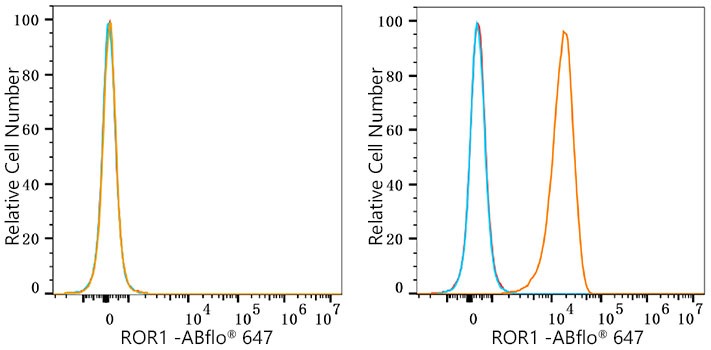
The antibody against ROR1 was raised in Rabbit using the recombinant fusion protein containing a sequence corresponding to amino acids 24-403 of Human ROR1 (NP_005003.2) as the immunogen. The monoclonal antibody exists as a isotype IgG1, by affinity purification. This antibody has been validated on FC.

ADA-15601A

The antibody against ROR1 was raised in Rabbit using the recombinant fusion protein containing a sequence corresponding to amino acids 24-403 of Human ROR1 (NP_005003.2) as the immunogen. The monoclonal antibody exists as a isotype IgG1, by affinity purification. This antibody has been validated on FC.

Number
Order Exclusive Products Now

Request a Quote
High Purity LevelsPrecision and ReliabilityCustomization Options

Specifications


Cat.No ADA-15601A ClonalityMonoclonal
Host SpeciesRabbitTarget NameROR1
Target SynonymsNTRKR1; dJ537F10.1; ROR1FormLiquid
Species ReactivityHumanIsotypeIgG1
Storage Buffer50% Glycerol, 0.05% BSA, PBS with 0.05% proclin300, pH7.3.Purification MethodAffinity purification
ApplicationFC

Immunogen Information


Immunogen DescriptionRecombinant fusion protein containing a sequence corresponding to amino acids 24-403 of human ROR1 (NP_005003.2).Target SpeciesHuman
Uniprot IDQ01973Immunogen Sequence
Background Information
  • Uniprot Id

    Q01973

  • Target Species

    Human

  • Target Name

    ROR1

  • Target Full Name

    Inactive tyrosine-protein kinase transmembrane receptor ROR1

  • Target Function

    Has very low kinase activity in vitro and is unlikely to function as a tyrosine kinase in vivo. Receptor for ligand WNT5A which activate downstream NFkB signaling pathway and may result in the inhibition of WNT3A-mediated signaling. In inner ear, crucial for spiral ganglion neurons to innervate auditory hair cells.

  • Target Involvement

    Deafness, autosomal recessive, 108 (DFNB108)

  • Target Subcellular Location

    Membrane; Single-pass type I membrane protein. Cell projection, axon.

  • Target Protein Families

    Protein kinase superfamily, Tyr protein kinase family, ROR subfamily

  • Target Tissue Specificity

    Expressed strongly in human heart, lung and kidney, but weakly in the CNS. Isoform Short is strongly expressed in fetal and adult CNS and in a variety of human cancers, including those originating from CNS or PNS neuroectoderm.

  • Target Research Area

    Neuroscience

  • Target Synonyms

    dJ537F10.1; Inactive tyrosine protein kinase transmembrane receptor ROR1; MGC99659; Neurotrophic tyrosine kinase; Neurotrophic tyrosine kinase receptor related 1; Neurotrophic tyrosine kinase; receptor related 1; NTRKR1; OTTHUMP00000010573; OTTHUMP00000010574; OTTMUSP00000008344; Receptor tyrosine kinase like orphan receptor 1; receptor-related 1; RGD1559469; ROR 1; ROR1; ROR1_HUMAN; RP11 24J23.1; Tyrosine kinase like orphan receptor 1 ; Tyrosine protein kinase transmembrane receptor ROR1; Tyrosine-protein kinase transmembrane receptor ROR1

  • Target Background

    This gene encodes a receptor tyrosine kinase-like orphan receptor that modulates neurite growth in the central nervous system. The encoded protein is a glycosylated type I membrane protein that belongs to the ROR subfamily of cell surface receptors. It is a pseudokinase that lacks catalytic activity and may interact with the non-canonical Wnt signalling pathway. This gene is highly expressed during early embryonic development but expressed at very low levels in adult tissues. Increased expression of this gene is associated with B-cell chronic lymphocytic leukaemia. Alternative splicing results in multiple transcript variants encoding different isoforms.

Inquire Rabbit anti-Human ROR1 Monoclonal Antibody Now


AbTriva respects your privacy and protects your personal data in accordance with AbTriva. For more information, please see our data protection statement. *

Notification