• Contact info@abtriva.com for inquiries and orders.
  • Chinese (Simplified)

  • English

  • German

  • Korean

  • Spanish

United States (English / $ USD)

PTPN11 Recombinant Monoclonal Antibody

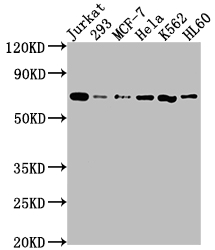
The recombinant antibody against PTPN11 was produced using a synthesized peptide derived from human SHP2 as the immunogen. This antibody exists as a non-conjugated isotype Rabbit IgG, Affinity-chromatography purified. This antibody has been validated on ELISA, WB, IHC.

ADC-57055A

The recombinant antibody against PTPN11 was produced using a synthesized peptide derived from human SHP2 as the immunogen. This antibody exists as a non-conjugated isotype Rabbit IgG, Affinity-chromatography purified. This antibody has been validated on ELISA, WB, IHC.

$350.00

Number
Order Exclusive Products Now

Request a Quote
High Purity LevelsPrecision and ReliabilityCustomization Options

Specifications


Cat.No ADC-57055A ClonalityMonoclonal
Target NamePTPN11Target SynonymsPTP2C SHPTP2, PTPN11, Tyrosine-protein phosphatase non-receptor type 11 (EC 3.1.3.48) (Protein-tyrosine phosphatase 1D) (PTP-1D) (Protein-tyrosine phosphatase 2C) (PTP-2C) (SH-PTP2) (SHP-2) (Shp2) (SH-PTP3)
FormLiquidSpecies ReactivityHuman
IsotypeRabbit IgGStorage BufferPH 7.4, 0.02% sodium azide and 50% glycerol., 150mM NaCl, Rabbit IgG in phosphate buffered saline
Purification MethodAffinity-chromatography purifiedConjugateNon-conjugated
ApplicationELISA, IHC, WBStorageUpon receipt

Immunogen Information


Immunogen DescriptionA synthesized peptide derived from human SHP2Target SpeciesHuman
Immunogen SequenceComplete sequences for the immunogen, target protein, and peptides are available upon request.Uniprot IDQ06124
Background Information
  • Uniprot Id

    Q06124

  • Target Species

    Human

  • Target Name

    PTPN11

  • Target Full Name

    Tyrosine-protein phosphatase non-receptor type 11

  • Target Function

    Acts downstream of various receptor and cytoplasmic protein tyrosine kinases to participate in the signal transduction from the cell surface to the nucleus. Positively regulates MAPK signal transduction pathway. Dephosphorylates GAB1, ARHGAP35 and EGFR. Dephosphorylates ROCK2 at 'Tyr-722' resulting in stimulation of its RhoA binding activity. Dephosphorylates CDC73. Dephosphorylates SOX9 on tyrosine residues, leading to inactivate SOX9 and promote ossification.

  • Target Involvement

    LEOPARD syndrome 1 (LPRD1); Noonan syndrome 1 (NS1); Leukemia, juvenile myelomonocytic (JMML); Metachondromatosis (MC)

  • Target Subcellular Location

    Cytoplasm. Nucleus.

  • Target Protein Families

    Protein-tyrosine phosphatase family, Non-receptor class 2 subfamily

  • Target Tissue Specificity

    Widely expressed, with highest levels in heart, brain, and skeletal muscle.

  • Target Research Area

    Neuroscience

  • Target Synonyms

    (Protein-tyrosine phosphatase 1D)(PTP-1D)(Protein-tyrosine phosphatase 2C)(PTP-2C)(SH-PTP2)(SHP-2)(Shp2)(SH-PTP3)

  • Target Background

    The protein encoded by this gene is a member of the protein tyrosine phosphatase (PTP) family. PTPs are known to be signaling molecules that regulate a variety of cellular processes including cell growth, differentiation, mitotic cycle, and oncogenic transformation. This PTP contains two tandem Src homology-2 domains, which function as phospho-tyrosine binding domains and mediate the interaction of this PTP with its substrates. This PTP is widely expressed in most tissues and plays a regulatory role in various cell signaling events that are important for a diversity of cell functions, such as mitogenic activation, metabolic control, transcription regulation, and cell migration. Mutations in this gene are a cause of Noonan syndrome as well as acute myeloid leukemia.

Inquire PTPN11 Recombinant Monoclonal Antibody Now


AbTriva respects your privacy and protects your personal data in accordance with AbTriva. For more information, please see our data protection statement. *

Notification