Direct vs Indirect vs Competitive ELISA: Formats, Use Cases, and Selection Guide
Choosing the wrong ELISA format wastes reagents, skews results, and delays publication. This reference explains how each format works, where each format excels, and which antibody types each format requires.
What All ELISA Formats Share
Every ELISA format relies on an enzyme-conjugated antibody producing a detectable signal in proportion to antigen binding. The formats differ in how the antigen is captured and how the detecting antibody reaches it.
The four major formats are direct, indirect, sandwich (a subtype of indirect), and competitive. Each solves a different analytical problem.
Direct ELISA
How Direct ELISA Works
The antigen is adsorbed directly onto the microplate well. A primary antibody conjugated directly to an enzyme (HRP or AP) is added, binds the antigen, and produces signal upon substrate addition.
There is no secondary antibody. The labeled primary antibody is the only detection reagent.
Advantages of Direct ELISA
Direct ELISA is fast, uses fewer reagents, and eliminates cross-reactivity from a secondary antibody. It is ideal for rapid screening when antigen concentration is high and sensitivity demands are moderate.
Limitations of Direct ELISA
Sensitivity is lower than indirect formats because there is no signal amplification from a secondary antibody. Every primary antibody must be individually conjugated to enzyme, which is costly and time-consuming.
Non-specific binding of the labeled primary to the plate surface also raises background if blocking is insufficient.
Indirect ELISA
How Indirect ELISA Works
The antigen adsorbs to the plate. An unlabeled primary antibody binds the antigen. An enzyme-conjugated secondary antibody then binds the primary, and substrate produces the signal.
The secondary antibody amplifies the signal because multiple secondary molecules can bind a single primary antibody.
Advantages of Indirect ELISA
Sensitivity is higher than direct ELISA due to signal amplification. A single labeled secondary antibody can be used with many different primary antibodies from the same host species, reducing cost.
Indirect ELISA is the preferred format for serology, autoantibody detection, and any application where detecting antibodies in patient serum is the goal.
Limitations of Indirect ELISA
An additional incubation step increases total assay time. Secondary antibody cross-reactivity with sample proteins is possible when testing complex biological matrices.
Sandwich ELISA
How Sandwich ELISA Works
A capture antibody is pre-coated on the plate. The sample is added and the analyte antigen binds the capture antibody. A detection antibody (labeled or unlabeled) then binds a different epitope on the same antigen, forming a sandwich.
Because two antibodies must bind simultaneously, both must recognize distinct, non-overlapping epitopes. This format is the basis of most commercial cytokine and biomarker quantification kits.
When to Choose Sandwich ELISA
Use sandwich ELISA when you need maximum sensitivity and specificity for a protein in a complex matrix such as serum, plasma, or cell lysate. It is not suitable for small molecules or haptens because those lack two accessible epitopes.
Competitive ELISA
How Competitive ELISA Works
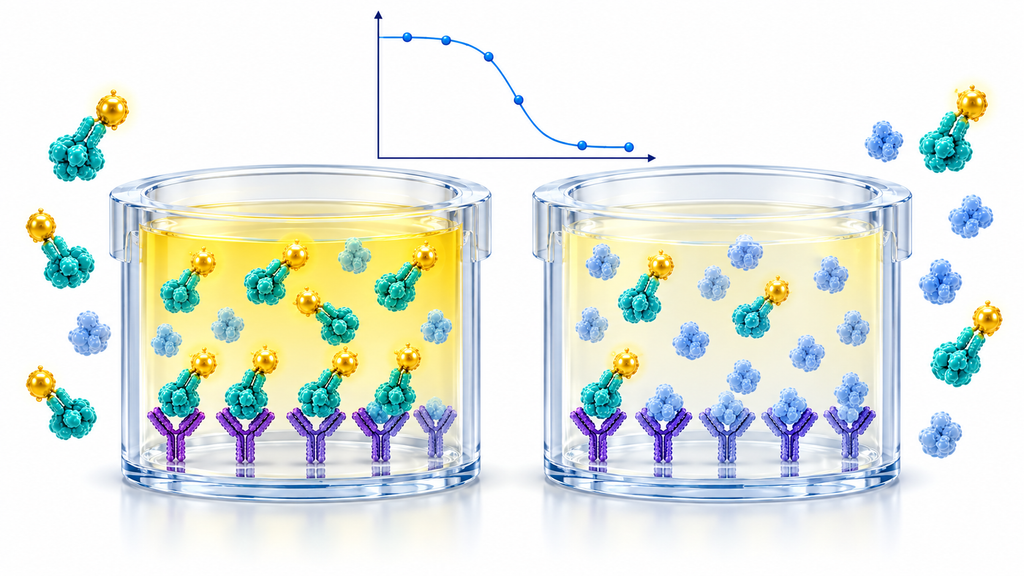
In a competitive ELISA, the sample antigen competes with a labeled antigen (or a labeled antibody) for a limited number of binding sites. Higher antigen concentration in the sample produces lower signal.
The relationship between concentration and signal is inverse: a strong signal means low analyte, and a weak signal means high analyte.
When to Use Competitive ELISA
Competitive ELISA is the format of choice for small molecules, haptens, and steroids that cannot form a sandwich (only one epitope available). It is also used for highly concentrated samples where hook effect would distort a sandwich assay.
Detection limits for competitive ELISA are often lower than sandwich formats for small molecules, making it preferred in drug monitoring and food safety testing.
Format Comparison at a Glance
Feature
Direct
Indirect
Sandwich
Competitive
Signal direction
↑ with conc.
↑ with conc.
↑ with conc.
↓ with conc.
Sensitivity
Low–Medium
Medium–High
Very High
High (small molecules)
Antigen size
Any
Any
≥ 2 epitopes
Small molecules OK
Primary Ab conjugated?
Yes
No
No (capture)
Varies by format
Secondary Ab required?
No
Yes
Yes (detection)
Sometimes
Best use case
Rapid screening
Serology / Ab detection
Protein quantification
Haptens / drugs / steroids
Cross-reactivity risk
Low
Moderate
Low
Low
Antibody Selection for Each ELISA Format
For direct ELISA, enzyme-conjugated monoclonal antibodies give the sharpest signal-to-noise ratio because their single specificity reduces non-specific plate binding.
Indirect and sandwich ELISAs rely on unlabeled primary antibodies paired with species-specific secondary antibodies for signal amplification. The secondary antibody host species must differ from both the sample species and any other antibody in the assay.
Sandwich ELISA kits for phosphorylated targets use phospho-specific antibodies as the detection antibody, allowing quantification of activated protein fraction separately from total protein.
Browse AbTriva's full antibody catalog to find validated capture and detection pairs across all four ELISA formats.
Frequently Asked Questions
What is the most sensitive ELISA format?
Sandwich ELISA is generally the most sensitive format for protein quantification because two antibodies provide dual specificity and secondary amplification.
Which ELISA format is best for detecting antibodies in patient serum?
Indirect ELISA is the standard format for serology because the patient's own antibodies act as the primary antibody that binds the coated antigen.
Can competitive ELISA quantify proteins?
Yes, but it is most commonly used for small molecules and haptens that cannot support a sandwich format.
Why does signal decrease as concentration increases in competitive ELISA?
Higher sample antigen outcompetes the labeled tracer antigen for antibody binding sites, leaving fewer labeled molecules bound and producing lower signal.
What is the hook effect in sandwich ELISA?
At very high antigen concentrations, both capture and detection antibody binding sites become saturated independently, reducing the number of complete sandwiches formed and causing a false low signal.
Do I need to conjugate my own antibody for direct ELISA?
Yes — direct ELISA requires a primary antibody already conjugated to HRP, AP, or another enzyme, which adds a preparation step not needed in indirect formats.
Can I use polyclonal antibodies in sandwich ELISA?
Polyclonal antibodies can be used as either capture or detection in a sandwich, but matched monoclonal pairs give better lot-to-lot reproducibility and lower background.
What blocking buffer reduces non-specific binding in ELISA?
BSA (1–5%) and casein are preferred for phospho-specific and biotin-based assays; non-fat dry milk blocks well for most standard indirect ELISAs but can interfere with phosphoantibody detection.
Fast & Free Shipping
Free shipping on orders $999+
Quality Guarantee
Advenit post multos Scudilo Scutariorum tribunus velament
Secure Payment
We accept credit cards, PayPal, and bank wires
Lifetime Customer Support
Responsive and knowledgable customer service via email, text or phone